Category: Unit 2: Positions

  • ∆ 1 Line of Enquiry

    During Positions through Iterating, Contextualising and Essaying my studio work was grounded in a growing bibliography of relevant sources. This pool of existing knowledge included historical documents, poetry, academic writing, archives and others design practices. These references were pulled apart and relayered to piece together the history of The Stone Cottage.

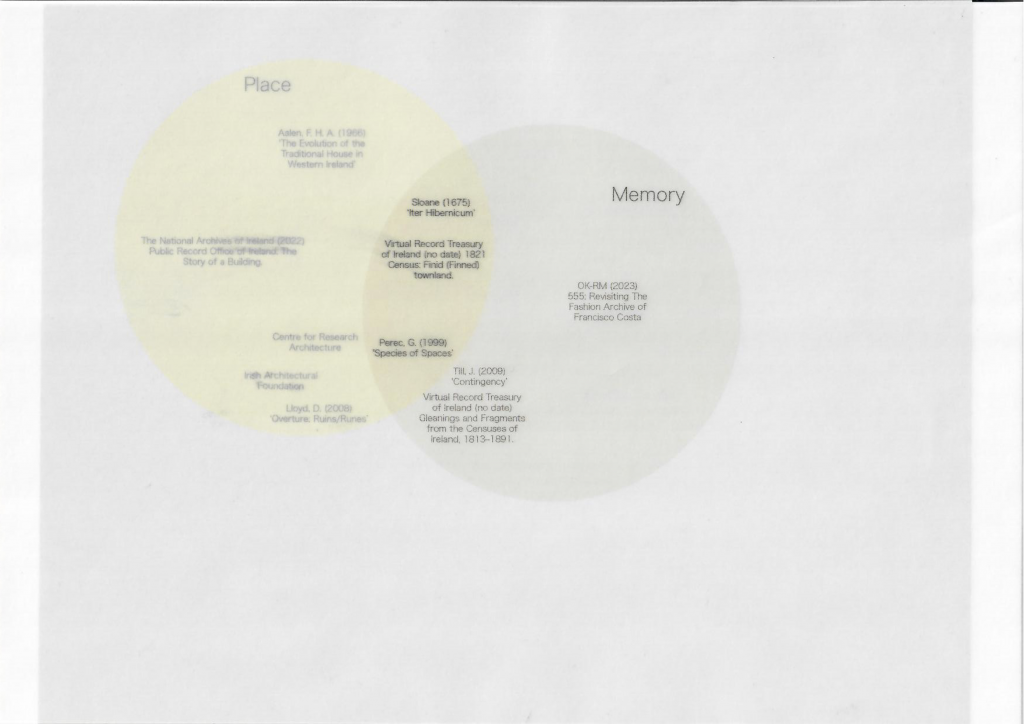
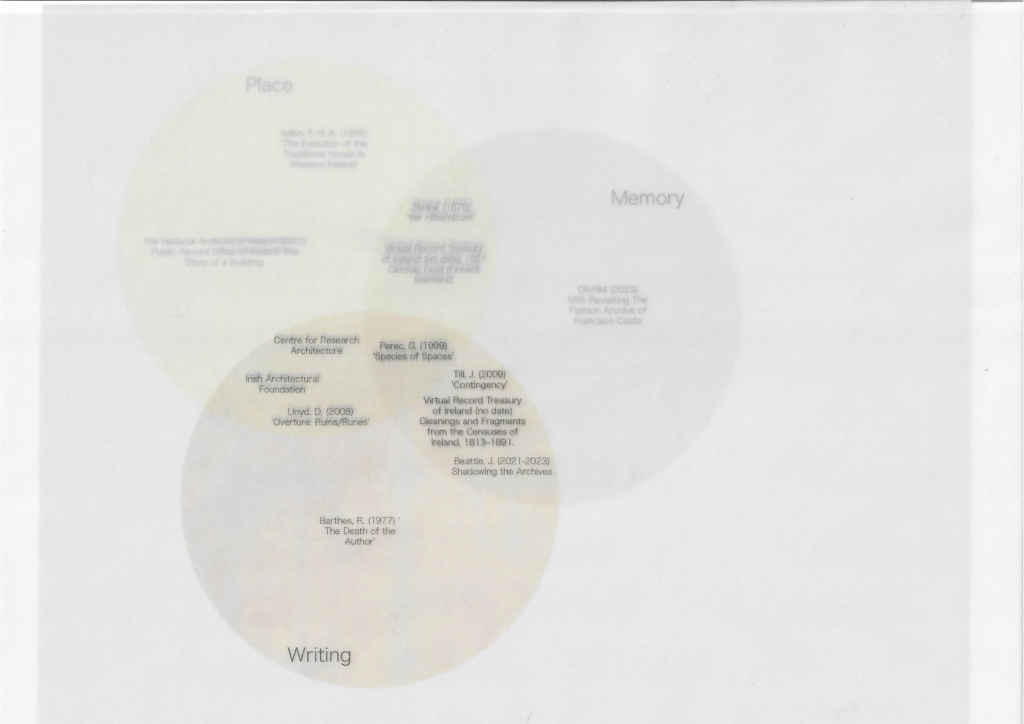
    This collection of sources was expanded during the Positions through Dialoguing work. In an effort to refine the line of enquiry within my studio work, I returned to my bibliography and began to index the key references into place, memory and writing. These three terms, introduced by Perec (1999) as methods to document ageing, have guided my archival practice thus far. This exercise revealed the intersections between the three methods of documenting ageing, and encouraged a further consolidation of the references which have the most relevance to my work.

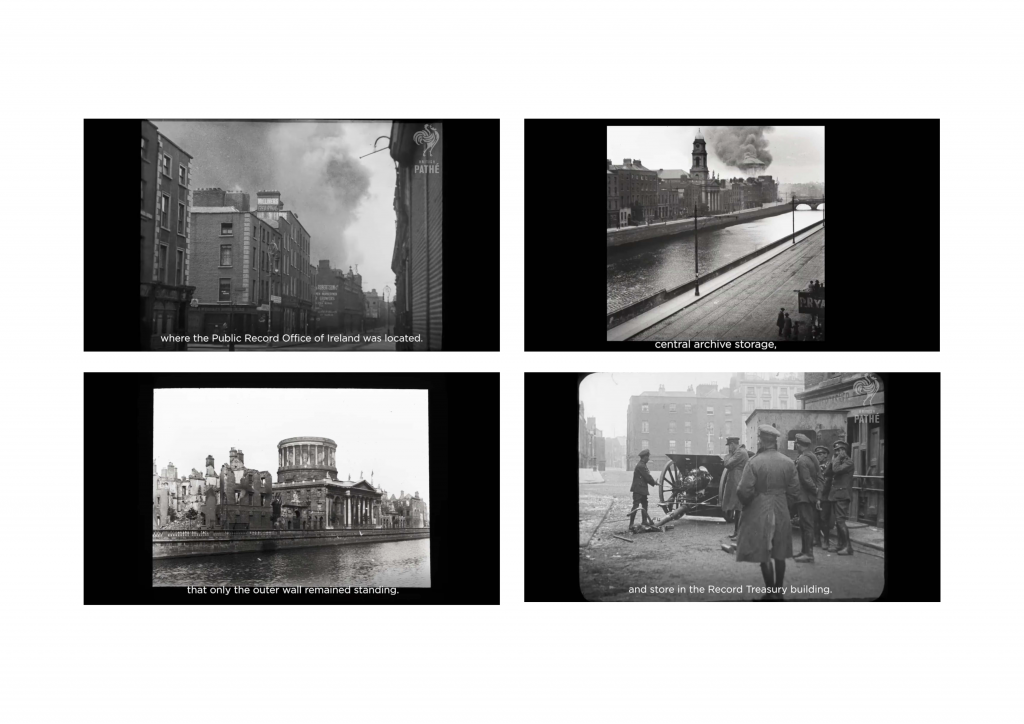
    Through this index, I rediscovered the Virtual Record Treasury of Ireland’s online platform ‘Gleanings and Fragments from the Censuses of Ireland, 1813-1891’ (no date). The website is contextualised by the 1922 Fire that destroyed The Public Records of Ireland. The map layers surviving fragments of documents to glean a better understanding of the history, and historiography, of Ireland. 

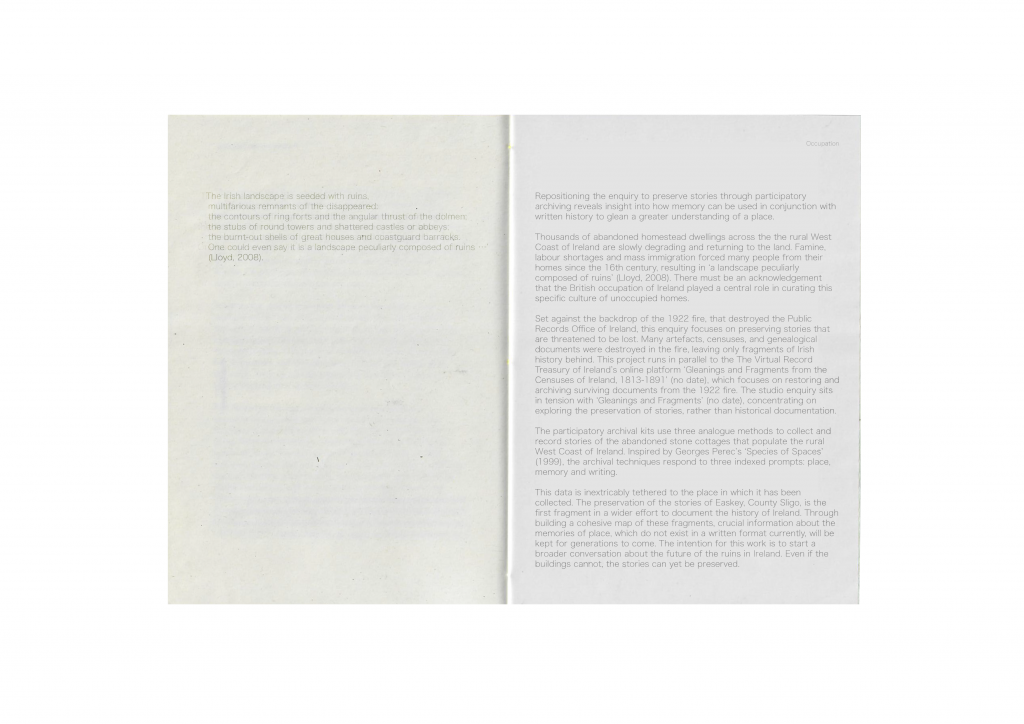
    There is thematic overlap between my own studio based practice and ‘Gleanings and Fragments from the Censuses of Ireland, 1813-1891’ (no date). I am interested in understanding how I can address the gaps in the archive and reinstate knowledge that perished within the fire. To document this emerging line of enquiry, I wrote a short synopsis about my intentions for the ∆ 1 studio enquiry. 

    Reference List:

    Lloyd, D. (2008) ‘Overture: Ruins/Runes’, in Irish Times: Temporalities of Modernity. Dublin: Field Days Publications.

    Perec, G. (1999) ‘Species of Spaces’, in Species of Spaces and Other Pieces. London: Penguin, pp. 46–56.

    Virtual Record Treasury of Ireland (no date) Gleanings and Fragments from the Censuses of Ireland, 1813–1891. Available at: https://virtualtreasury.ie/gold-seams/census-gleanings (Accessed: 6 May 2026).

  • Rendered Positions through Dialoguing

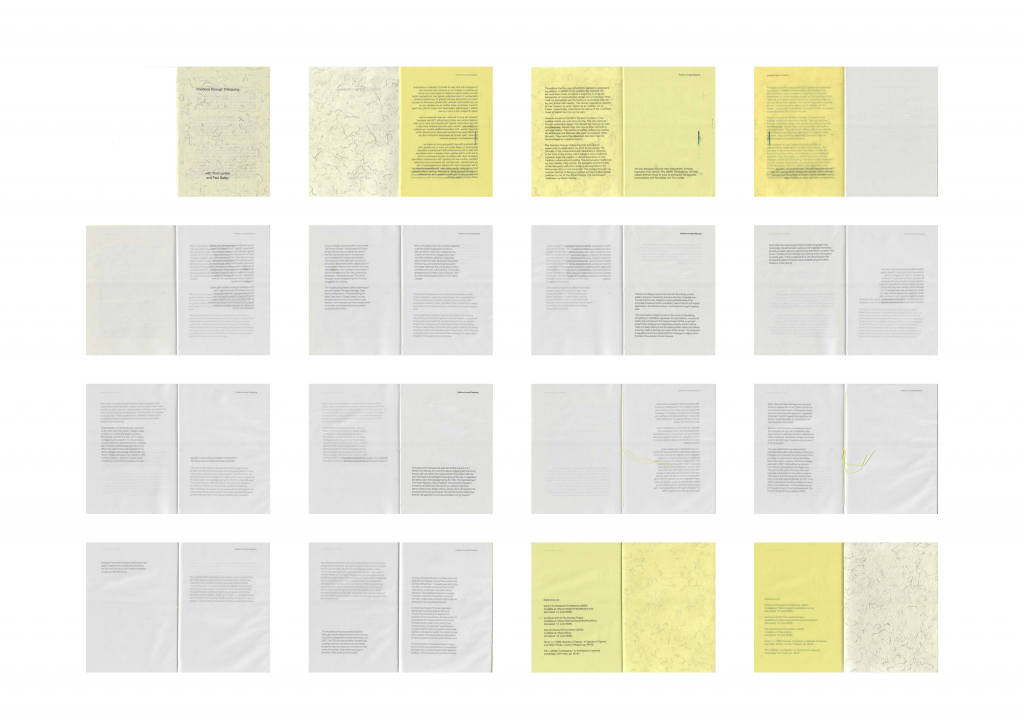
    I rendered my Positions through Dialoguing writing into an experimental publication. 

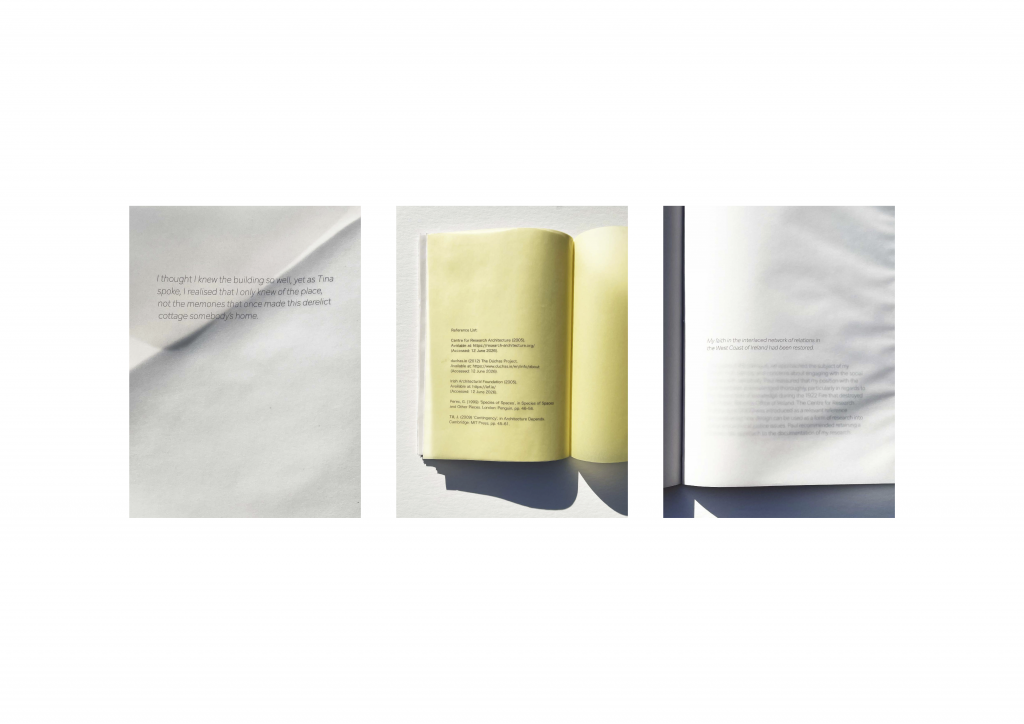
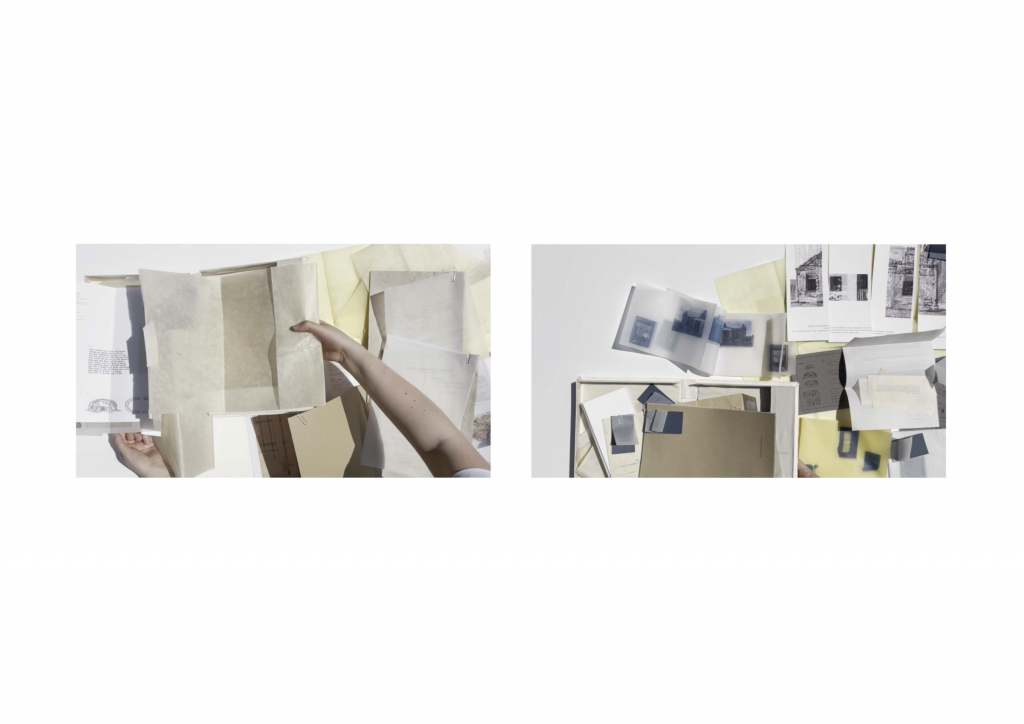
    The two dialogues must be read concurrently. Drawing inspiration from Jeremy Till’s (2009) ‘Contingency’, the text utilises different tones of voice to distinguish the separate conversations with Paul Bailey and Tina Lavelle. To further enhance this notion, the rendering of the text visually portrays the dual narratives. Using a combination of opaque and tracing paper, the two dialogues are materially separated, whilst still being read simultaneously. 

    Reference List:

    Till, J. (2009) ‘Contingency’, in Architecture Depends. Cambridge: MIT Press, pp. 45–61.

  • Positions through Dialoguing

    Throughout the first year of MAGCD I started to understand my position in relation to my practice. My research into the rural West Coast of Ireland is beginning to sit at the intersection of communication design and architecture. What I had not anticipated was the feeling of uncertainty towards my own British-Irish identity. This heavily impacted all aspects of how I viewed my work: neither as an outsider, nor an insider. I superficially understand the culture of the rural West Coast of Ireland, but it is not my own. 

    Towards the end of the term, my work focused on how multiple stories can exist concurrently. This was explored through publication design that allowed two texts to be read simultaneously. Stories map onto one another and build a textured history. This method of writing reflects my position. My Britishness and Irishness also exist concurrently within the work. They cannot be separated, therefore must be acknowledged as a layered position.

    The Positions through Dialoguing brief provided an opportunity to speak about my work to two people. The formality in the conversation with Paul Bailey is reflected in the form of the writing, which adopts a more traditional academic style. We related on shared experience of Irish tradition, culture and storytelling. The conversation reaffirmed my Irish identity. Alternatively, the looseness and informality of the discussion with Tina Lavelle is demonstrated in the first person story of our encounter. This dialogue brought up complex feelings of being an outsider as Tina recalled stories, unknown to me, of The Stone Cottage. The conversation reaffirmed my British identity.

    The two dialogues must be read concurrently. Drawing inspiration from Jeremy Till’s (2009) ‘Contingency’, the text utilises different fonts and tone of voice to distinguish the separate conversations with Paul Bailey and Tina Lavelle.

    It was a late spring evening when I last visited The Stone Cottage. I found myself in Finned Bridge, attempting to unearth the story of why the homestead, which I had become so enchanted with, had become derelict. The remnants of the walls were sturdy and grounded, despite the further degradation of its structural integrity since my last visit. If you defocused your eyes it became impossible to discern the structure from the surrounding landscape. I feared the story of The Stone Cottage may be disappearing into the land, along with the building.

    The neighbouring farmer offered little insight into who owned The Stone Cottage. They mentioned a woman, “Tina Something-or-other,” that lived in Easkey village that may be able to tell me more. In true West Coast tradition, her house did not have a street name or number, simply described as the yellow house past the school. 

    When I knocked on the door of what I believed to be the yellow house past the school I was met with an older man. I explained the location of The Stone Cottage which was met with confusion, albeit an unwavering determination to help. We spoke freely about the farming culture and local gossip within the village. Although the conversation further contextualised my understanding of how tales spread across the West Coast of Ireland, I felt no closer to locating the owner of The Stone Cottage.

    The second dialogue was conducted with Paul Bailey, an Irish graphic designer, researcher and educator. Paul, originally from County Roscommon, shared a mutual understanding of the antiquated traditions of the rural West Coast of Ireland and related personally to the themes arising in my Positions through Essaying work.

    The conversation initially focused on the notion of storytelling. Storytelling is irrefutably engrained into Irish tradition, culture and history. Paul introduced The Dúchas Project (2012), an archival project that catalogues and digitalises artefacts of Irish Folklore. There is a deep history of oral storytelling within Ireland, but efforts are being made to formally document these stories. This motivation is arguably due to the societal shift from analogue to digital, which threatens the existence of oral histories. 

    Paul noted the political power that the Gaelic language holds. Historically, it would be been used as a tool to spread information secretly, as Gaelic was not understood by the British occupiers. The theme of distributing knowledge has implicitly arisen throughout my studio work. There is potential for a new line of enquiry that focuses the research towards social and political justice within traditions of storytelling.

    Downtrodden and disheartened, I returned to the main, and only, street in Easkey village. I picked up a coffee and began to chat to the barista. I told her the story of The Stone Cottage and my research into the ancestral history of the local area; the farmers unhelpful advice and the yellow house past the school. When she asked to see a photograph of The Stone Cottage, she casually told me that The Stone Cottage belongs to her Grandma. With a sense of elation, I took the number of her Grandma and thanked the barista profusely. 

    My faith in the interlaced network of relations in the West Coast of Ireland had been restored.

    Throughout the dialogue, we approached the subject of my British-Irish identity and concerns about engaging with the social themes with sensitivity. Paul reassured that my position with the work had been acknowledged thoroughly, particularly in regards to the destruction of knowledge during the 1922 Fire that destroyed The Public Records Office of Ireland. The Centre for Research Architecture (2005) was introduced as a relevant reference demonstrating how design can be used as a form of research into social and political justice issues. Paul recommended retaining a forensic-like approach to the documentation of my research.

    After a few brief text messages, we arranged a time to meet at her house. When I arrived at her home, the description of the yellow house past the school became apparent. I regretted the doubt I had felt towards the neighbouring farmer I had first spoken to. I knocked on the door and met Tina Lavelle.

    We sat in her front room and spoke for hours. She wrapped me up in her imagination and took me into her world as she recounted stories of her childhood. The Stone Cottage came alive and, for the first time, I could actually envision it in its occupation.

    Tina was interested in my research and provided clarity about the timeline of The Stone Cottage. As an outsider, the precise story of the building, its users and its history had always been shrouded in mystery. The Stone Cottage was built in 1901. The building had served a civic function and acted as the village shop. The room to the right of the main door was originally subdivided into two distinct spaces. The volume at the front was the shop and the room in the back was the kitchen. In 1973 Tina’s father extended the building, adding two extra rooms and a bathroom. At times there was up to 11 people living in the small homestead. Tina and her family left the property in 1985.

    I thought I knew the building so well, yet as Tina spoke, I realised that I only knew of the place, not the memories that once made this derelict cottage somebody’s home.

    Paul reiterated the relevance of using ‘place, memory and writing’ as critical lenses to examine the studio work (Perec, 1999). One institution that currently works across these three themes is Irish Architecture Foundation (2005). IAF explores how the built environment has shaped culture and community across Ireland through ‘festivals, exhibitions, learning and placemaking’ (Irish Architectural Foundation, 2005). This reference, provided by Paul, demonstrates the necessity of working across disciplines to gain a greater understanding of how place, memory and writing interact. 

    My interest as a designer sits at the intersection of communication design and architecture. My work throughout the Positions module has focused on alternative forms of archiving; a method more commonly associated with communication design. The research into the history of The Stone Cottage could be strengthened if an architectural dimension is also introduced, explored and celebrated within my ongoing work. Paul highlighted that my professional and educational background in architecture offers a specific and unique position, which has become subdued over the course of the semester. Reframing my line of enquiry with a more critical architectural approach will offer new insight into how the history of the rural West Coast of Ireland is evidenced through changes in the built environment.

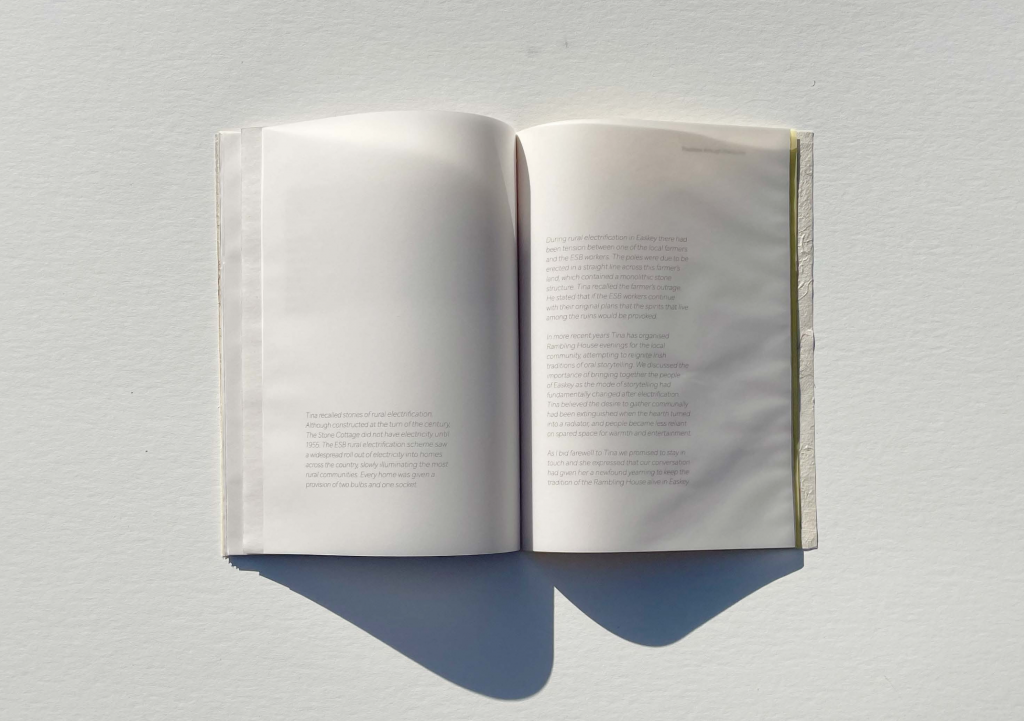
    Tina recalled stories of rural electrification. Although constructed at the turn of the century, The Stone Cottage did not have electricity until 1955. The ESB rural electrification scheme saw a widespread roll out of electricity into homes across the country, slowly illuminating the most rural communities. Every home was given a provision of two bulbs and one socket. 

    During rural electrification in Easkey there had been tension between one of the local farmers and the ESB workers. The poles were due to be erected in a straight line across this farmer’s land, which contained a monolithic stone structure. Tina recalled the farmer’s outrage. He stated that if the ESB workers continue with their original plans that the spirits that live among the ruins would be provoked.

    In more recent years Tina has organised Rambling House evenings for the local community, attempting to reignite Irish traditions of oral storytelling. We discussed the importance of bringing together the people of Easkey as the mode of storytelling had fundamentally changed after electrification. Tina believed the desire to gather communally had been extinguished when the hearth turned into a radiator, and people became less reliant on spared space for warmth and entertainment. 

    As I bid farewell to Tina we promised to stay in touch and she expressed that our conversation had given her a newfound yearning to keep the tradition of the Rambling House alive in Easkey.

    Reference List:

    Centre for Research Architecture (2005). Available at: https://research-architecture.org/(Accessed: 12 June 2026).

    duchas.ie (2012) The Dúchas Project. Available at: https://www.duchas.ie/en/info/about (Accessed: 12 June 2026).

    Irish Architectural Foundation (2005). Available at: https://iaf.ie/ (Accessed: 12 June 2026).

    Perec, G. (1999) ‘Species of Spaces’, in Species of Spaces and Other Pieces. London: Penguin, pp. 46–56.

    Till, J. (2009) ‘Contingency’, in Architecture Depends. Cambridge: MIT Press, pp. 45–61.
  • Week Two Process


    The video essay serves a dual purpose to exhibit the work produced during Positions through Iterating and Positions through Contextualising, whilst simultaneously conveying the concept of The Palimpsest Archive. To address both concerns, the choice of medium was considered. This created parameters for the narration, audio and visual of the video essay. 


    Archive in Use

    As discovered during Week 1 of Positions through Essaying, The Palimpsest Archive must be physically used to understand how the documents interact with each other. A large portion of the visual relies on the palimpsestic archival process.


    Script

    The Written Response guides the script to follow the sequence, tempo, and form of Georges Perec’s (1999) ‘The Street’ in Species of Spaces.


    Dual Narrative

    Similarly to the written response, the video essay conveys two narratives: The 1922 Fire that destroyed The Public Records Office of Ireland, and, the past, present, and future of The Stone Cottage. These histories exist concurrently within The Palimpsest Archive


    Irish Voices

    Although large portions of the narration is my own voice, it feels important for Irish voice to be included. I primarily narrated the description about the project, whilst the chorus of Irish voices instruct the use of The Palimpsest Archive. This change in the narrator reflects the fourth subchapter of Perec’s (1999) writing, whilst also implicitly suggesting my own position within Irish historiography. 


    Layering

    As the audio uses the chorus of Irish voices, this was also reflected within the visual of the video. Layered video footage is used to mimic the unbinding of the archival documents to disentangle the history of The Stone Cottage. 


    Document Scans

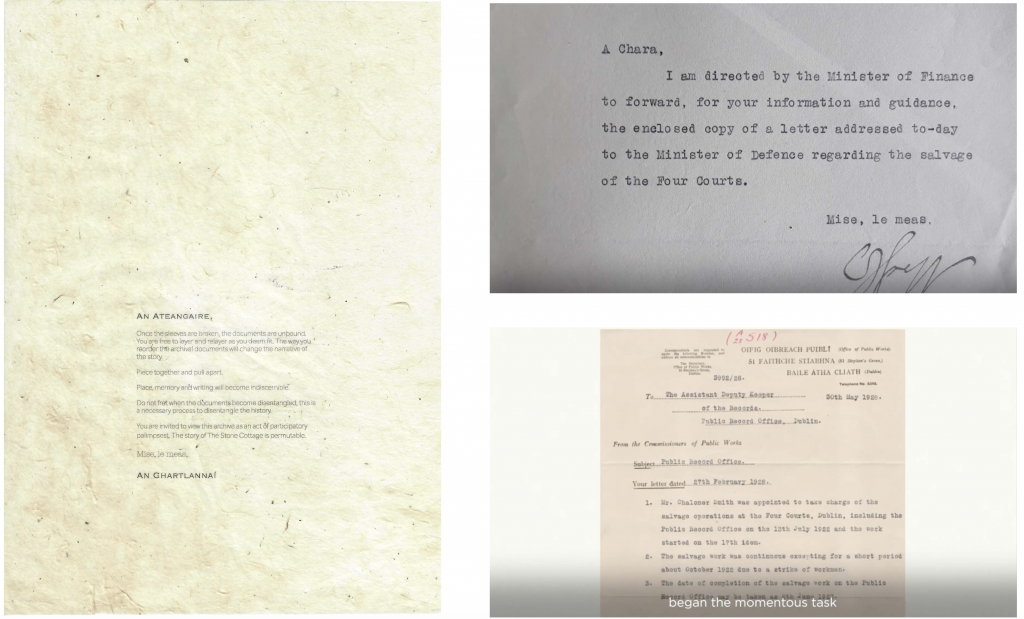
    To illustrate the work put in to creating the archival documents, scans of the artefacts are included within the video essay. 

    Found Footage

    The video essay includes found footage of The 1922 fire.


    Typewriter

    The sound of a typewriter is used to punctuate keys moments of the video essay. These sound objects were created by me. The typewriter harks back to traditional methods of writing seen in many of the archival document references used within the project. 

    Reference List:

    Perec, G. (1999) ‘Species of Spaces’, in Species of Spaces and Other Pieces. London: Penguin, pp. 46–56.

  • Week One Process

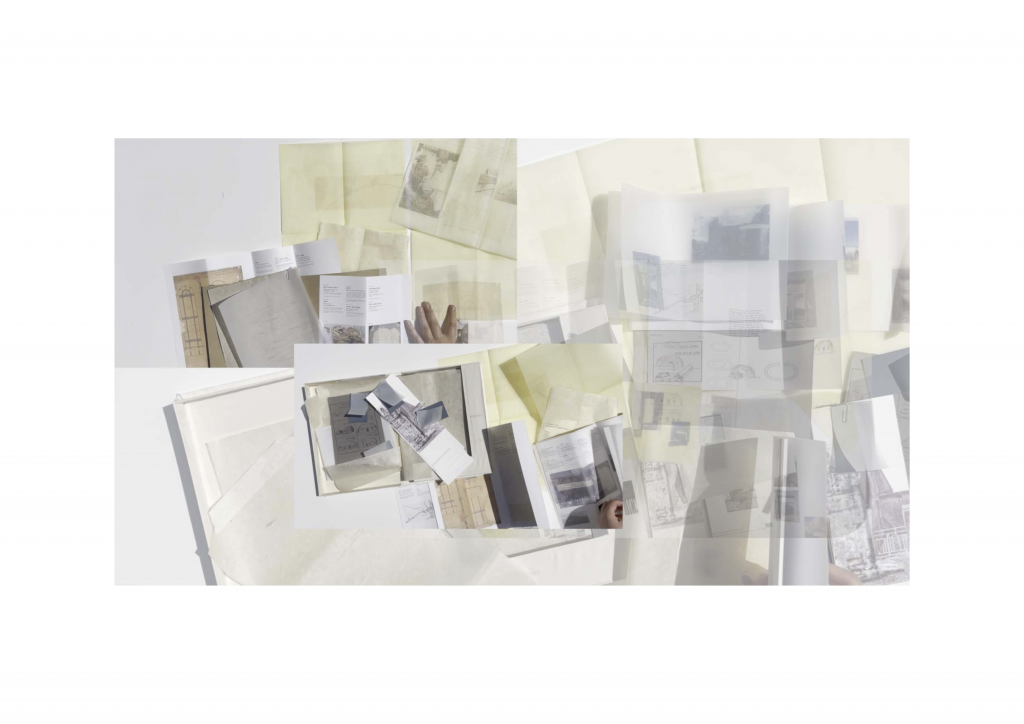
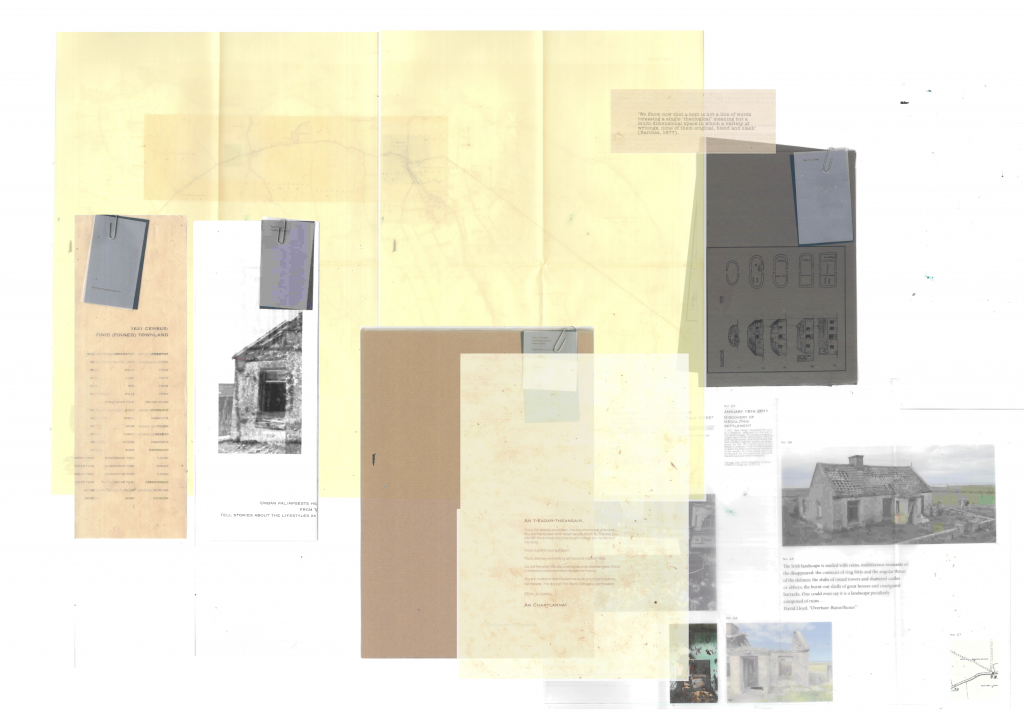
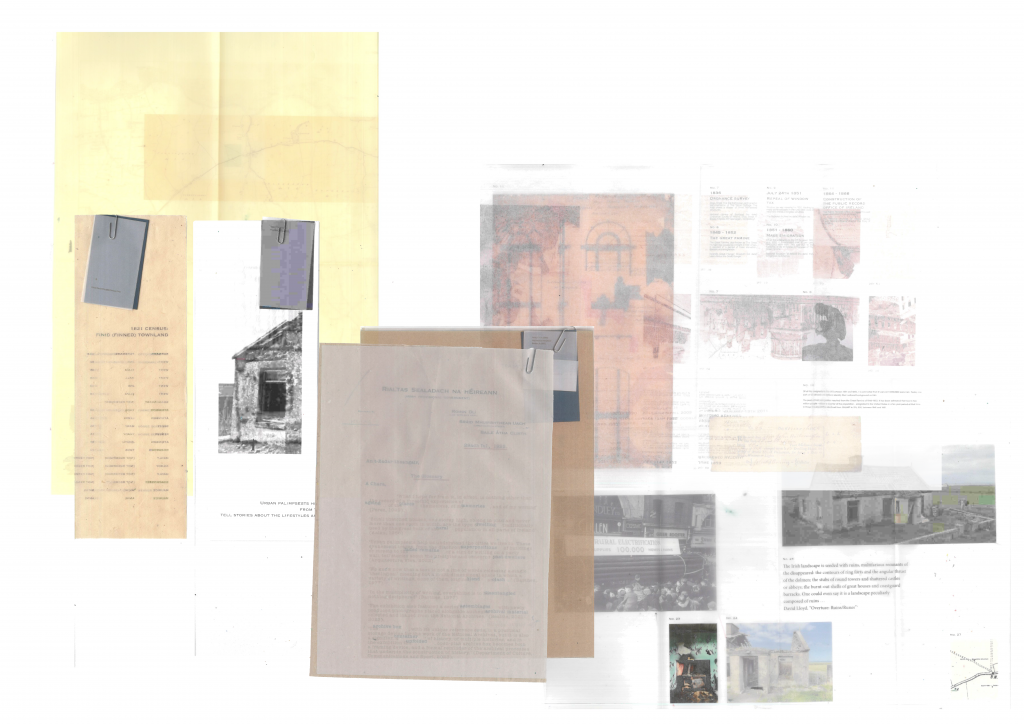
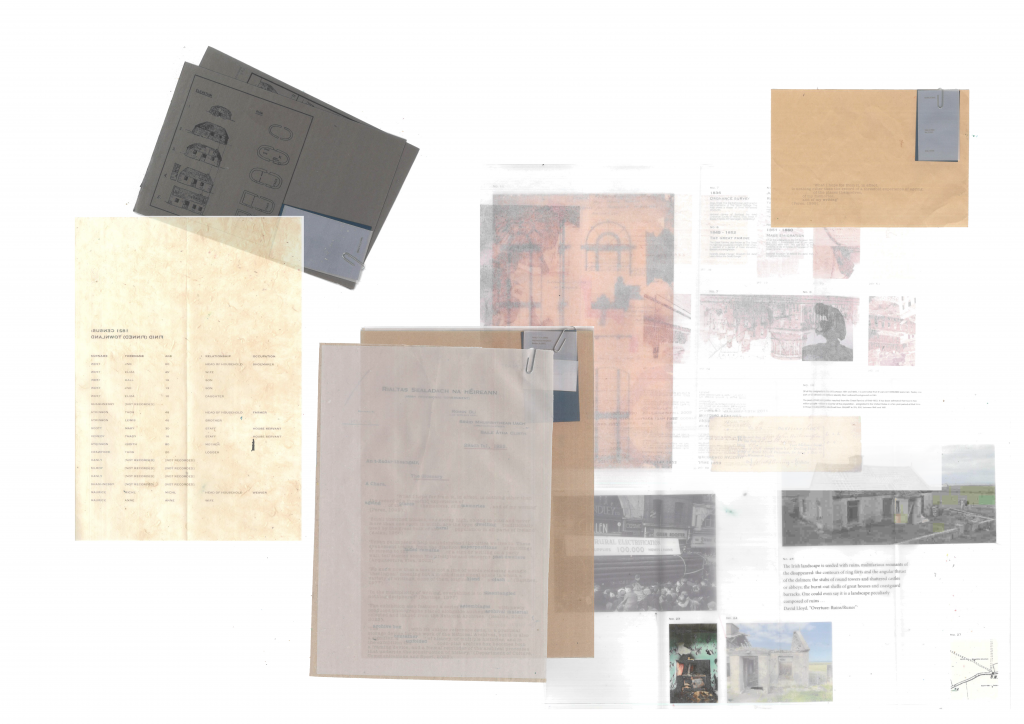
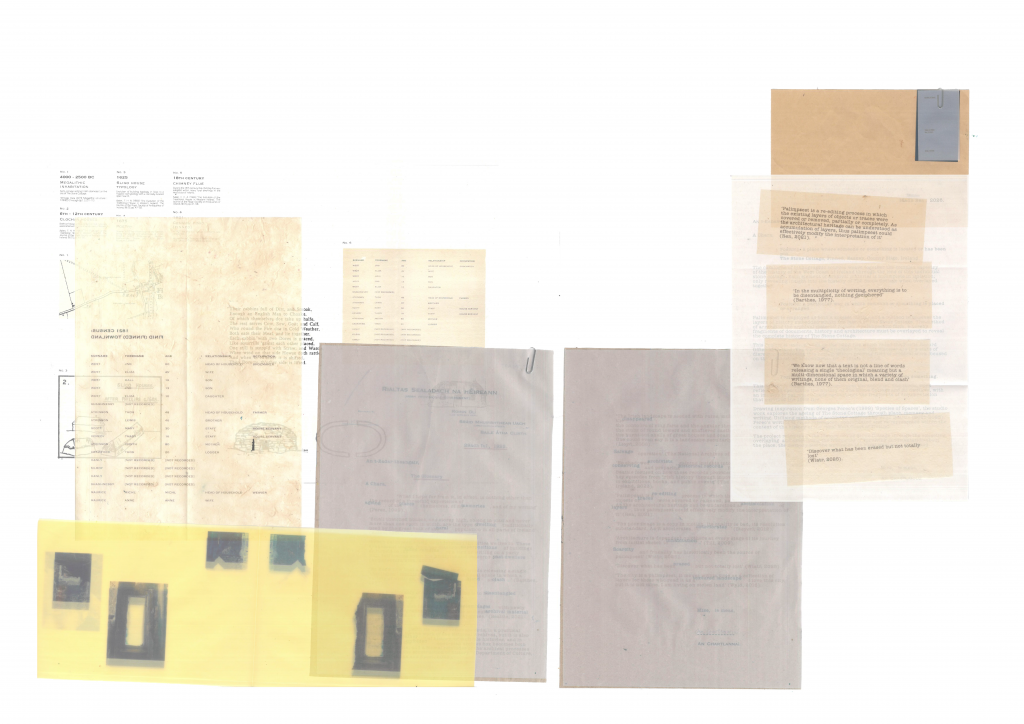
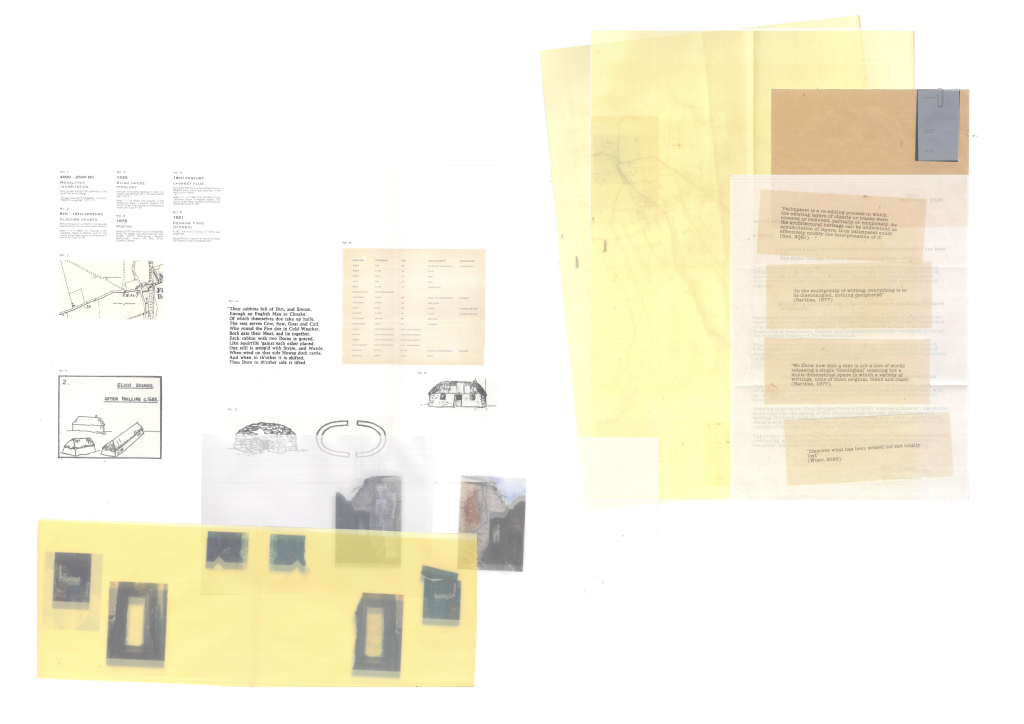
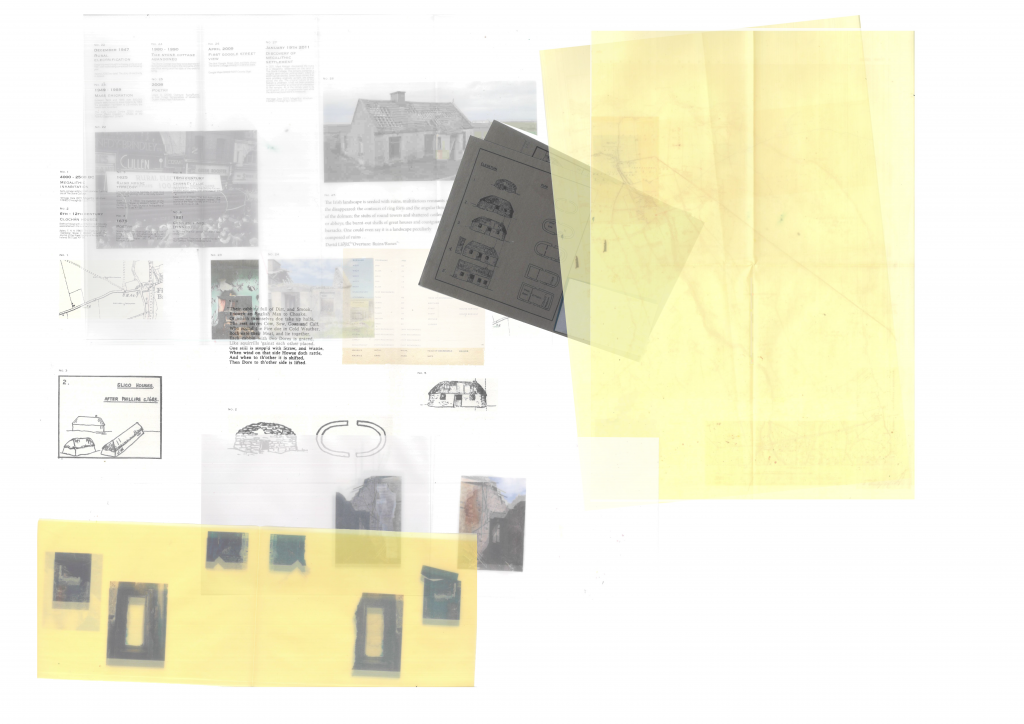
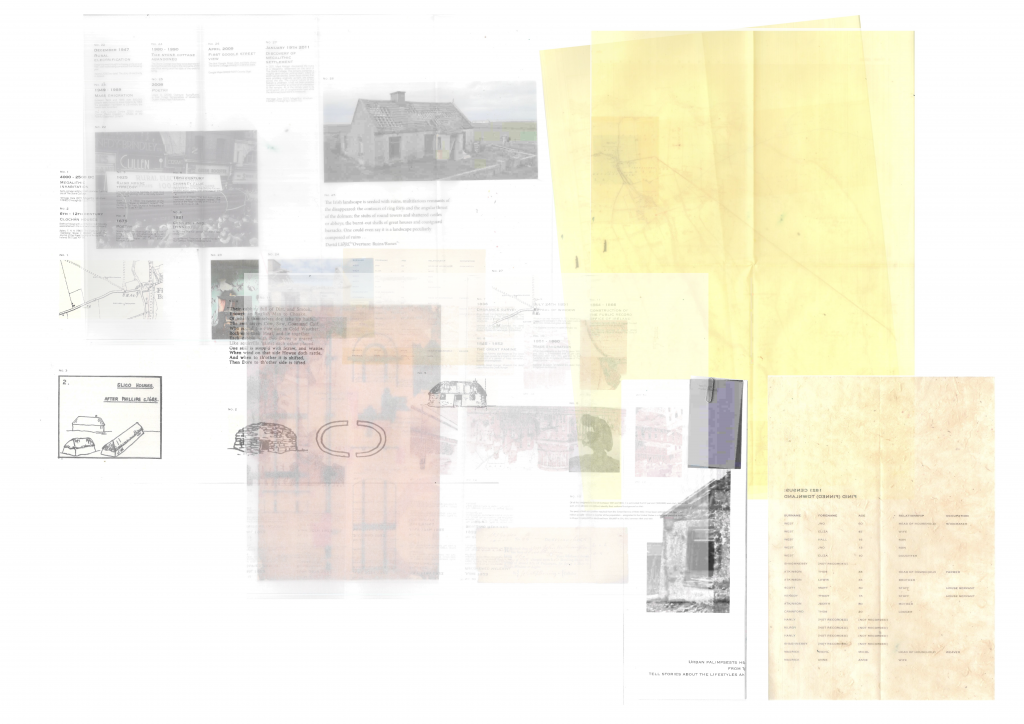
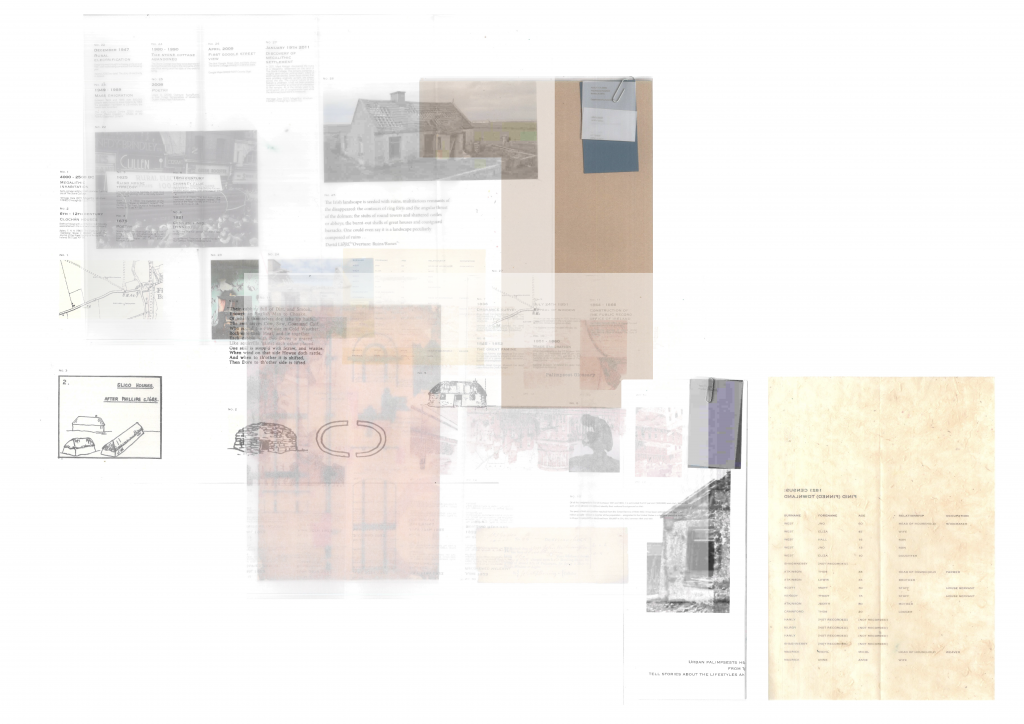
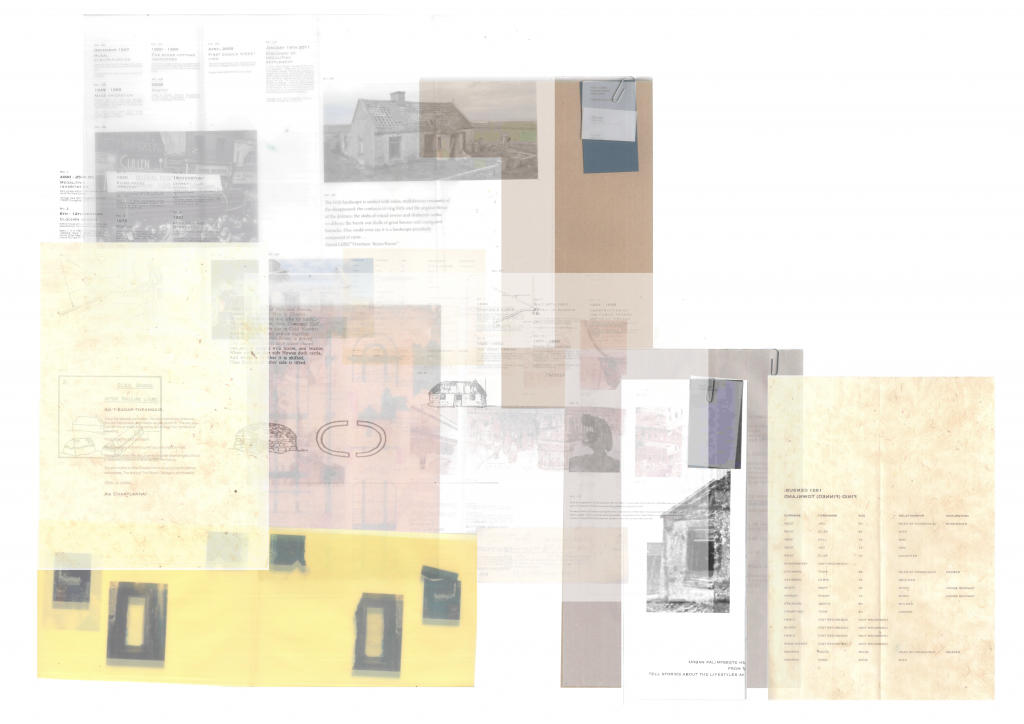
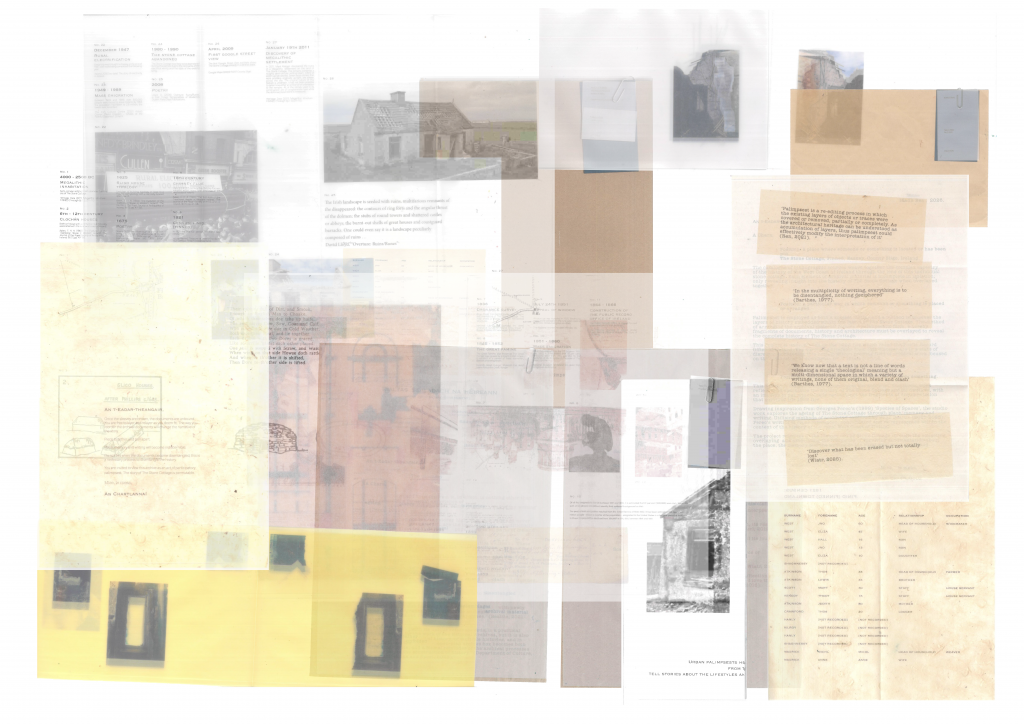
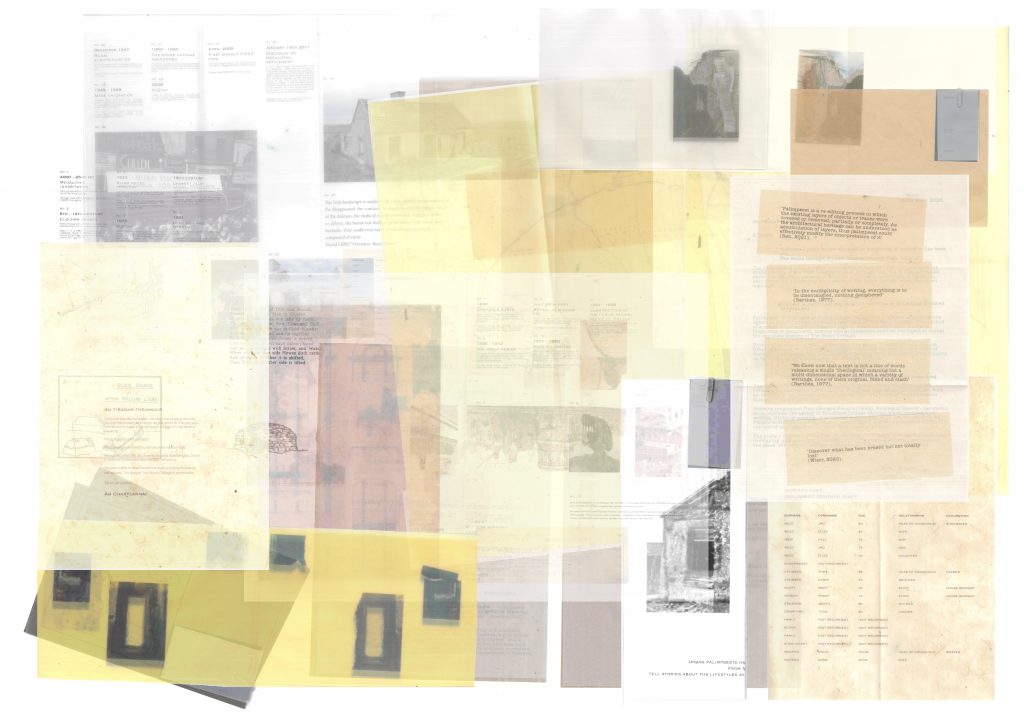
    The Palimpsest Archive demands participation. To understand the narratives that exist within the documents requires them to be placed in conversation with one another. I initially began to explore the archive in use through an iterative tableau exercise. Scans of the documents were positioned and overlayed to glean different compositions that live within the archival material. Each time the archive is used, only one narrative is explored. Multiple histories exist concurrently. 

    The materiality of the archive enables layering, which is not translated through the digital renditions. This observation inform the intentions for the video essay. Dual narratives can be conveyed through the physical positioning of the documents, suggesting the necessity of a performance of the archive in use during the video essay.

  • Written Response

    “This project is positioned within The Stone Cottage, Finned, Easkey, County Sligo, the rural West Coast of Ireland.

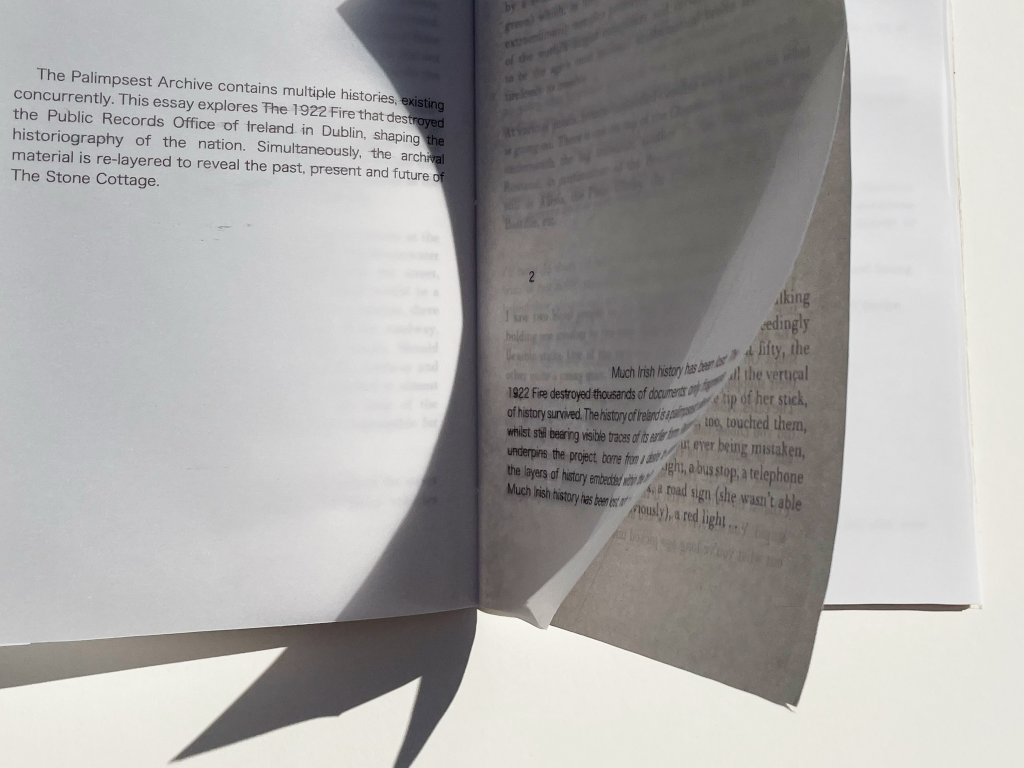
    The Palimpsest Archive contains multiple histories, existing concurrently. This essay explores The 1922 Fire that destroyed the Public Records Office of Ireland in Dublin, shaping the historiography of the nation. Simultaneously, the archival material is re-layered to reveal the past, present and future of The Stone Cottage.


    Much Irish history has been lost. The 1922 Fire destroyed thousands of documents; only fragments of history survived. The history of Ireland is a palimpsest: altered, whilst still bearing visible traces of its earlier form. Palimpsest underpins the project, borne from a desire to understand the layers of history embedded within the built environment. Much Irish history has been lost, not erased…


    I am merely the collector, the archivist, An Chartlannaí.

    You are the curator, the interpreter, An Ateangaire.


    An Ateangaire, 

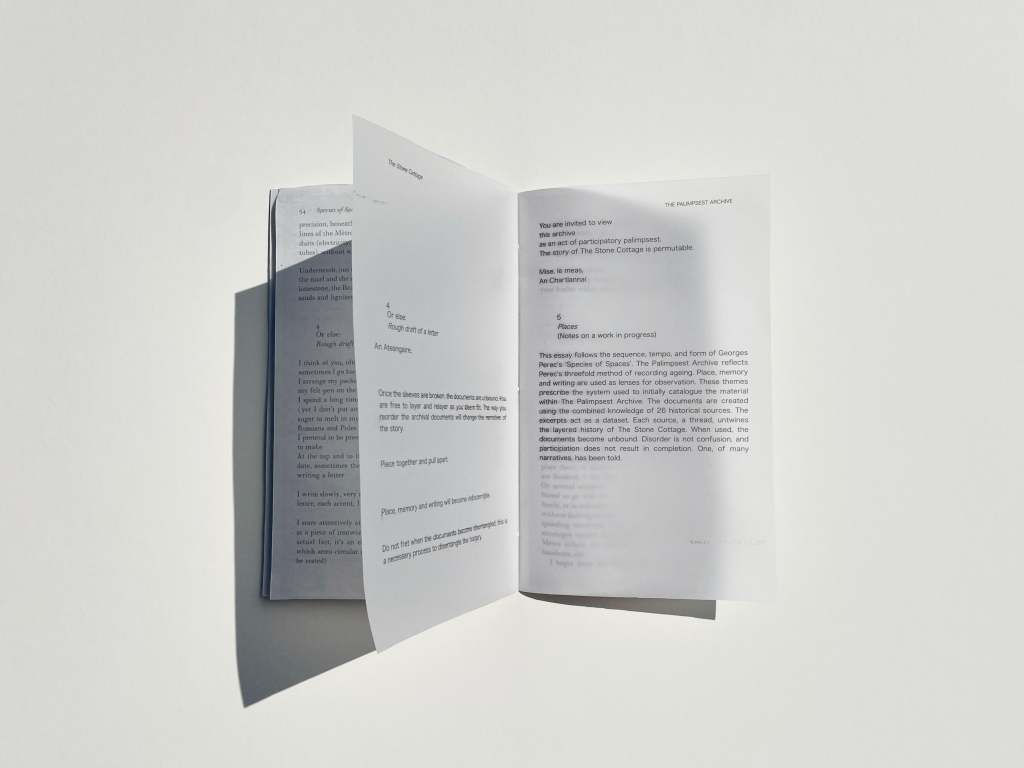
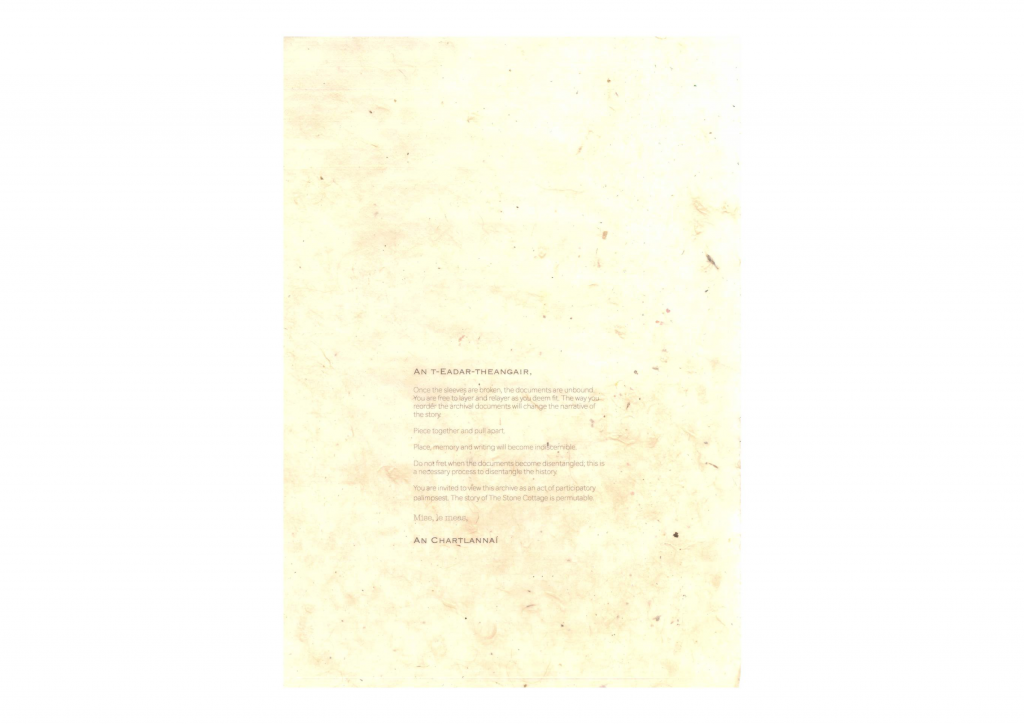
    Once the sleeves are broken, the documents are unbound. You are free to layer and relayer as you deem fit. The way you reorder the archival documents will change the narrative of the story. 

    Piece together and pull apart. 

    Place, memory and writing will become indiscernible. 

    Do not fret when the documents become disentangled; this is a necessary process to disentangle the history. 

    You are invited to view this archive as an act of participatory palimpsest. The story of The Stone Cottage is permutable.

    Mise, le meas, 

    An Chartlannaí 


    This essay follows the sequence, tempo, and form of Georges Perec’s ‘Species of Spaces’. The Palimpsest Archive reflects Perec’s threefold method of recording ageing. Place, memory and writing are used as lenses for observation. These themes prescribe the system used to initially catalogue the material within The Palimpsest Archive. The documents are created using the combined knowledge of 26 historical sources. The excerpts act as a dataset. Each source, a thread, untwines the layered history of The Stone Cottage. When used, the documents become unbound. Disorder is not confusion, and participation does not result in completion. One, of many narratives, has been told. 

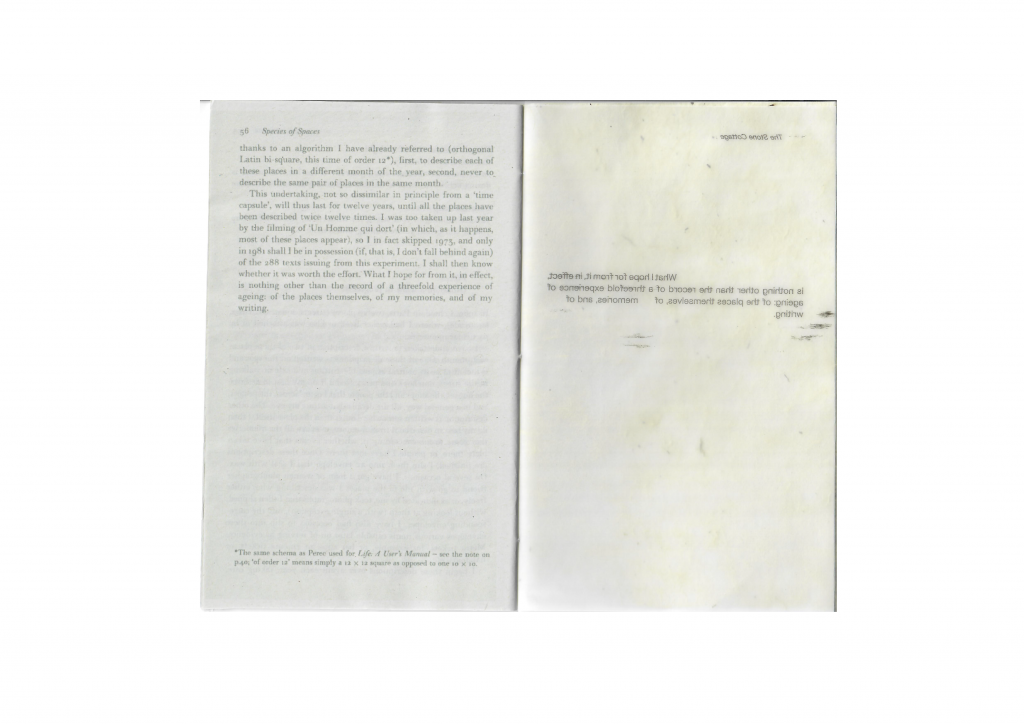
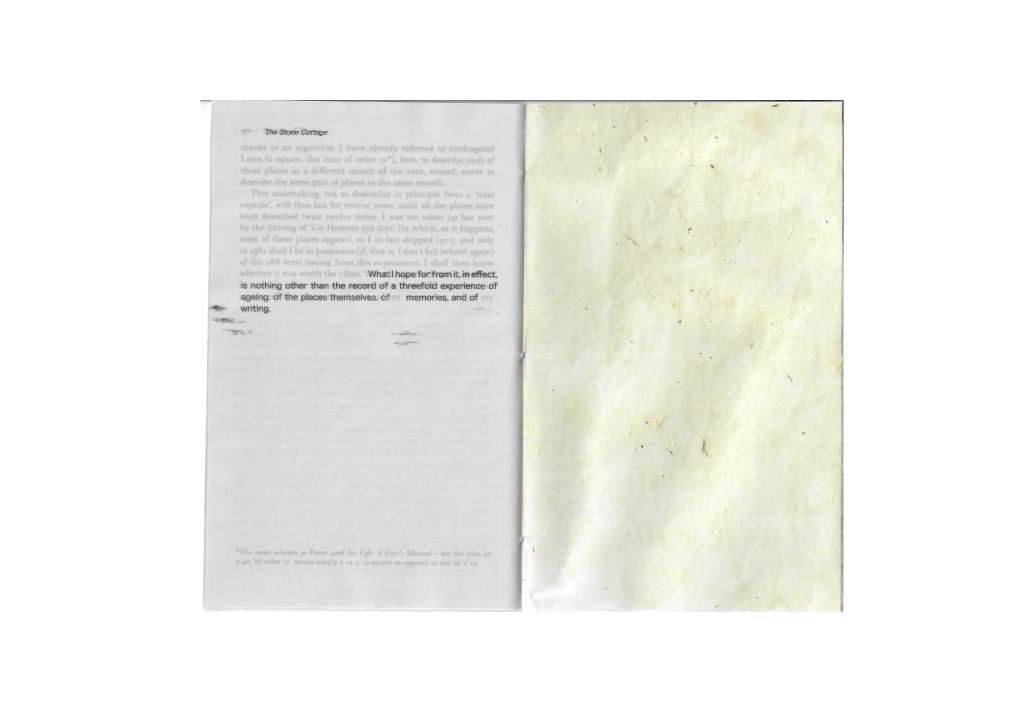
    What I hope for from it, in effect, is nothing other than the record of a threefold experience of ageing: of the places themselves, of memories, and of writing. 

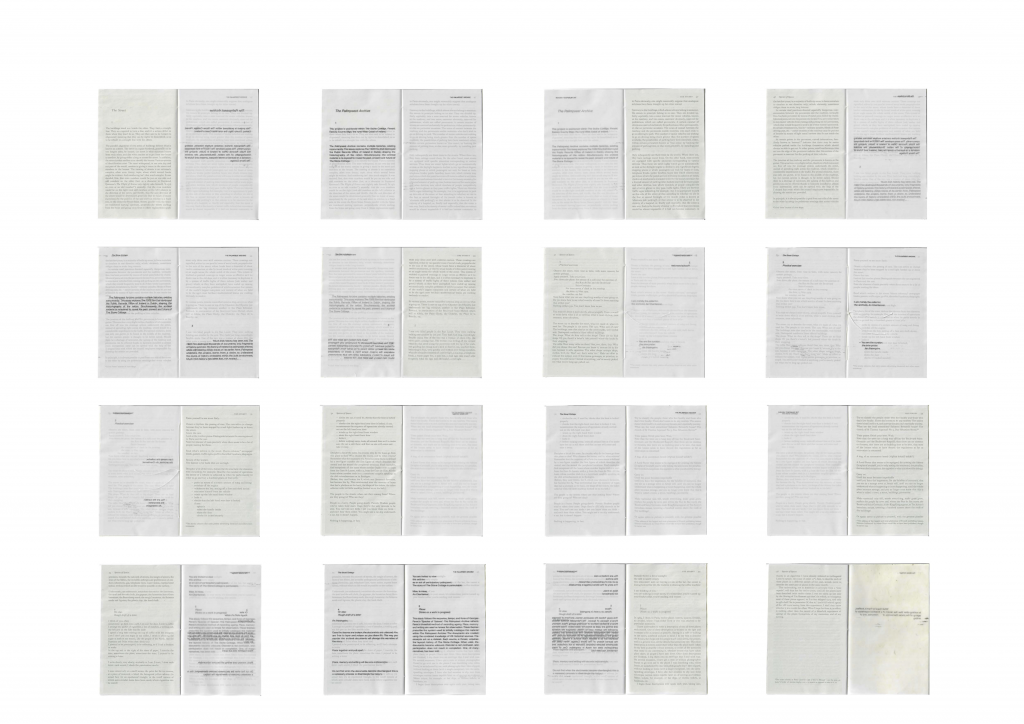
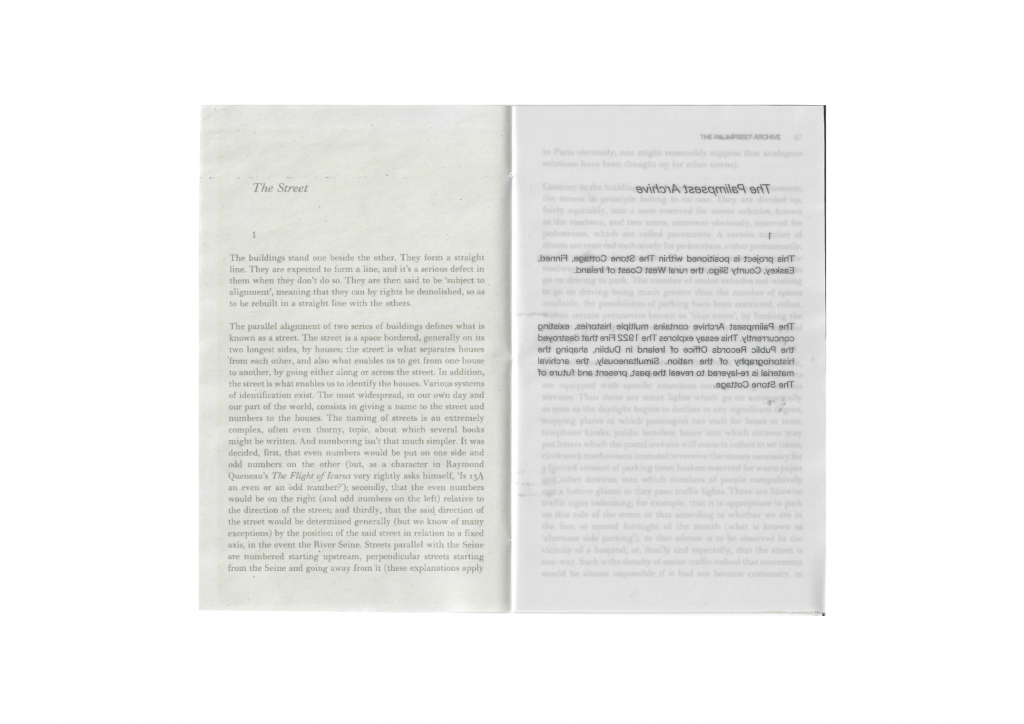
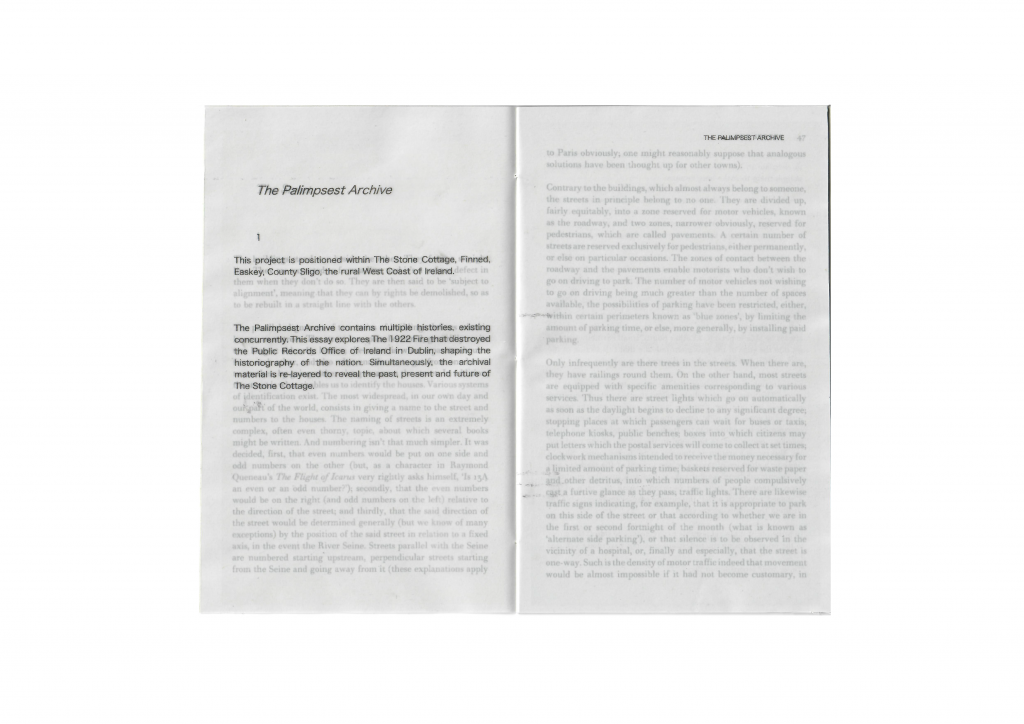
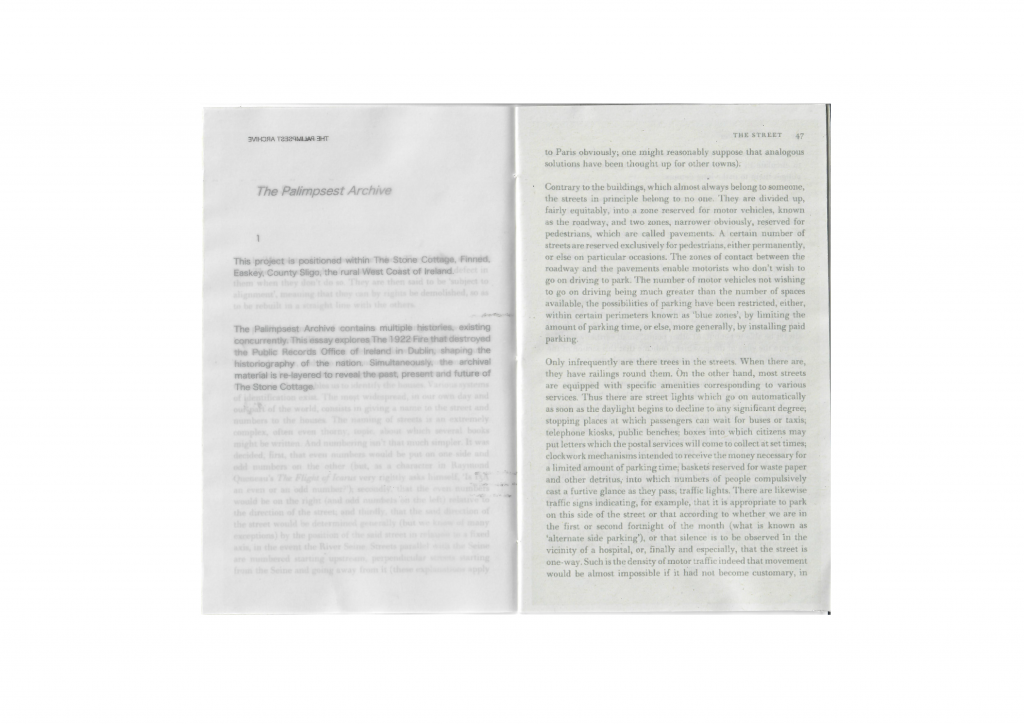
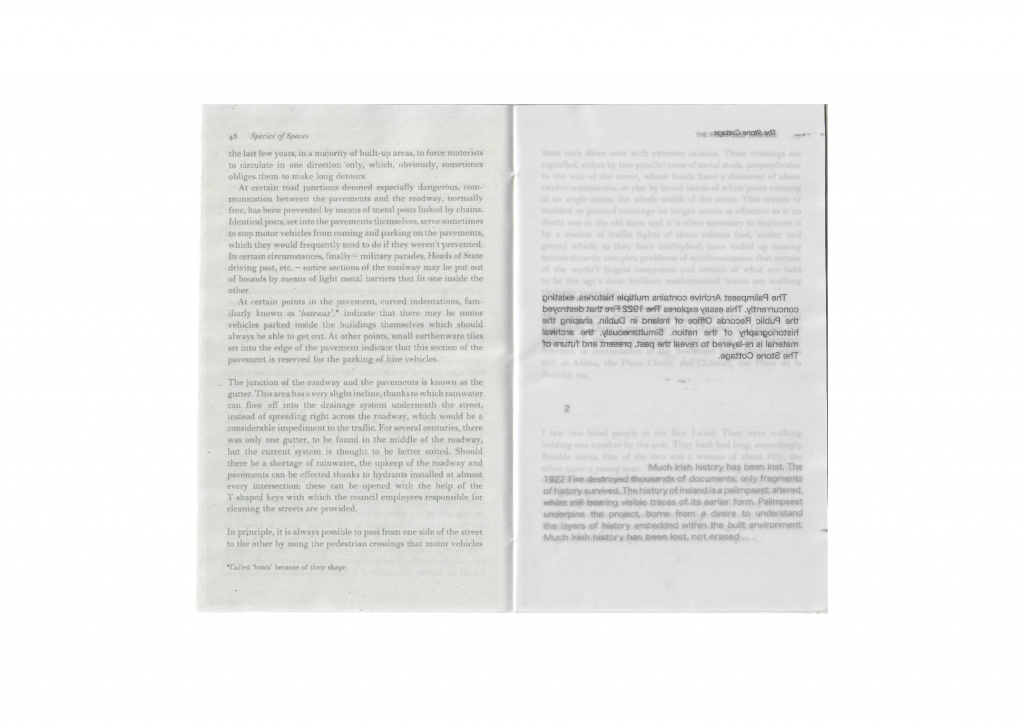
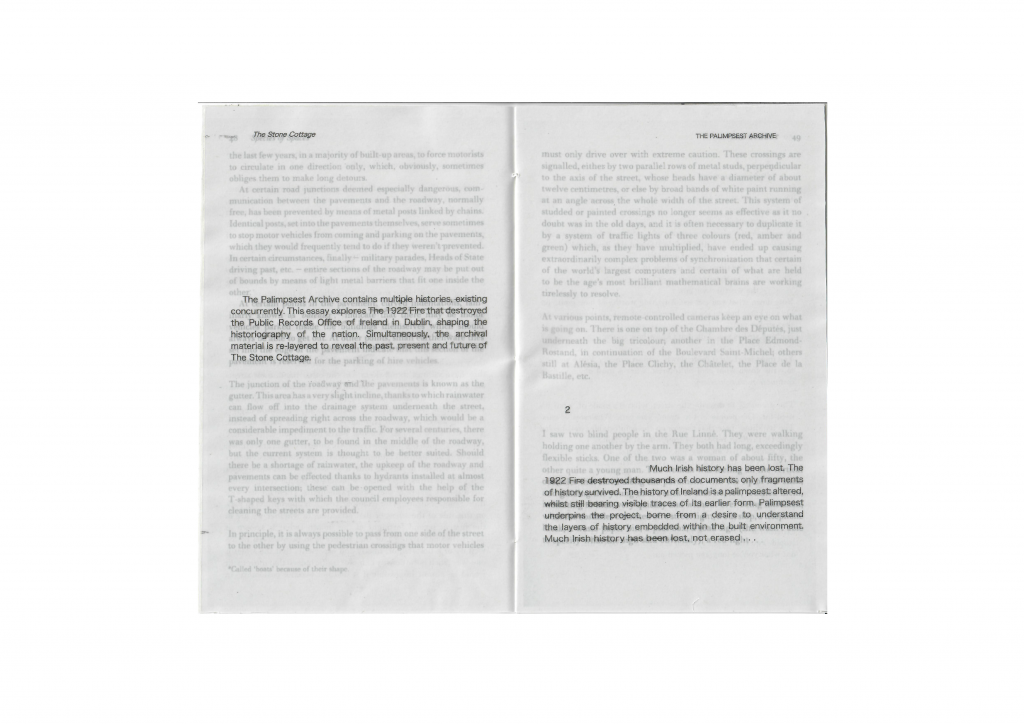
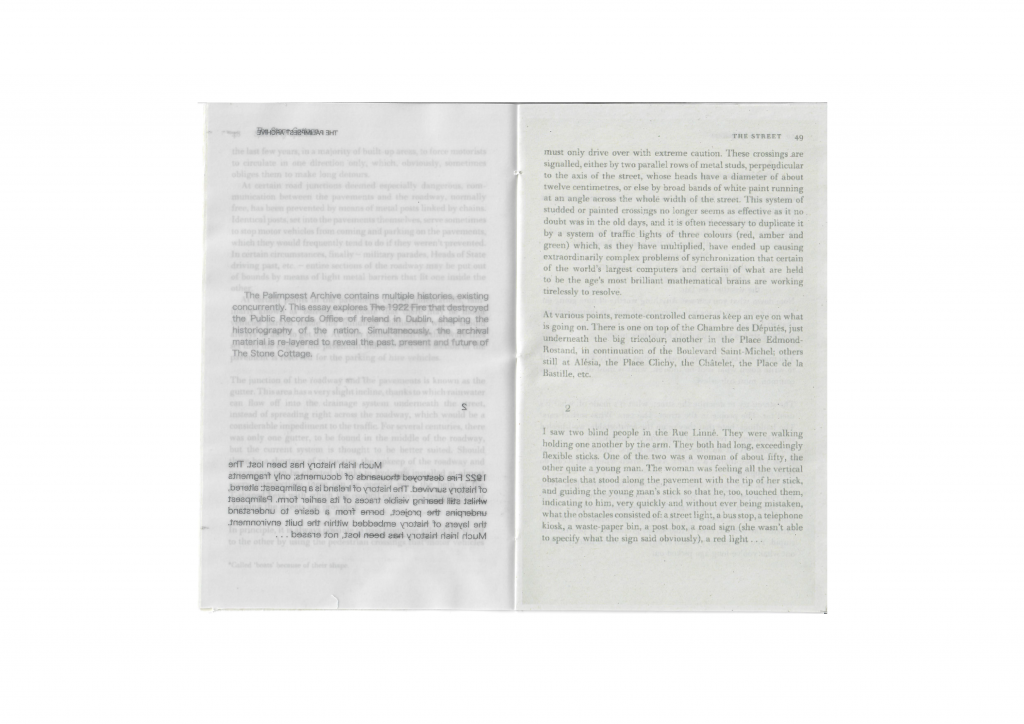
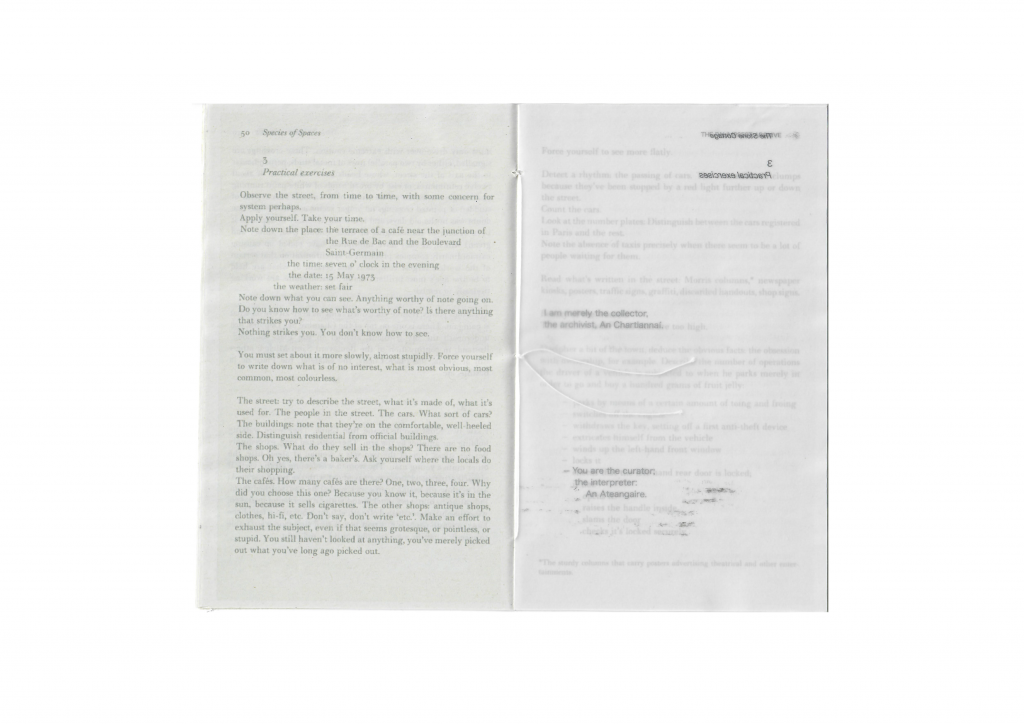
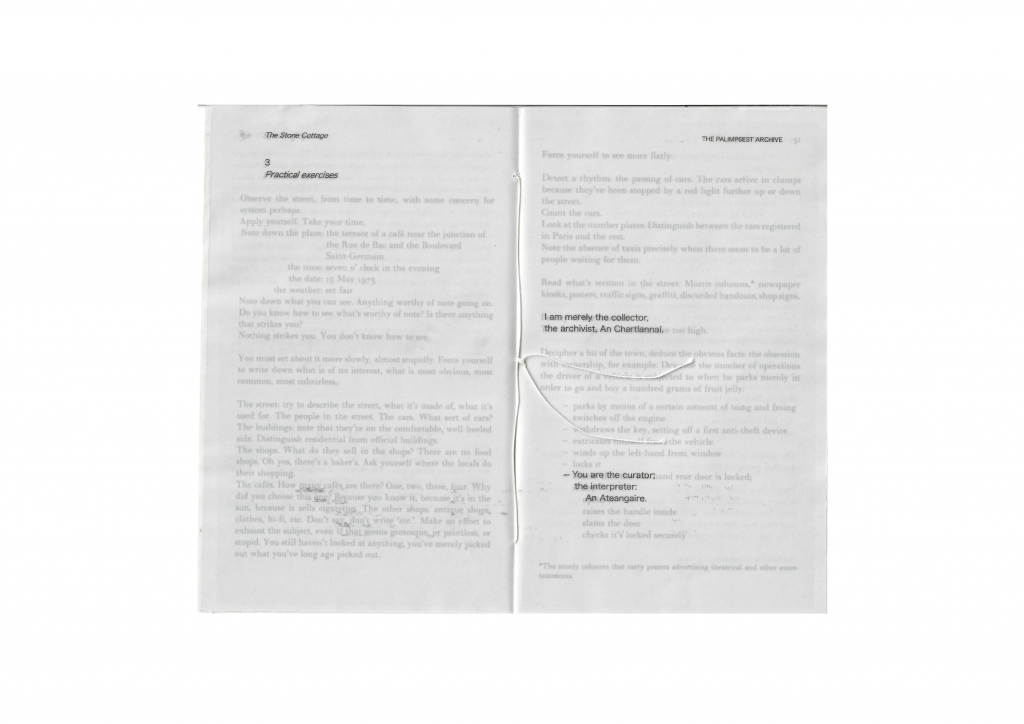
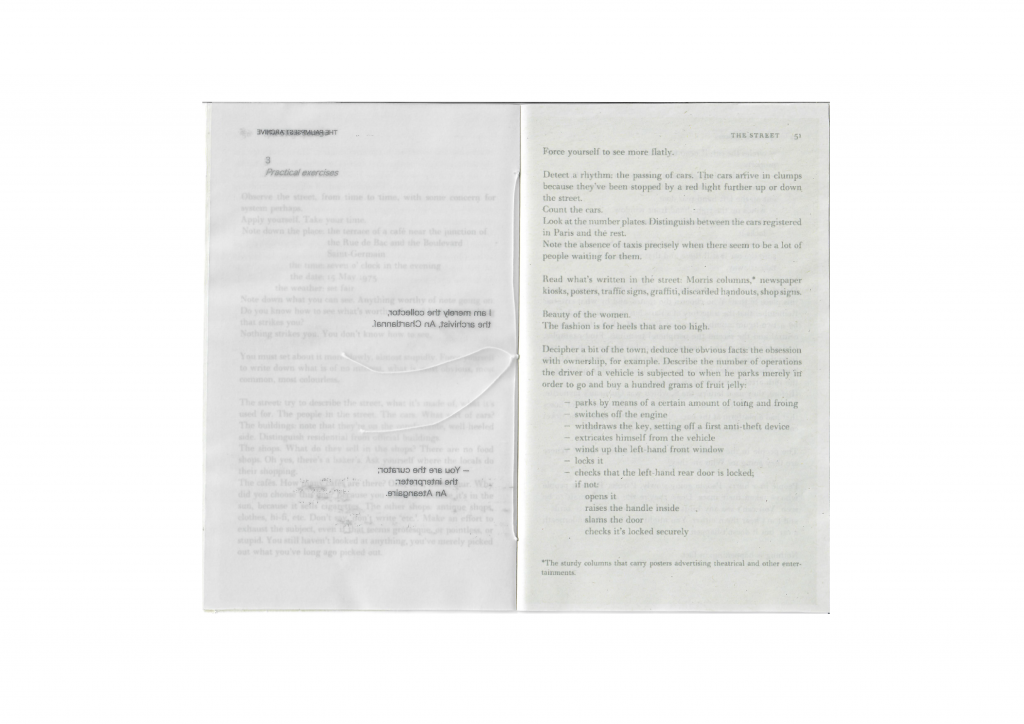
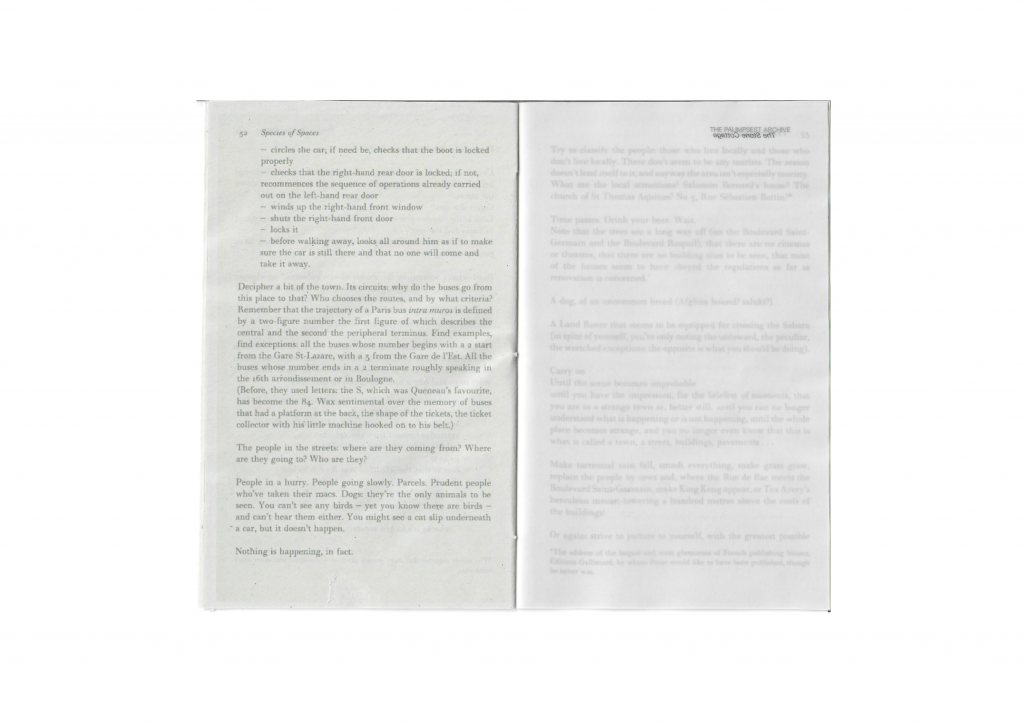
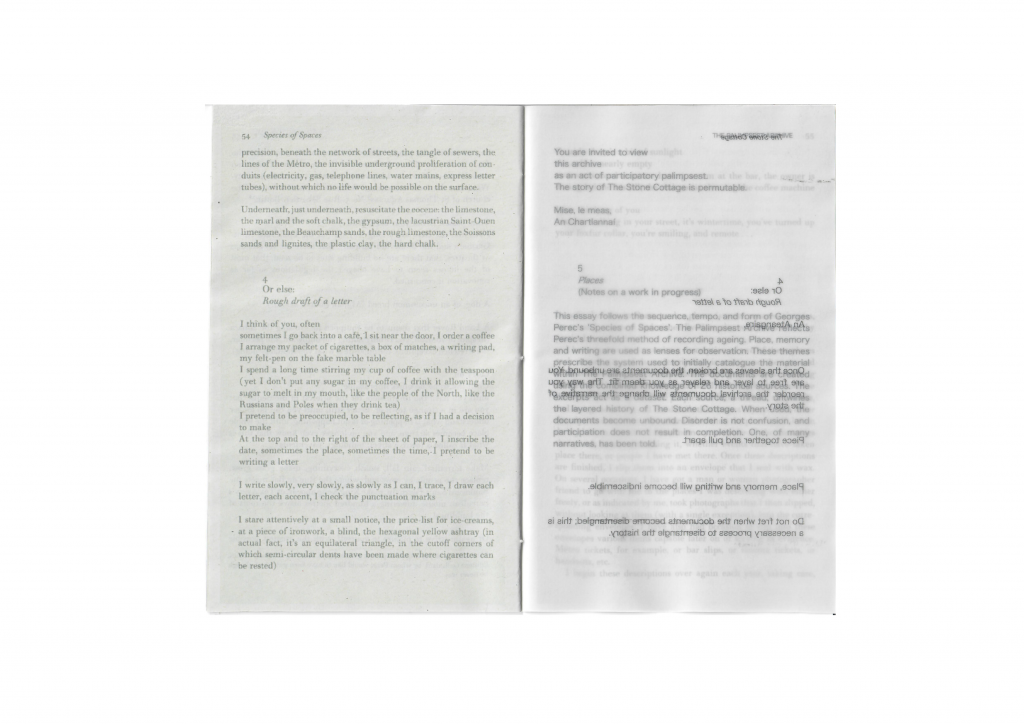
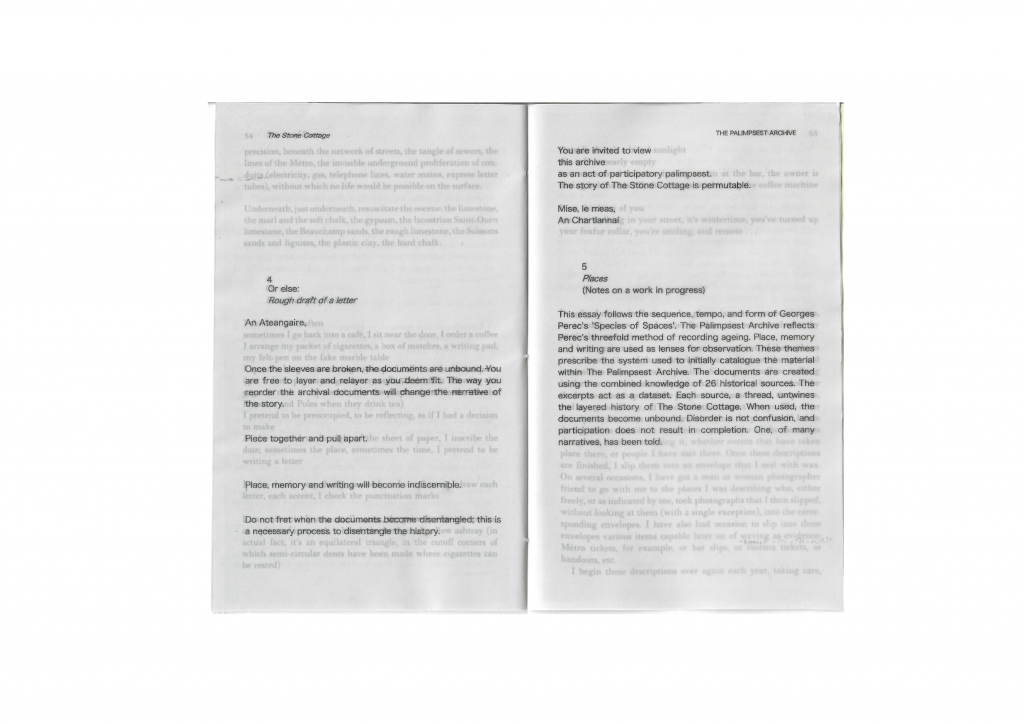
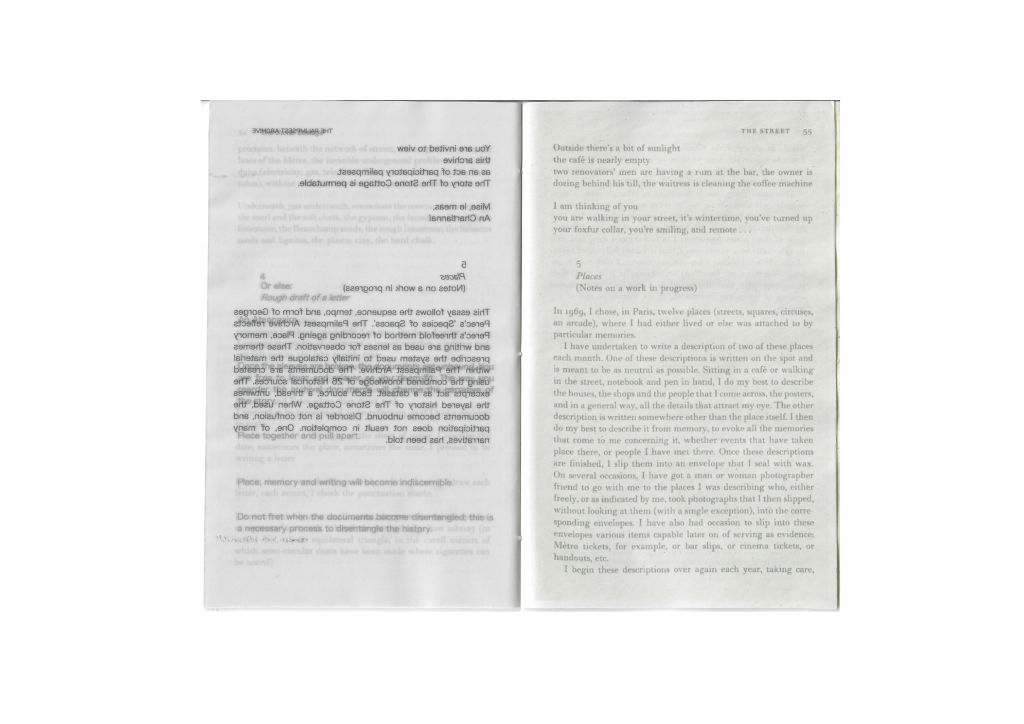
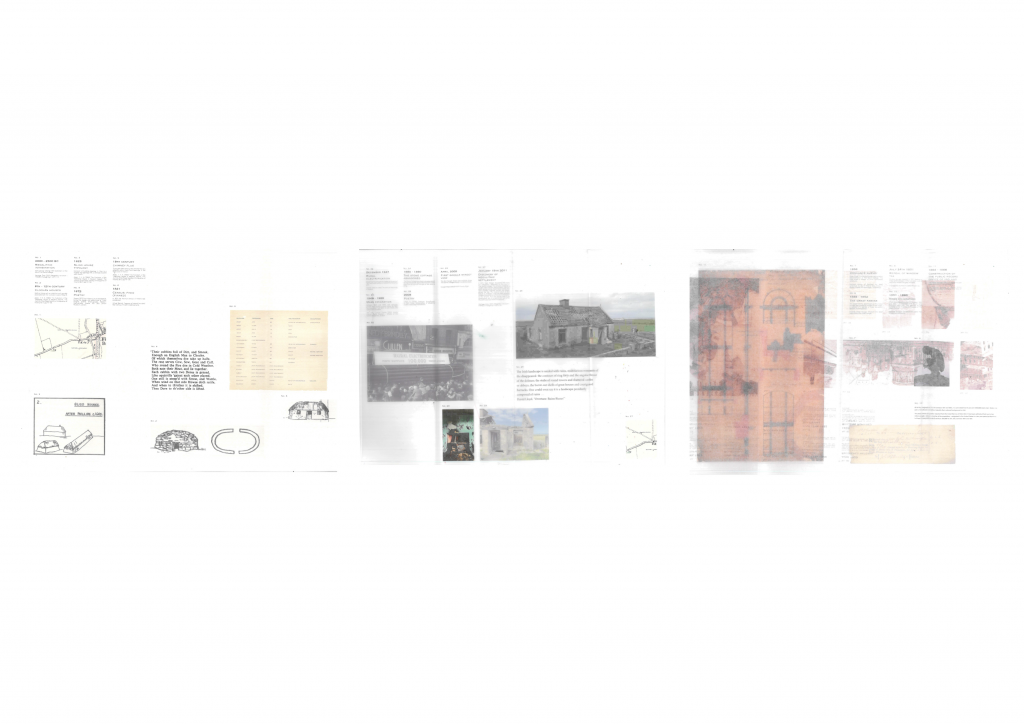
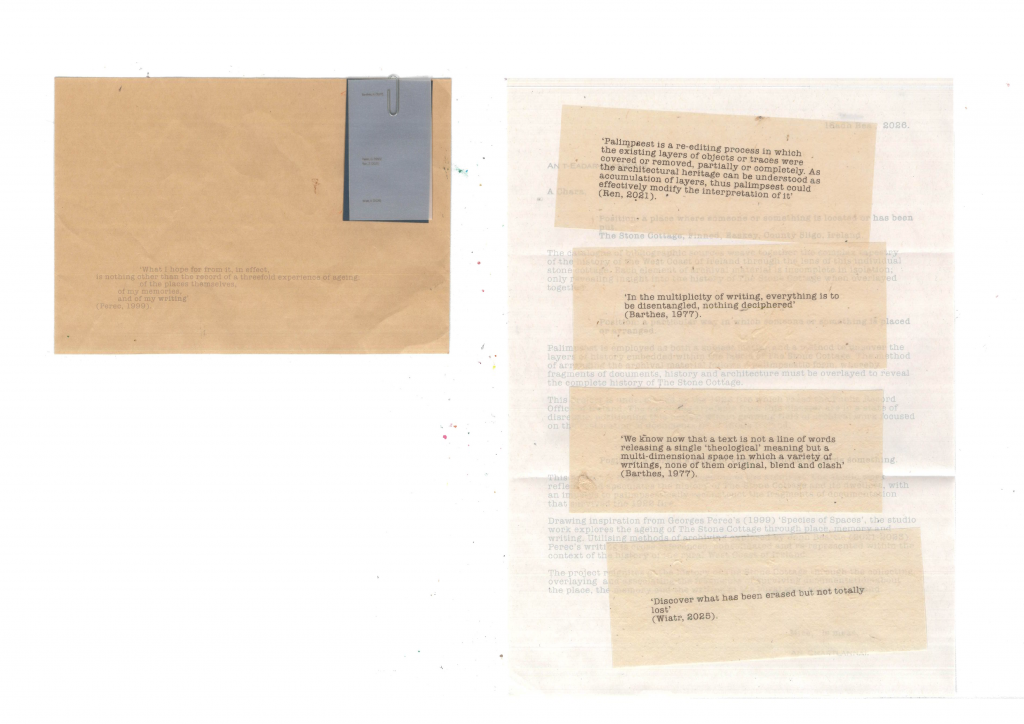
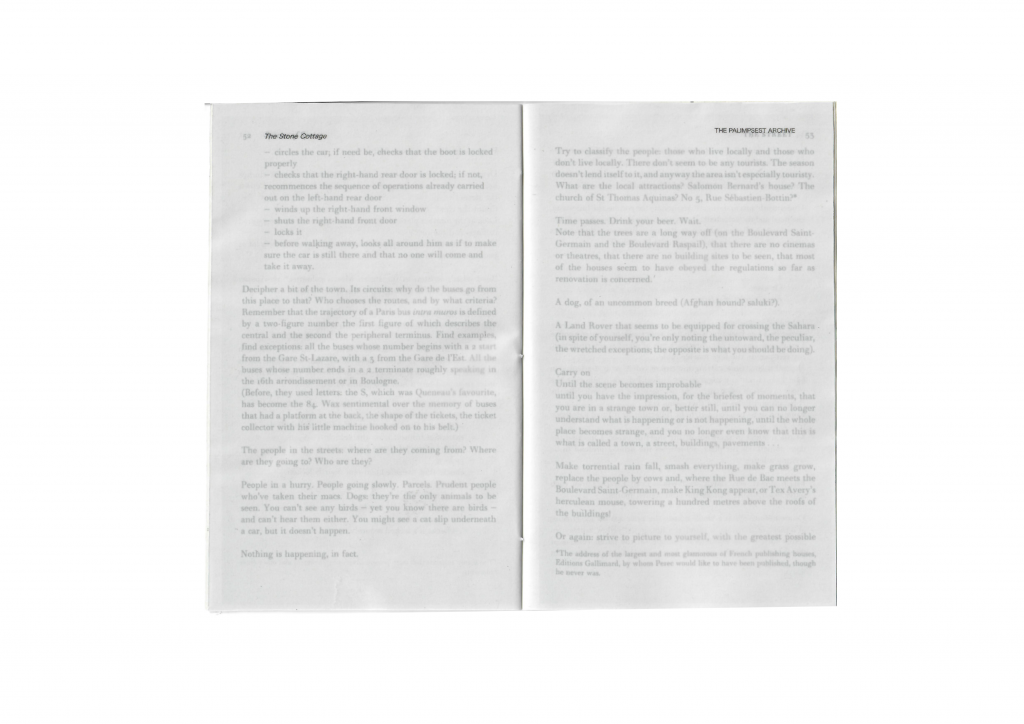
    Fig. 1. Scans of the rendered written response, showing the video essay transcript overlayed with Georges Perec’s (1999) text. A document of scans can be downloaded at the bottom of this blog post.
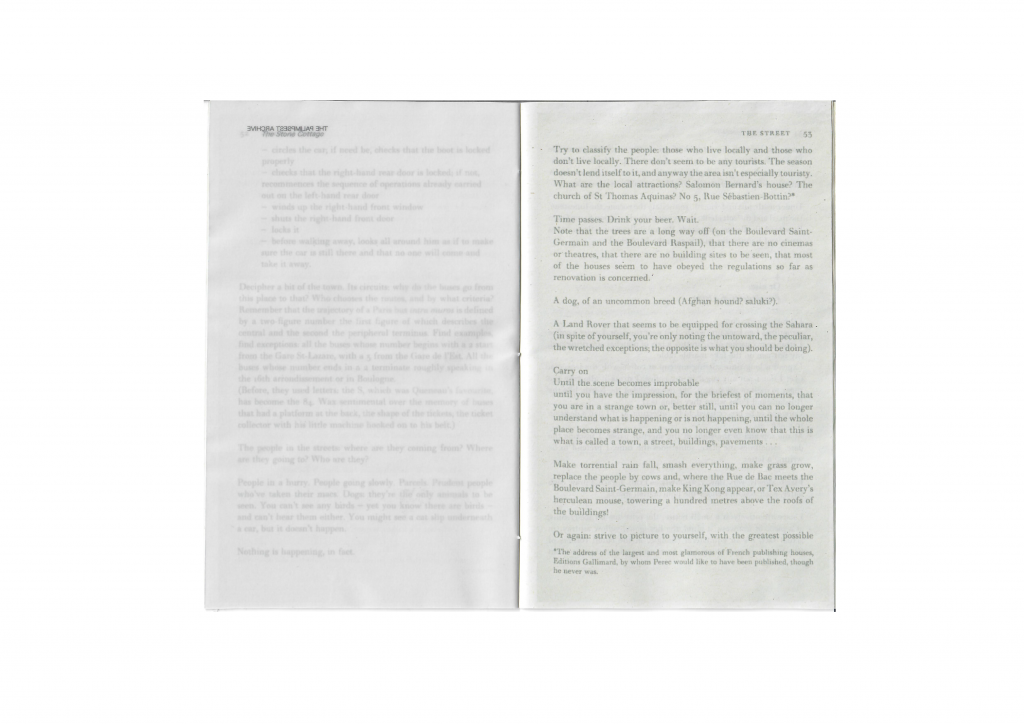
    The Positions through Essaying video reflects the sequence, tempo and form of Georges Perec’s (1999) ‘Species of Spaces’. The chapter titled ‘The Street’ was responded to during Positions through Contextualising (Perec, 1999). The excerpt is divided into five distinct subchapters.

    The first and second subchapters follow a traditional prose structure, characterised by justified text, long sentences and descriptive language. This is replicated in my video essay, as I introduce The Stone Cottage, the dual narratives shown in the film, and The 1922 Fire that provides the rationale for the project. 

    The third and fourth segments within ‘The Street’ have a faster, more staccato pace. Perec (1999) describes Practical exercises used to decipher the city. The dynamic writing style reflects the content in these extracts. This change of tempo is mirrored in the narration and visual of the video essay. My own position as The Archivist is stated, followed by instructions of how to use the archive. The layering of the Irish voices implicitly convey with works position within the wider political and historical context of the West Coast of Ireland. The visual also becomes layered. The archive is in use and the documents are becoming disentangled. 

    Perec’s (1999) fifth, and final, subchapter returns to the prose structure, and the pace slows once again. This deceleration mimics the end of the participatory archival process, where one narrative has been distilled from the layered historical documents. 

    The rendered written response amplifies the themes explored in the video essay through a text-based investigation. The transcript of the video essay is overlayed with Georges Perec’s (1999) passage in ‘Species of Spaces’. The parallels between the reference and the video essay become explicit. Pace, tone, structure, punctuation and format are commonality.

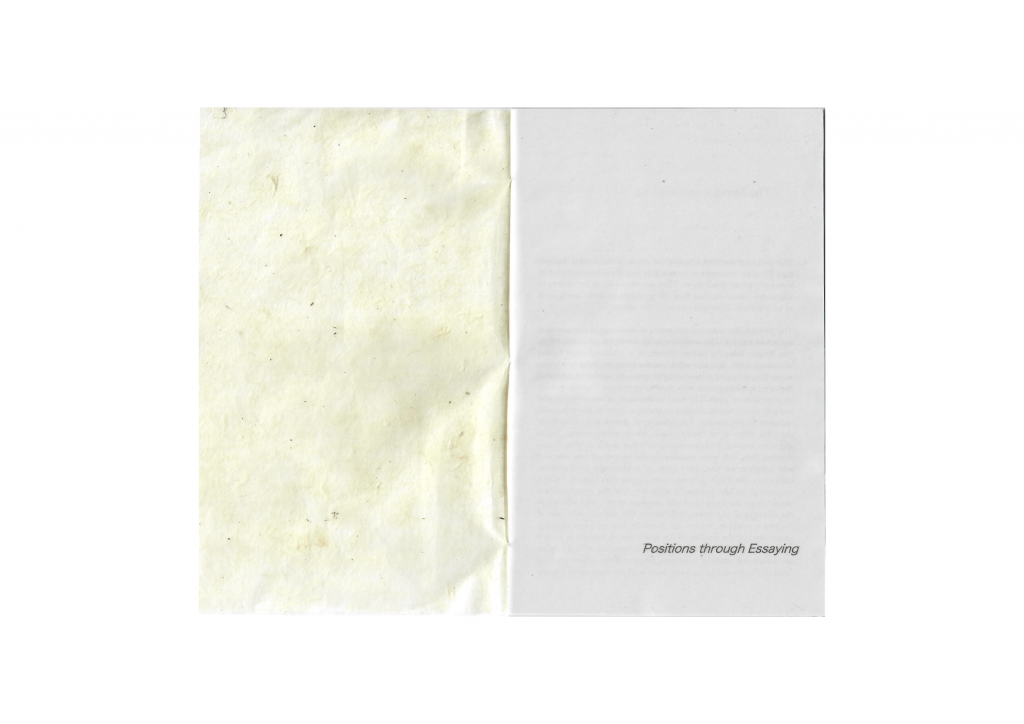
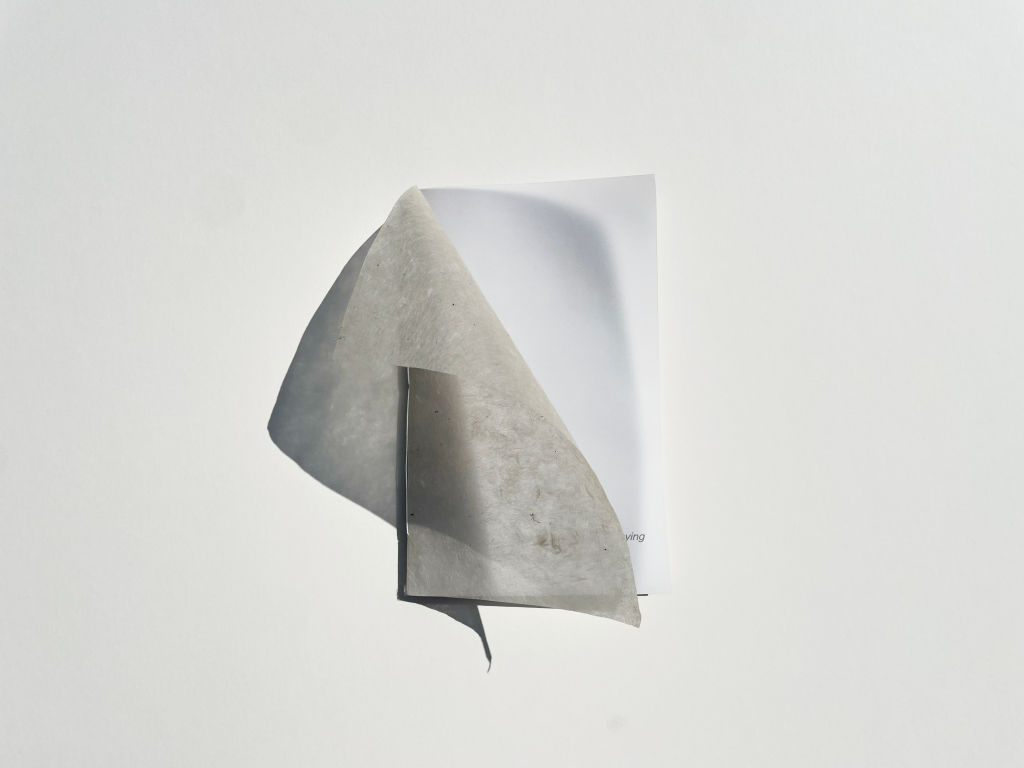
    The materiality of The Palimpsest Archive is emulated within the rendered written response. The translucent and opaque paper textures allow Perec’s writing and my own transcript to be read simultaneously. This format communicates key themes explored within the essay: The Palimpsest Archive contains multiple histories, existing concurrently. Similarly, two distinct narratives are examined within the video essay: The 1922 Fire that destroyed the Public Records Office of Ireland, and, the past, present and future of The Stone Cottage. The composition of the publication follows a palimpsestic form. The Perec (1999) text has been altered to reflect my own studio exploration, whilst still bearing visible traces of its earlier form.

    Fig. 2. Photographs of the rendered written response publication.

    Reference List:

    Perec, G. (1999) ‘Species of Spaces’, in Species of Spaces and Other Pieces. London: Penguin, pp. 46–56.

  • Week Three Process

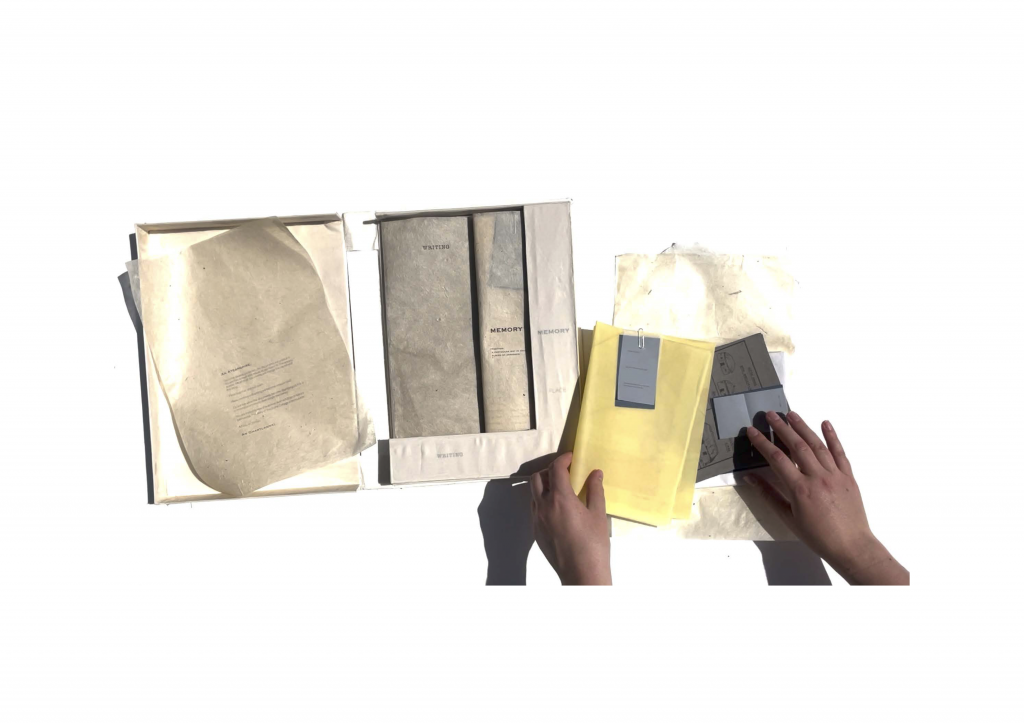
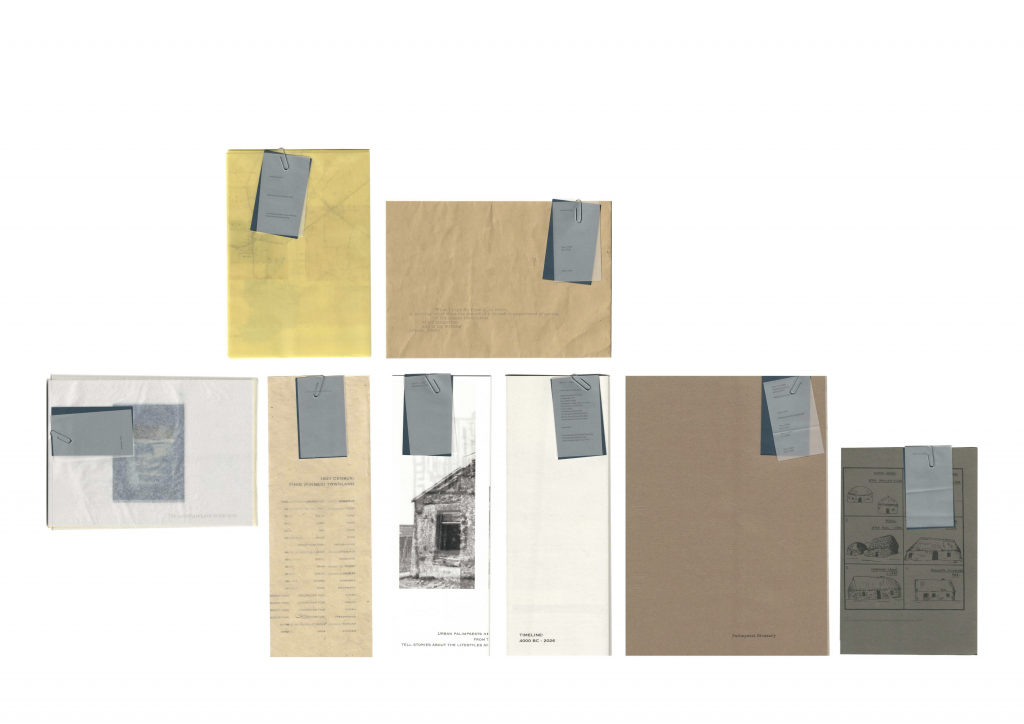
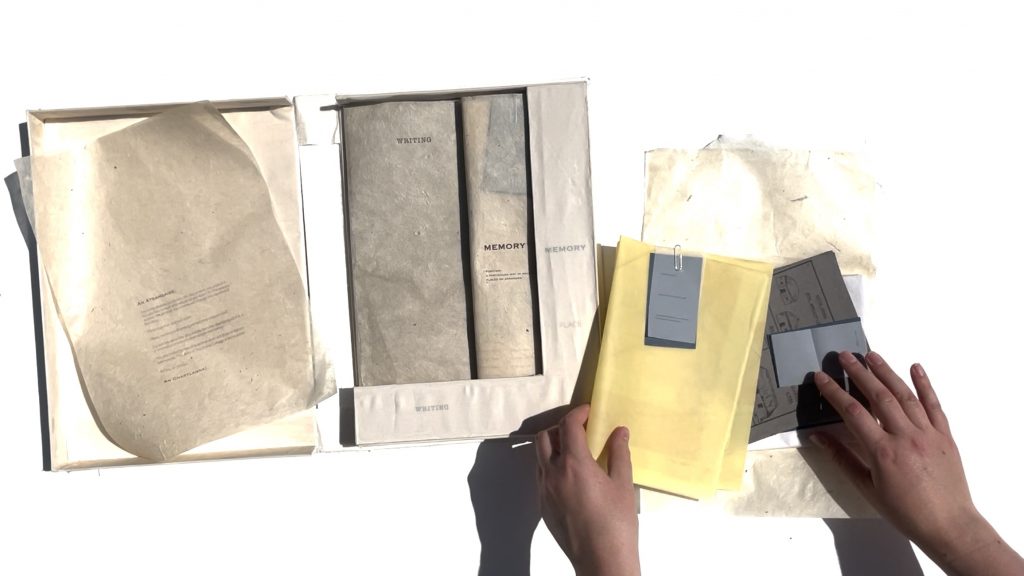
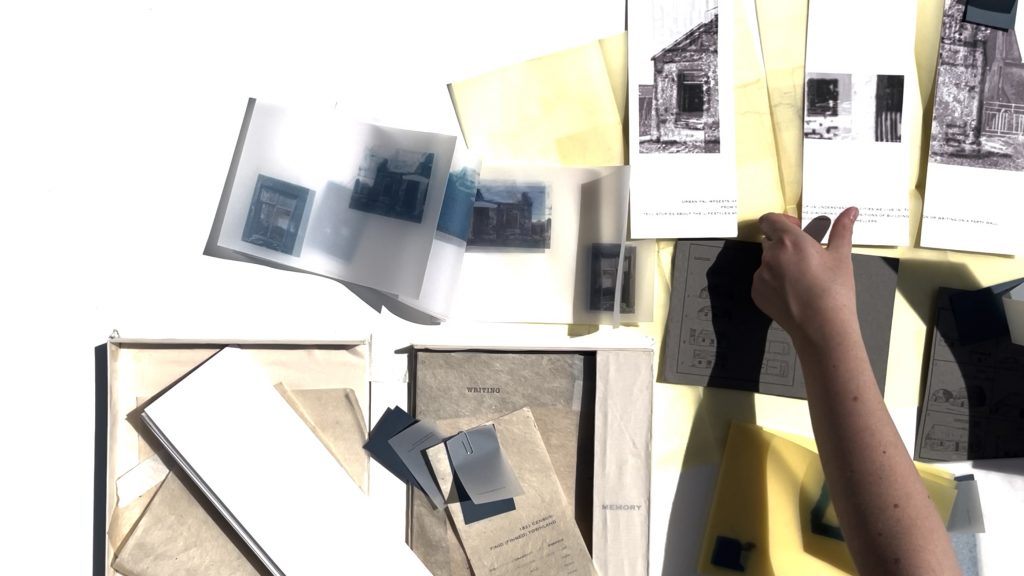
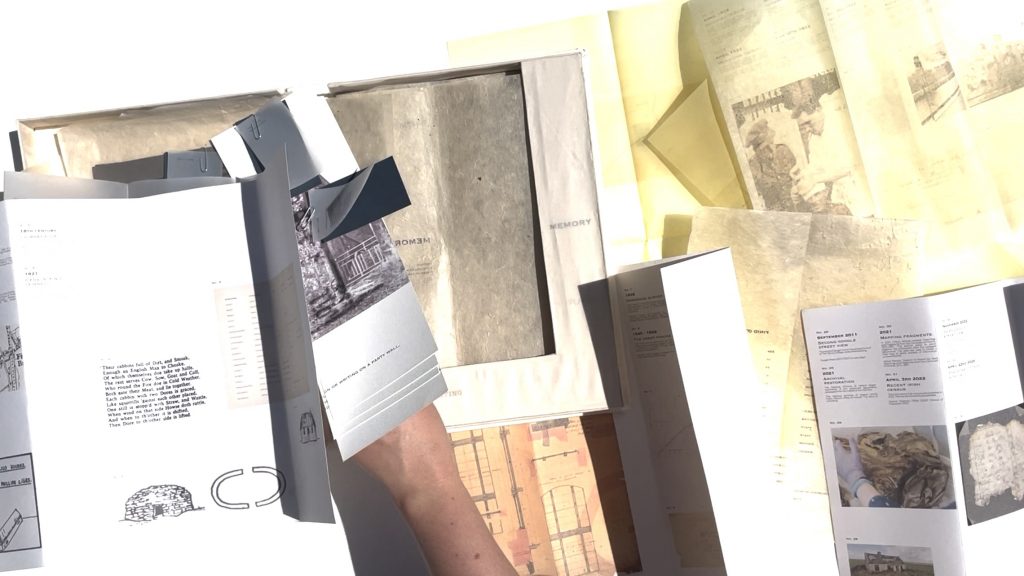
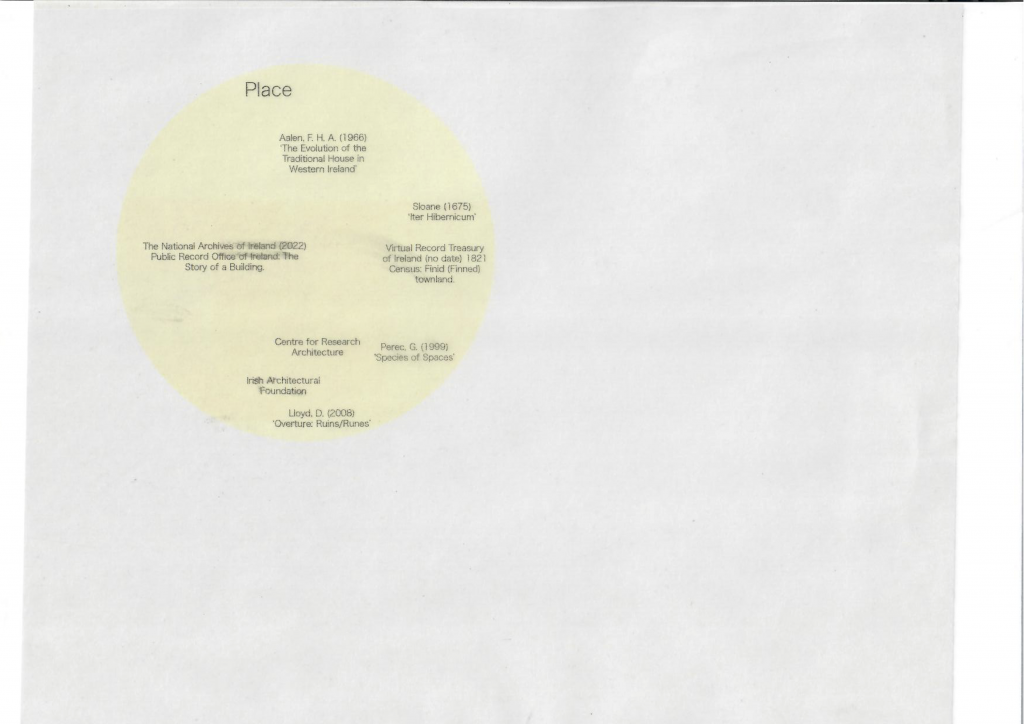
    Each artefact is created using a different combination of sources. The role of every document is different as they each act as a fragment of information about The Stone Cottage. The documents are initially categorised into place, memory and writing, accompanied by a preamble which instructs how to the archive is to be used. The contents of the archive are listed below:


    Preamble:

    An t-Eadar-theangair 

    Addressing An t-Eadar-theangair (The Interpreter) with instructions on how to use the archive.


    Place:

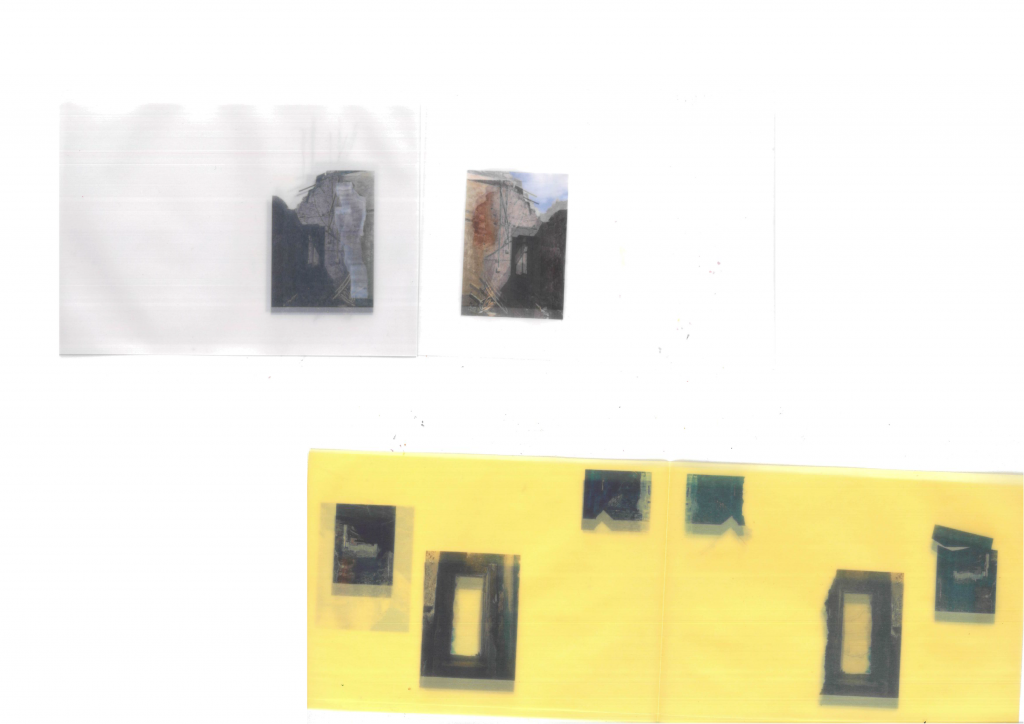
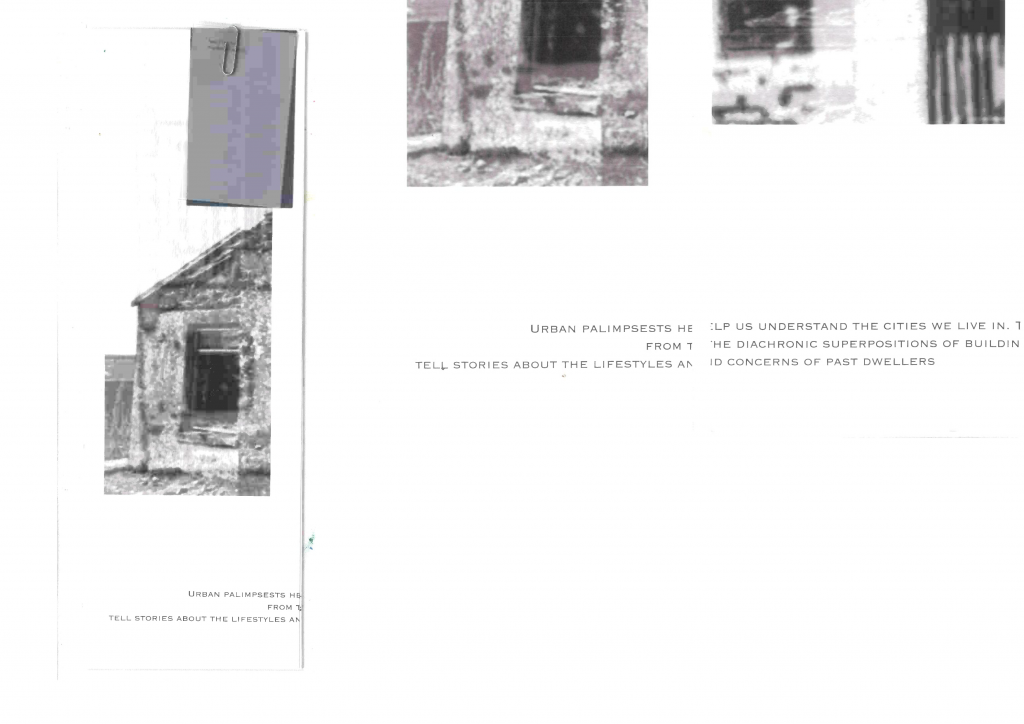
    The Building Returns to the Land

    Publication using tracing paper to layer the image-degradation investigations from week two of Positions through Iterating.

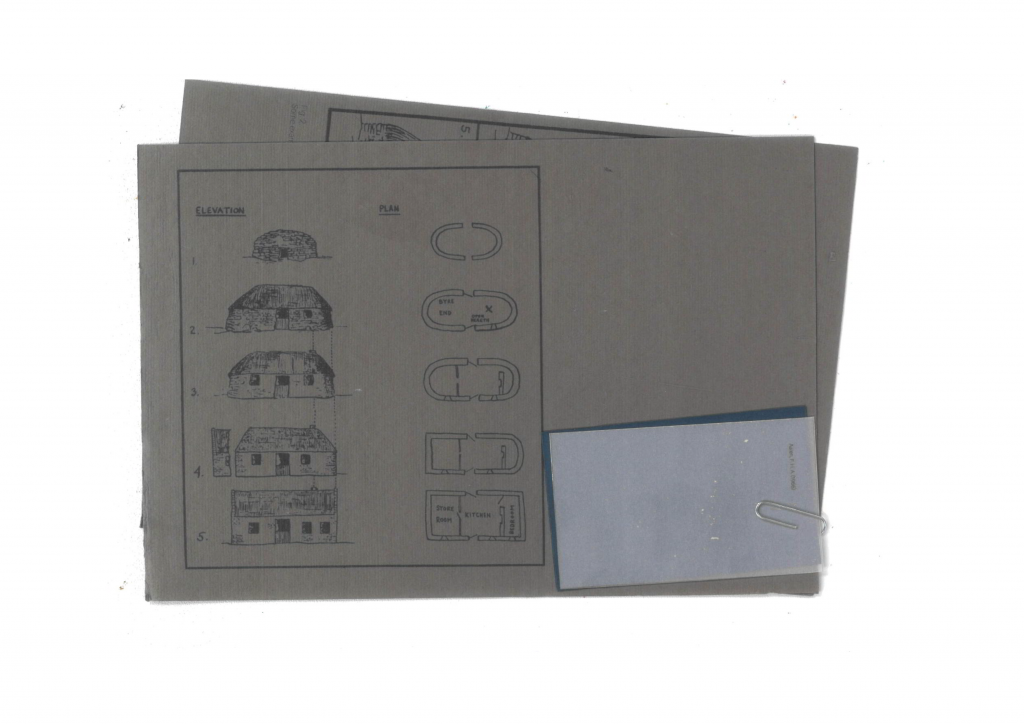
    Traditional West Ireland Cottage Typologies

    Diagrams and captions from Aalen, F. H. A. (1966) ‘The Evolution of the Traditional House in Western Ireland’, The Journal of the Royal Society of Antiquaries of Ireland, 96 (1), pp. 47–58.

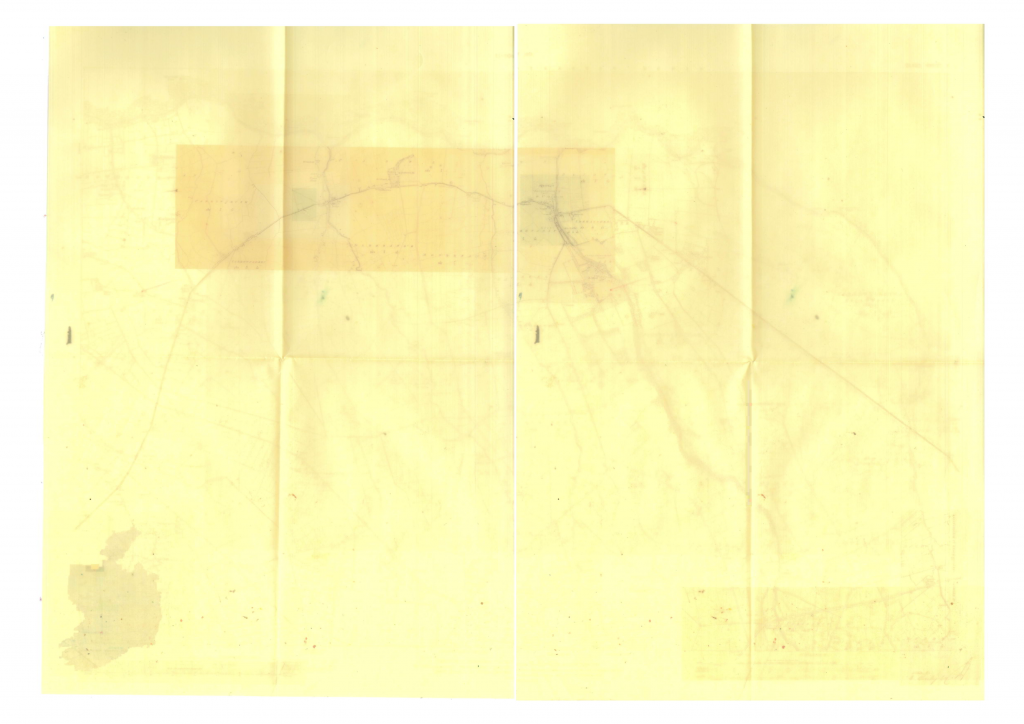
    Fragments of Ordnance Survey of Ireland, Sligo Sheet 11

    Collage overlaying fragments of different historical and contemporary maps to show the position of The Stone Cottage in relation to Easkey.


    Memory:

    Timeline: 4000BC – 2026AD

    Mapping a timeline of events of the history, and historiography, of The Stone Cottage.

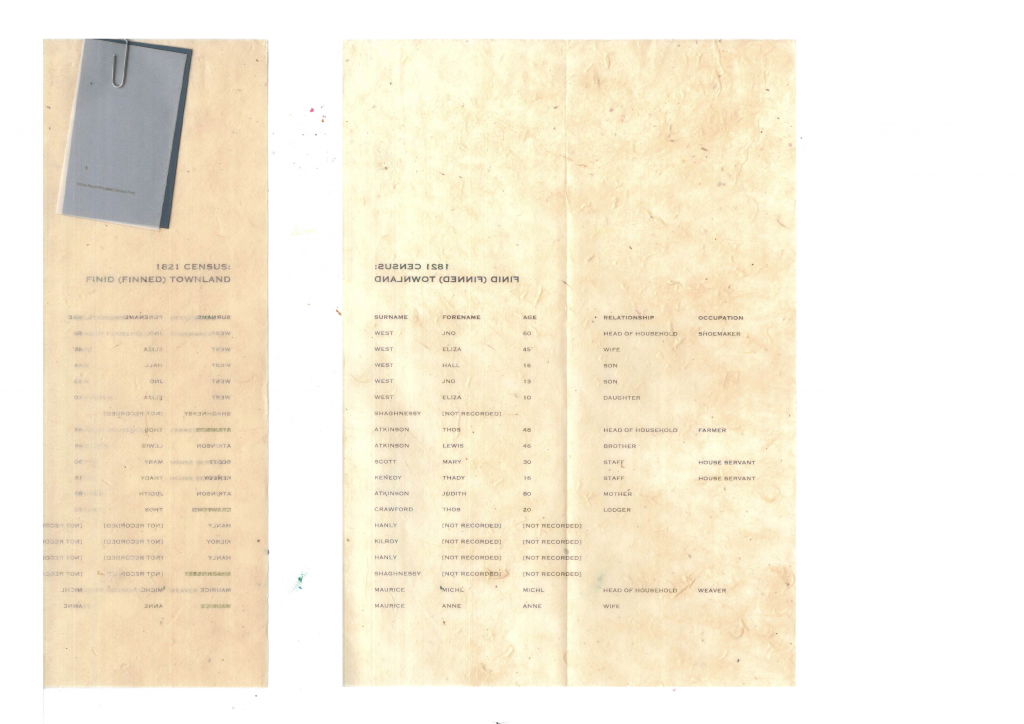
    1821 Census: Finid (Finned) Townland

    Census content from Virtual Record, Treasure of Ireland (no date) 1821 Census: Finid (Finned) townland. Available at: https://virtualtreasury.ie/item/VRTI-CEN-1821-4-44-7-3-Finid (Accessed: 6 May 2026).

    Evanescent Traces

    Collage using Positions through Iterating experiment overlayed with Aalen’s (1966) diagram of traditional cottage typologies in Western Ireland.

    Writing:

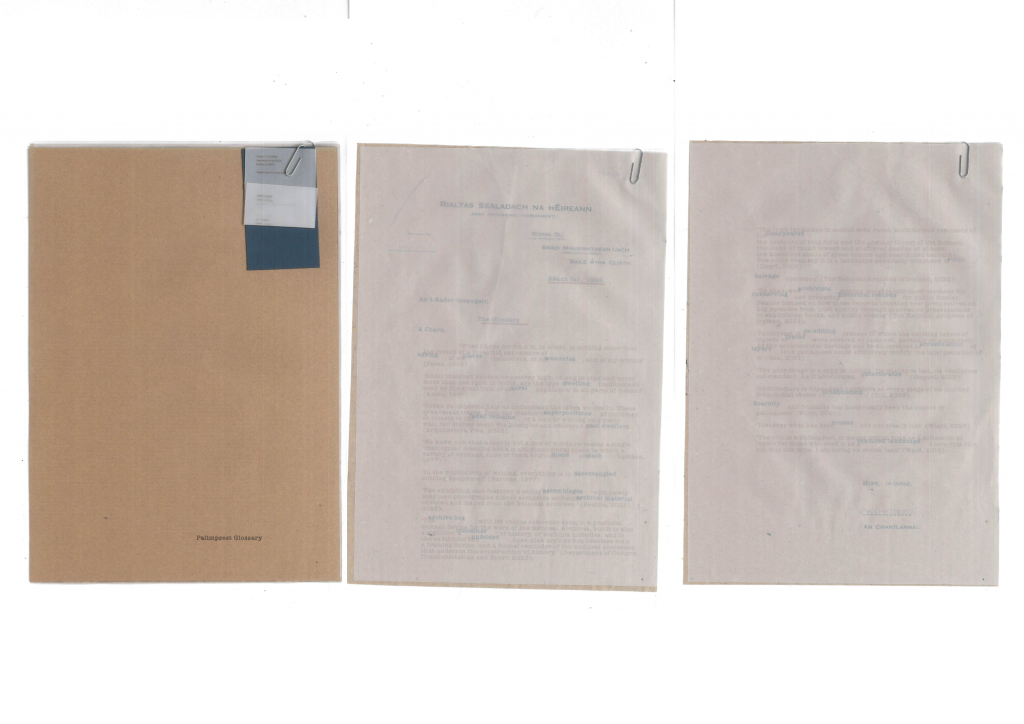
    Palimpsest Glossary

    Key terms relating to palimpsest highlighted from textual sources in the dataset used to create the archive. 

    And of My Writing

    Refined line of enquiry text, accompanied by four short quotes centred around the theme of writing as a form of palimpsest. 

    Screenshot

  • Week Two Process

    During the first week of the Positions through Contextualising brief, I began to refine my line of enquiry through research into the history, and historiography, of The Stone Cottage. The work naturally began to form an archive, where the research material should be read in conjunction to weave together a narrative about the building. To develop the visual language of the studio enquiry, I began to gather references of successful archival projects.

    [References marked with an asterisk are included within the written response. The written response explores the position of these sources within the context of my studio enquiry in greater detail].

    Beattie, J. (2021-2023) Shadowing the Archives [Film, video stills, archival material]. Dublin Castle, Dublin.*

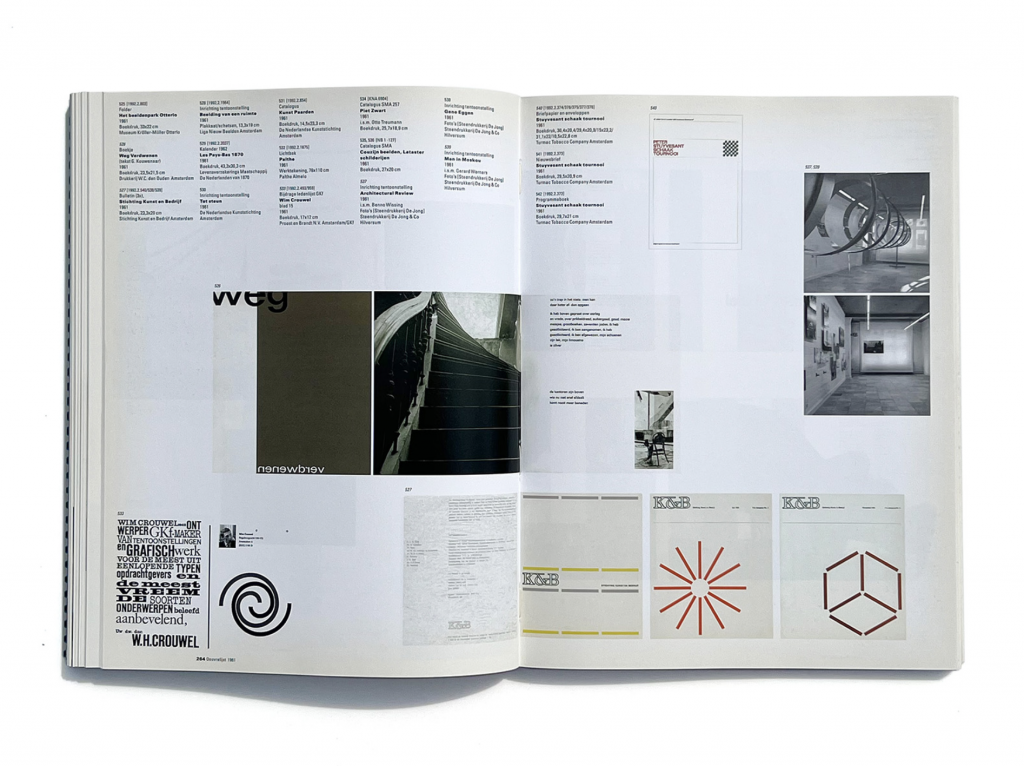
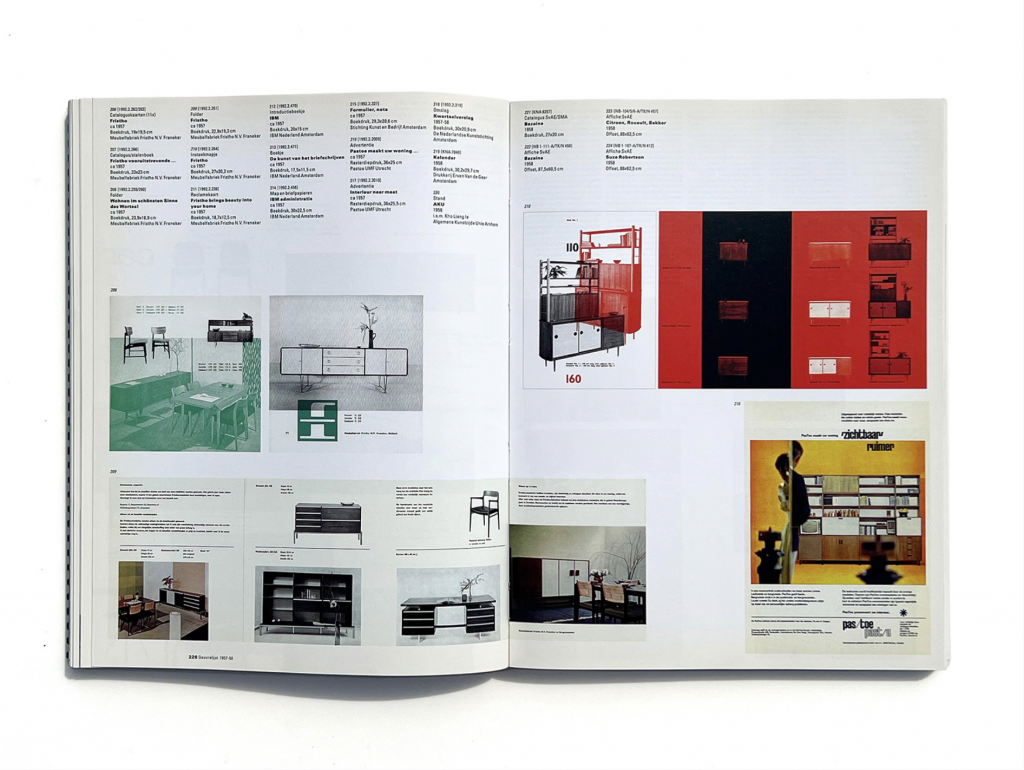
    Huygen, F. and Boekraad, H. C. (1997) Wim Crouwel: Mode en module. Rotterdam: 010 Uitgeverij.

    The publication is dominated by a contemporary visual language used to create an archival timeline of Wim Crouwel’s work (Huygen and Boekraad, 1997). There is a consistency to the page hierarchy and text placement, which ensures the legibility of the spread. The publication successfully balances the density of the academic references without overpowering the accompanying imagery. This balance will be paramount within my own archival work, as there is potential for the work becoming stuffy and overly-dense. 

    Fig. 1. Wim Crouwel: Mode en module.

    OK-RM (2023) 555: Revisiting The Fashion Archive of Francisco Costa. New York: Rizzoli.*

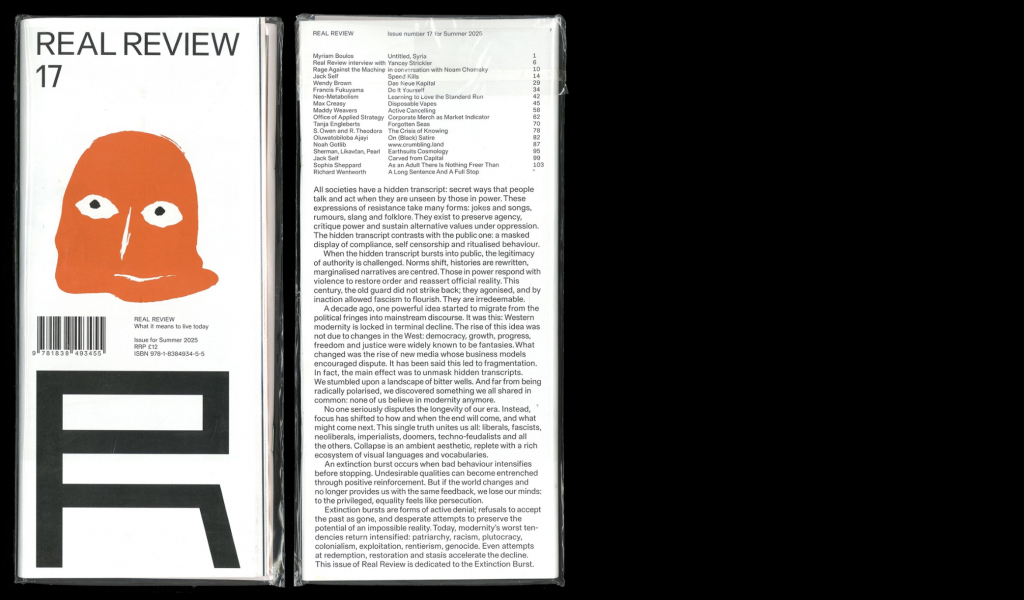
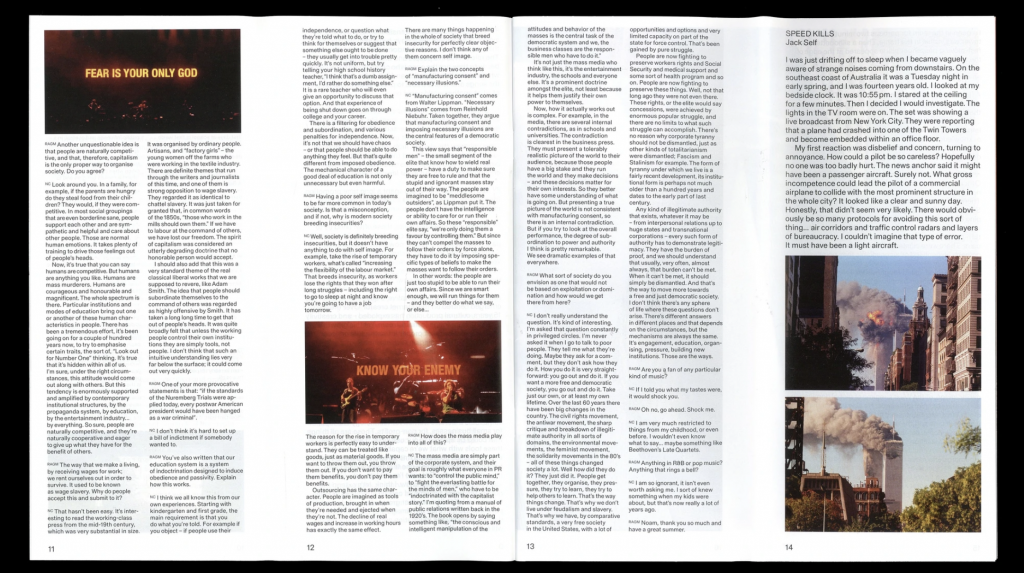
    Real Review (2025) Real Review. London: Real Review.


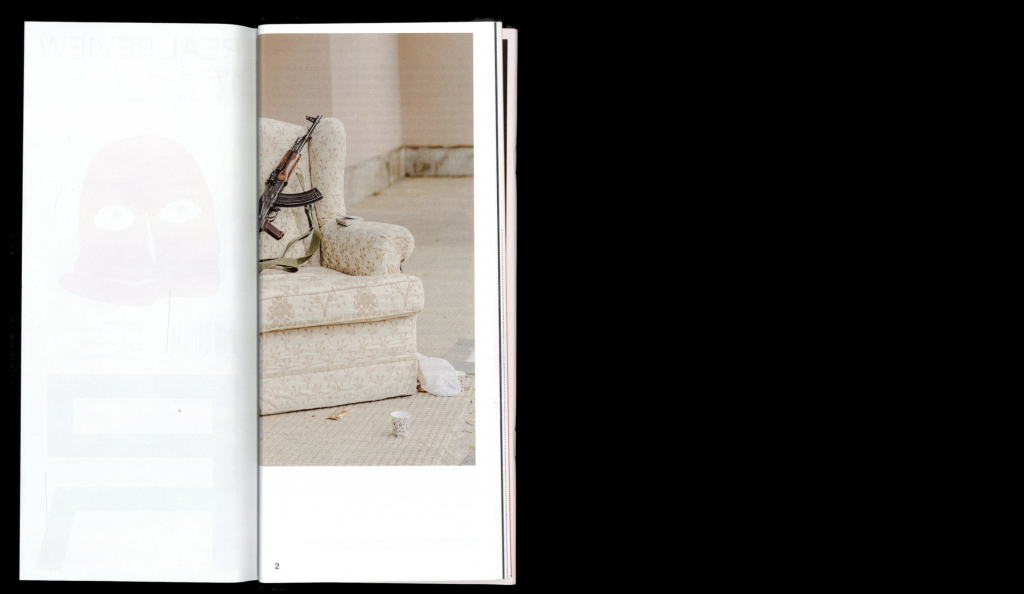
    Real Review is a ‘quarterly contemporary culture magazine’ (Real Review, 2025. Each edition of the magazine utilises an A3 double parallel fold. The publication is not formerly bound, allowing the pages to move freely and be reordered as the reader wishes. Impermanence within the construction of my own archival documents will allow the information to be manipulated by the user (the interpreter) so that they can glean their own insight into the history of The Stone Cottage.

    Fig. 2. Real Review.

    Shea, D. and OK-RM (2019) Ex Nihilo. London: InOtherWords.

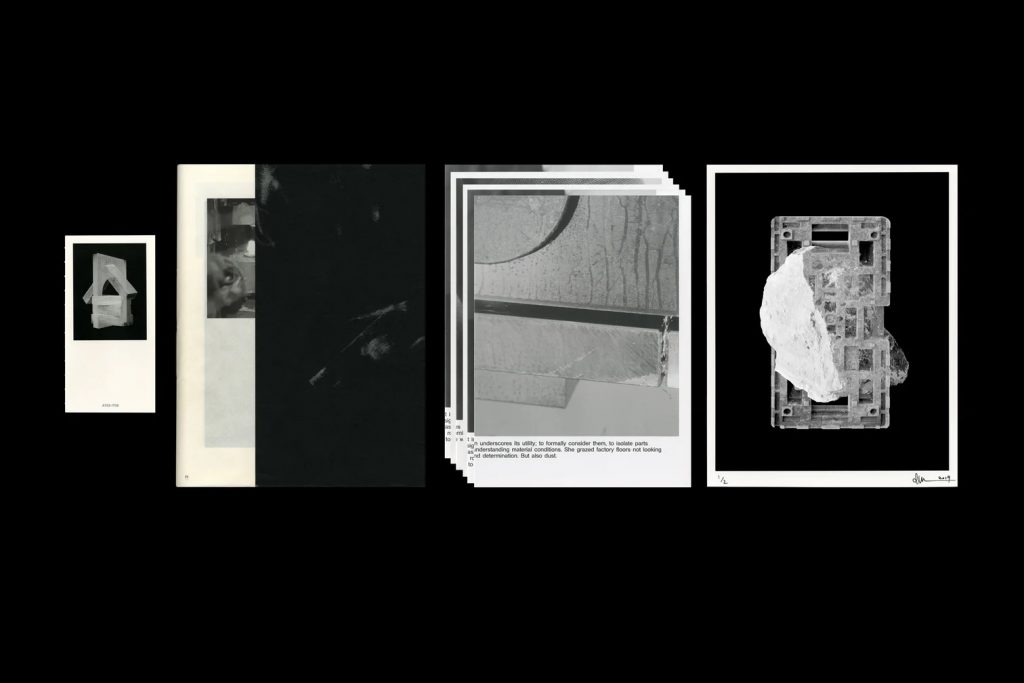
    Daniel Shea and OK-RM successfully combine a variety of material finishes within Ex Nihilo (2019). ‘The edition comprises a series of printed objects (a book, a set of six posters and a signature of plates) in a high-gloss folder secured with a rubber band. Each of the objects explore distinct formats, materiality and print techniques’ (Shea and OK-RM, 2019). The texture and visual language of each element of the publication has been considered and speaks to its content. The project focuses on the materiality and physicality of the work, utilising full bleed images with text that runs over the edge of the pages. Materiality within my archive will be paramount, as each document must communicate its provenance within the collection. I intend for the archive to sensitively communicate the nostalgia and memory of the lives lived in the rural west coast of Ireland, whilst simultaneously remaining engaging so that the user (the interpreter) palimpsestically positions the documents.

    Fig. 3. Ex Nihilo.

    Wolfgang Tillmans, I Didn’t Inhale (1997) [Exhibition]. Chisenhale Gallery, London. 7 July 1997 – 3 August 1997.*