DRAFT ONE
While you’re working on your copy, articulate (in writing) the key critical questions that emerge through this exploration. Discuss how the project that you’re copying raises these questions and write a proposal for a studio-based experiment that would allow you to explore them further.
The initial copying exercise saw a recreation of aspects of ‘Size, Format, Stock’ produced by Fenner Paper and Studio8 Design (2009). The publication was included within the Bookbinding Toolkit, provided by Central St Martins to every MA Graphic Communication Design student. The information within the publication was manipulated and divided into four explorations, each looking at a distinct bookbinding process. Elements of the graphical style of the Fenner Paper (2009) infozine were replicated, and the simple illustration style was adopted to visually represent the binding processes.
The iterative exercise of copying raised critical questions about the hidden labour of bookbinding. The craftsmanship and skill required for bookbinding cannot be seen in the final output, as the labour is concealed within the spine and gutter. Moreover, the bookbinders toolkit leaves no trace, thus exacerbating the elusiveness of the binder. This raised further questions about what is seen and what is left unseen. ‘Size, Format, Stock’ (Fenner Paper, 2009) does not address the handcraft aspect of bookbinding, and the binder themselves remains out of the conversation. Is a successful bookbind one that has no trace?
Dieter Rams’s ‘Ten Principles for Good Design’ (2021) suggests that ‘good design is unobtrusive’. Within the field of bookbinding, this seems to be the desired outcome. This notion of design being inconspicuous sits at odds with Rams’s sixth principle; that ‘good design is honest’. Can design be both unobtrusive and honest? How does this translate into the process of bookbinding?
It is impossible to uproot ‘Size, Format, Stock’ (Fenner Paper, 2009) from its original context; the Bookbinding Toolkit. Shared knowledge of bookbinding is therefore considered as a critical tool within the Bookbinding Toolkit. In an attempt to create honest design, the studio-based experiment will focus on revealing the tools that are used within the process of bookbinding. This process will attempt to unravel the fixed notions of bookbinding, and rebuild the process with an emphasis on celebrating the craftsmanship of the binder.
DRAFT TWO
Identify a reference from the reading list that you can use as a lens through which to view and analyse your project. Then create a second draft of your writing that advances your enquiry in response to this new context.
Ronald Barthes (1977) proposes the idea that the role of the author ceases to exist within his seminal work ‘The Death of the Author’. Barthes’s (1977) primary argument is that the author has been suppressed in the interests of writing. The notion that writing is the author’s cohesive voice is discredited, suggesting that we have entered an era where the role of the author is a steward of pre-existing texts. Barthes (1977) proposes that the author merely ‘holds together, in a single field, all the traces by which the text is constituted’.
Within my Methods of Iterating studio project, there has been an astute focus on the role of the binder. The tension between the craftsmanship and lack of trace of this craftsmanship within the process of bookbinding has been explored thus far. Barthes (1977) raises critical questions about whether the role author has been reduced to a curator. If the author’s sole duty is to ‘blend and clash’ (Barthes, 1977) others writing, then what does this mean for the role of the binder?
The binder weaves and stitches text into a coherent and sequential narrative: Is this not the same role as the author? Barthes (1977) reaches a climax within his argument stating: ‘the birth of the reader must be at the cost of the death of the author’. The concept that the author must die is rooted in the ongoing degradation of the role of the author to only a curator. If this logic if applied to my studio brief, then one could say that the role of the author as a curator also must die, to enable the craftsmanship of the binder to flourish. If the binder is reinstated as an important figure within society, then there is no demand for the author.
The birth of the reader must be at the cost of the death of the author, on condition of the resurrection of the binder.
Furthermore, Barthes (1977) highlights that ‘in the multiplicity of writing, everything is to be disentangled, nothing deciphered’. Writing has become a linear expression of an interwoven mesh of others ideas. If this were not the case, how would the reader decipher the writing? If knowledge is not granted, then the text will be constrained. The reader will have to understand, scrutinise and interpret the writing for themselves. The notion of constraint is a key theme explored within my studio project, Methods of Iterating. The process of binding conceals and reveals different aspects of the information shared; a constraint on knowledge.
DRAFT THREE
For the third draft of your written response, render your text using the tool or medium that you’ve been exploring during this project. This is both a visual and intellectual exercise. How does the text and its meaning change when you translate it in this way?
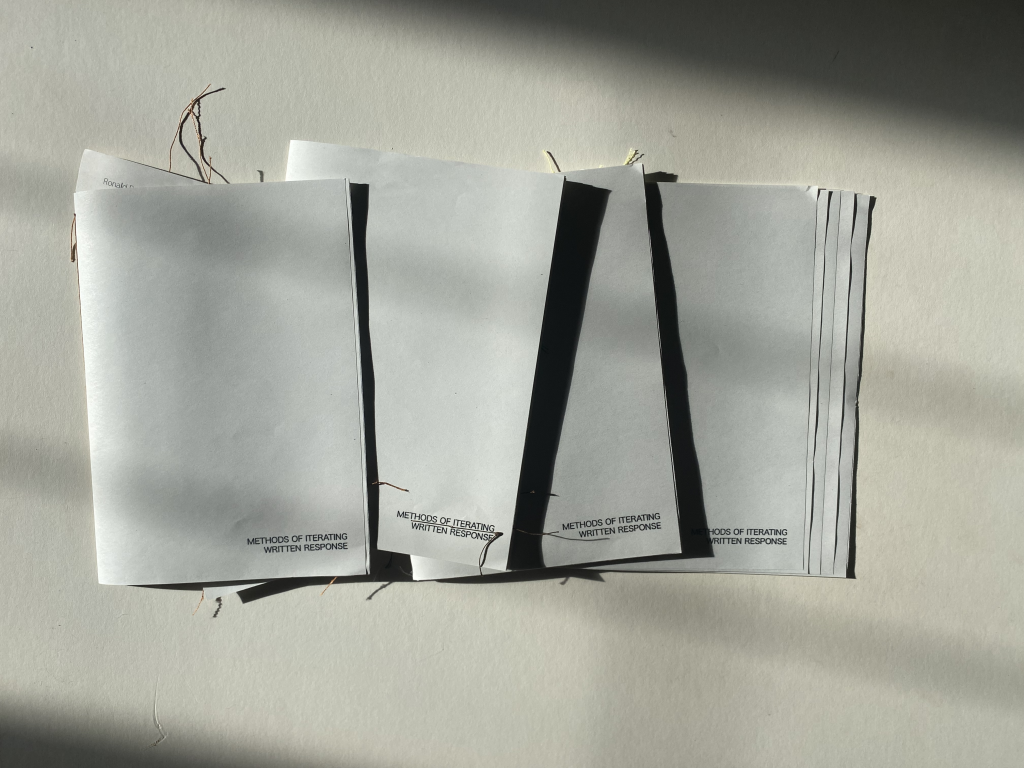
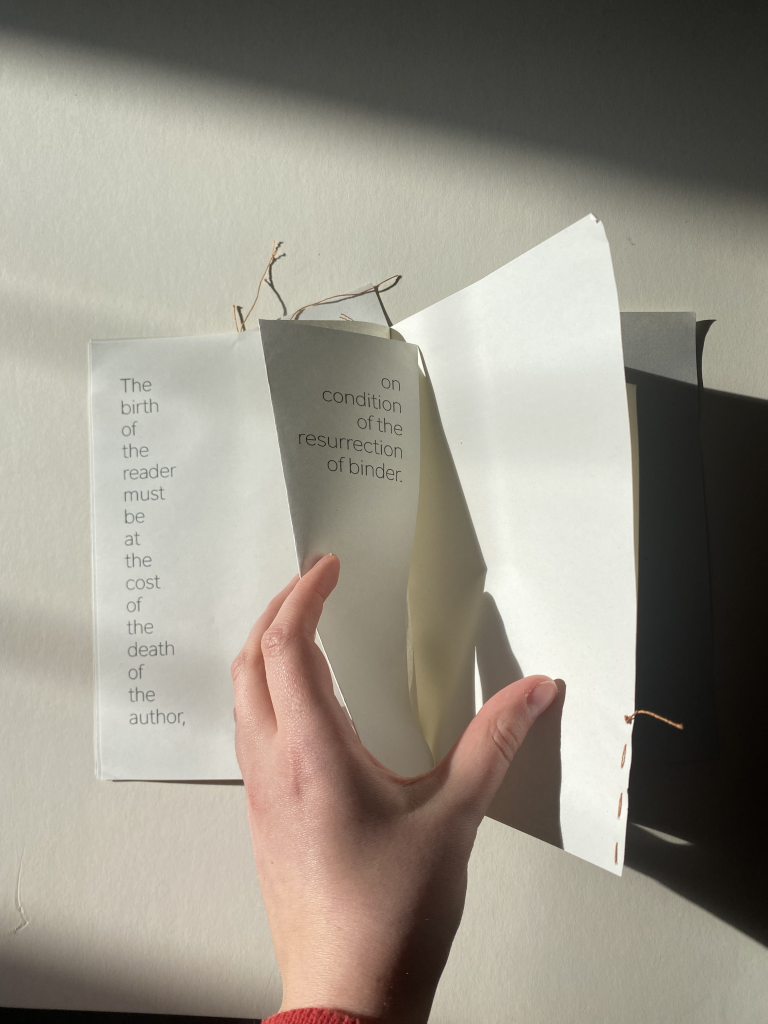
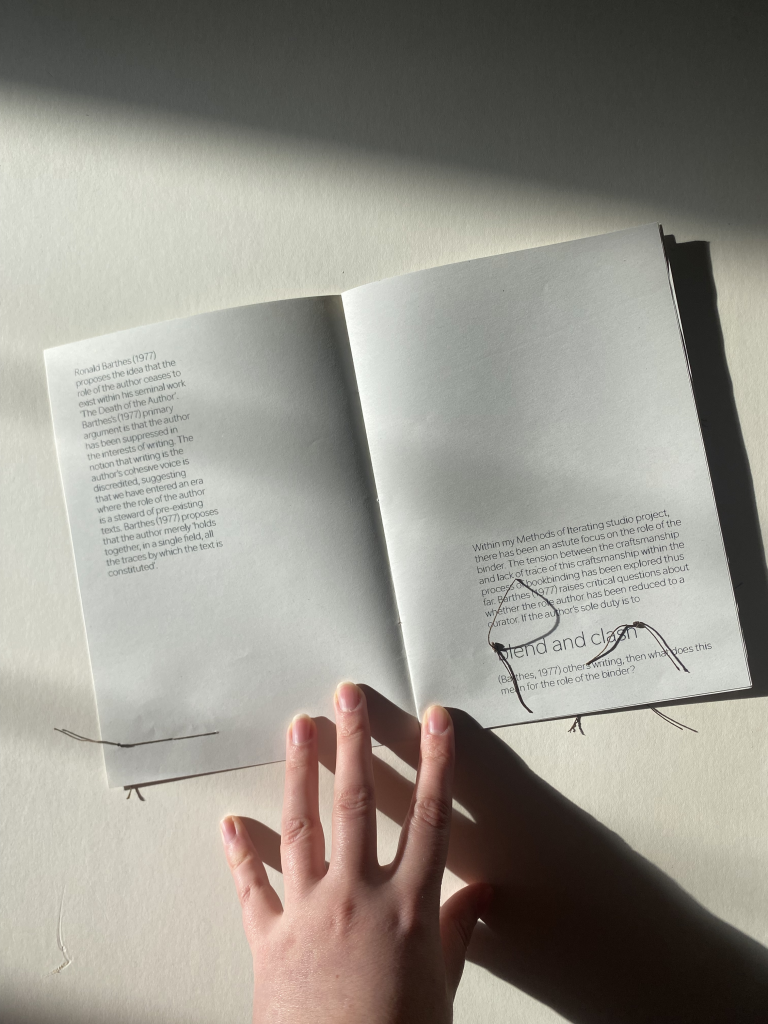
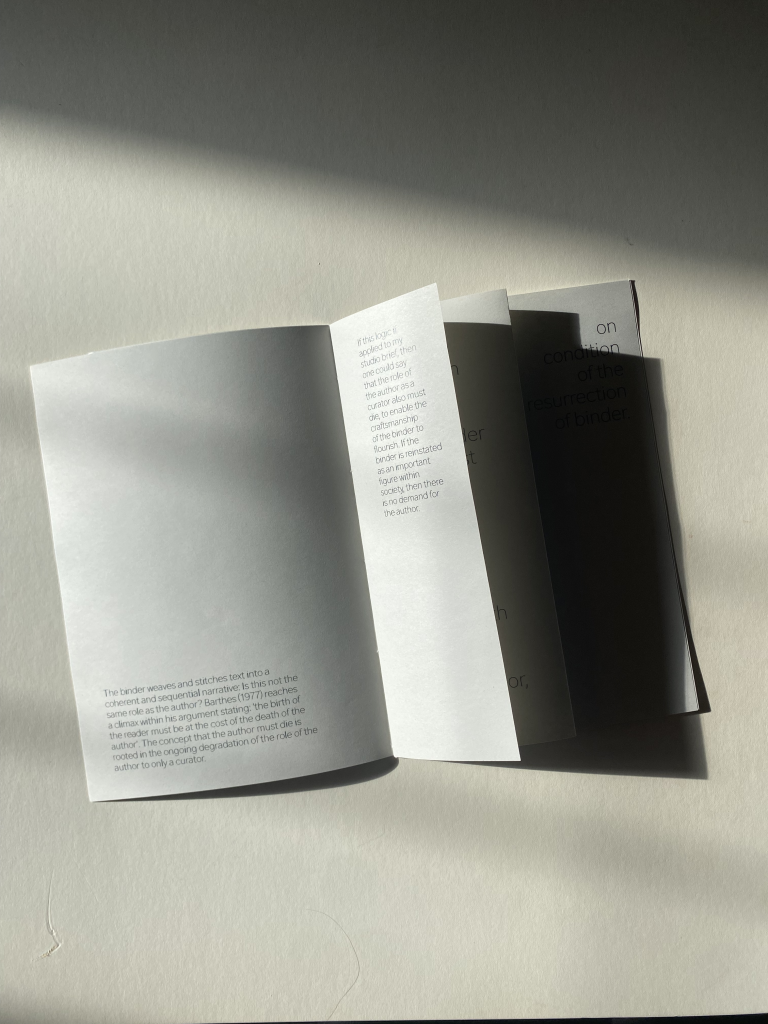

For the third draft of my written response, I rendered the second draft of text using the process of bookbinding. Similarly to all my other experiments through the Methods of Iterating project, the binding process exclusively used the equipment included within the CSM Bookbinding Toolkit.
The text was stitched together four times, each correlating to the terms which I have discovered to be bound within the process of bookbinding: constraint, friction, sequence and trace. This iterative experiment plays with the parameters that define bookbinding, disturbing with the readability of the text as different elements are concealed and revealed.
The rendering reinforces the notion that constraint, friction, sequence and trace are bound outcomes within bookbinding, whilst simultaneously scrutinising the meaning of these terms. The fixed outcomes have been reimagined to produce a binding that is no longer conventional. Does that these outcomes are no longer bound?
Reference List:
Barthes, R. (1977) ‘The Death of the Author’ in Image, Music, Text. London: Fontana Press, pp. 143-148.
Fenner Paper. (2009) Size, Format, Stock. Tonbridge: Fenner Paper.
Rams, D. (2021) Ten Principles for Good Design. Munich: Prestel Publishing.
Leave a Reply