Category: Unit 1: Methods

  • Week 3 (& Week 4) Process


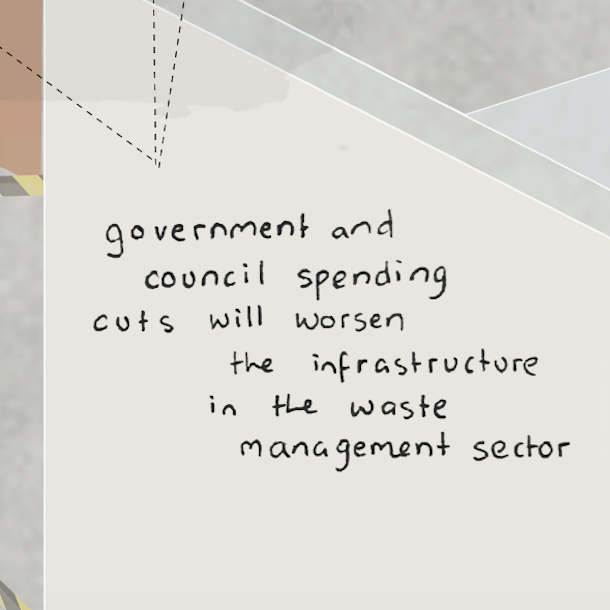
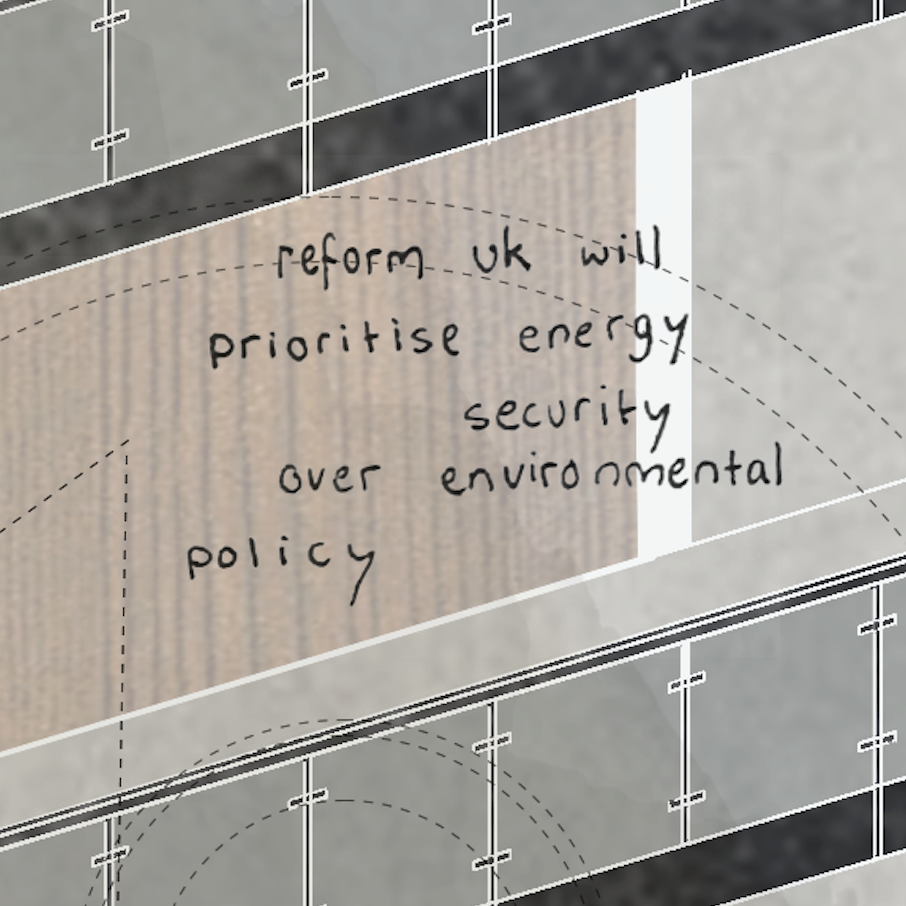
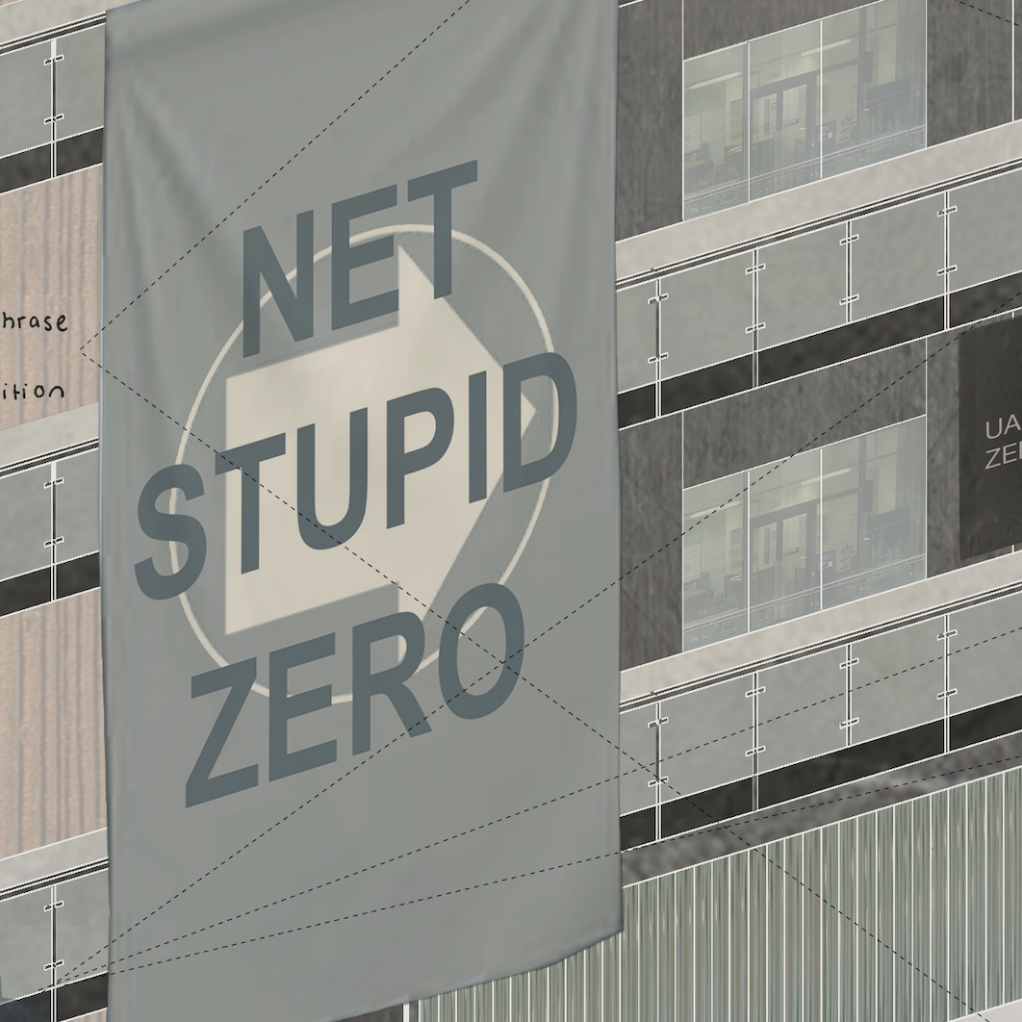
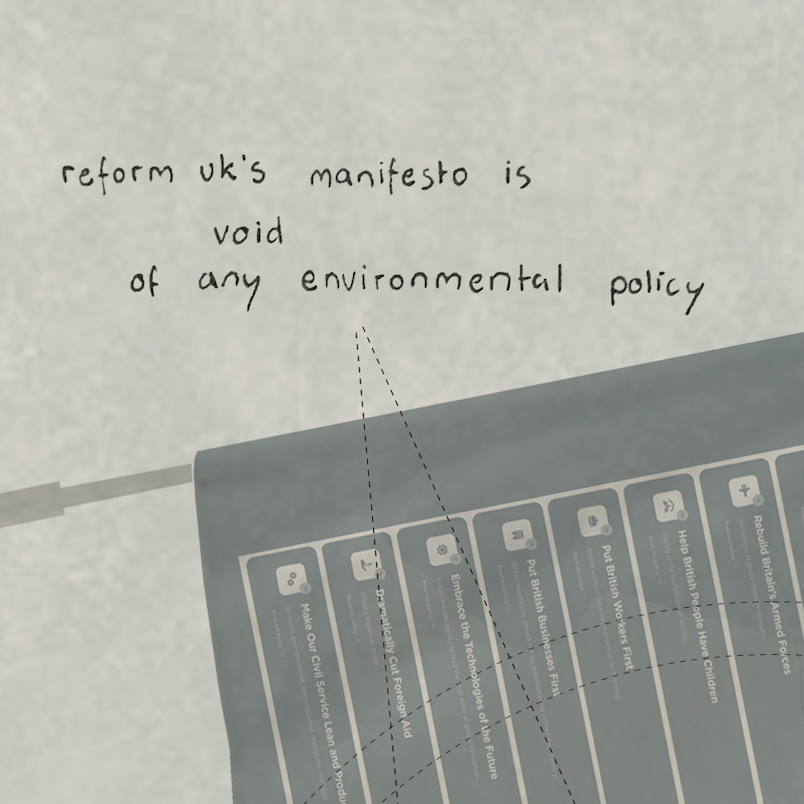
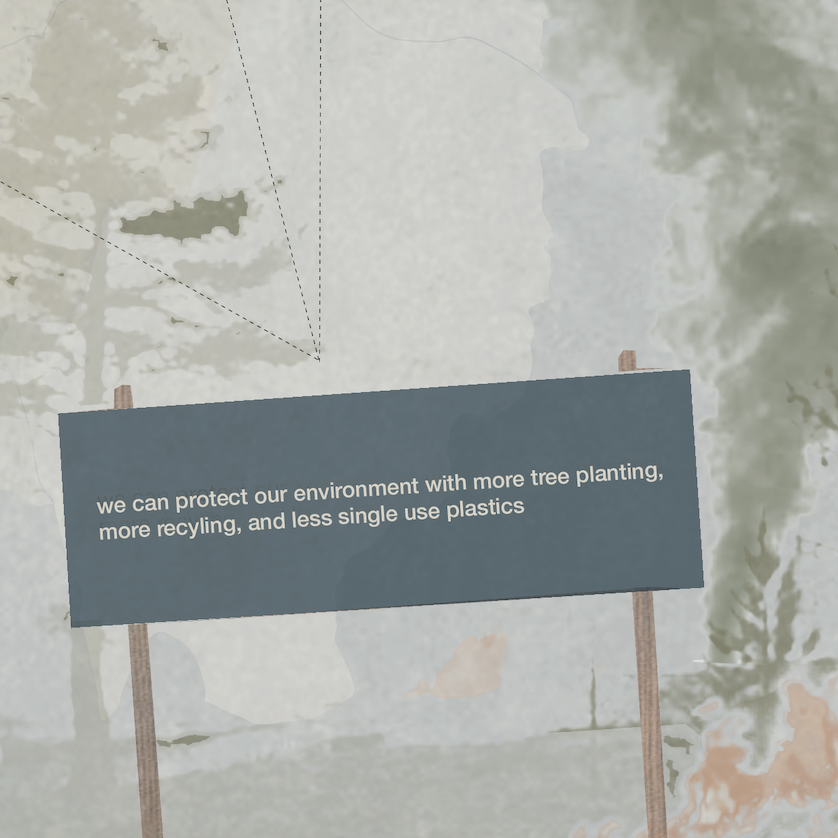
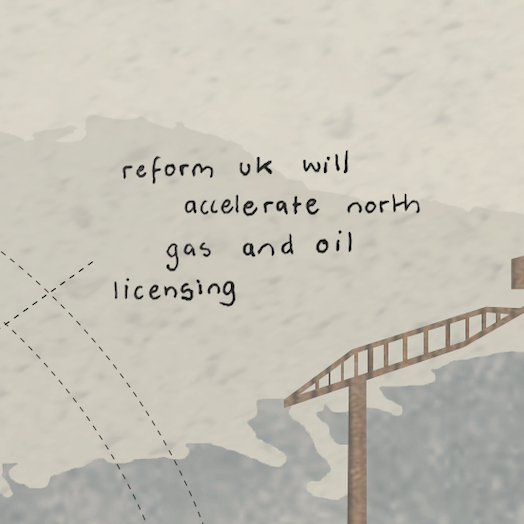
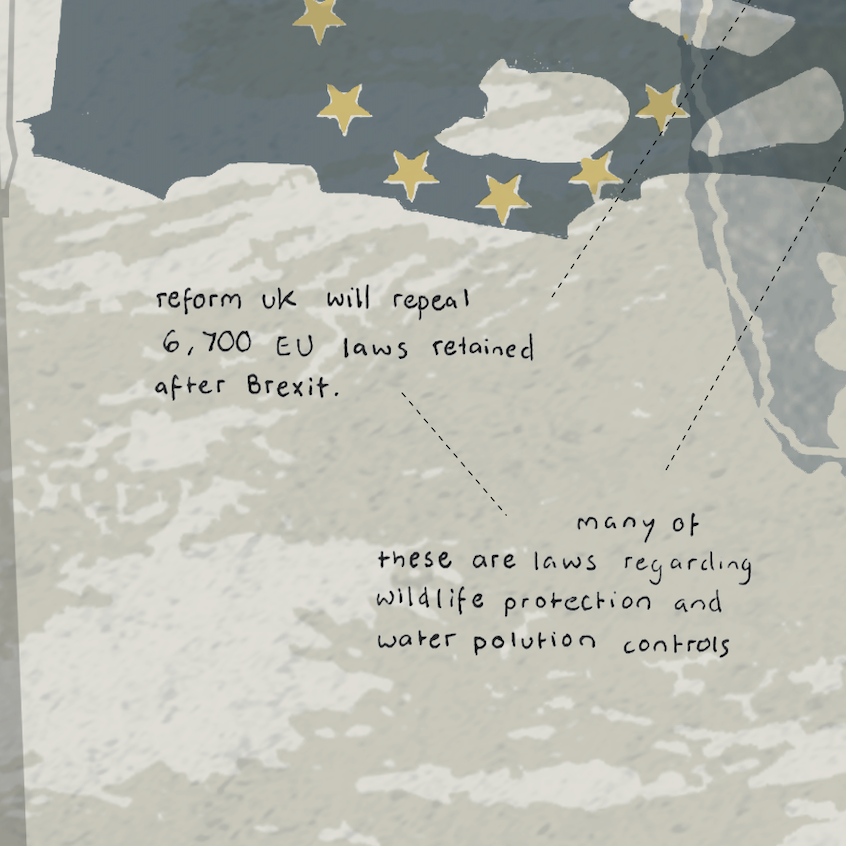
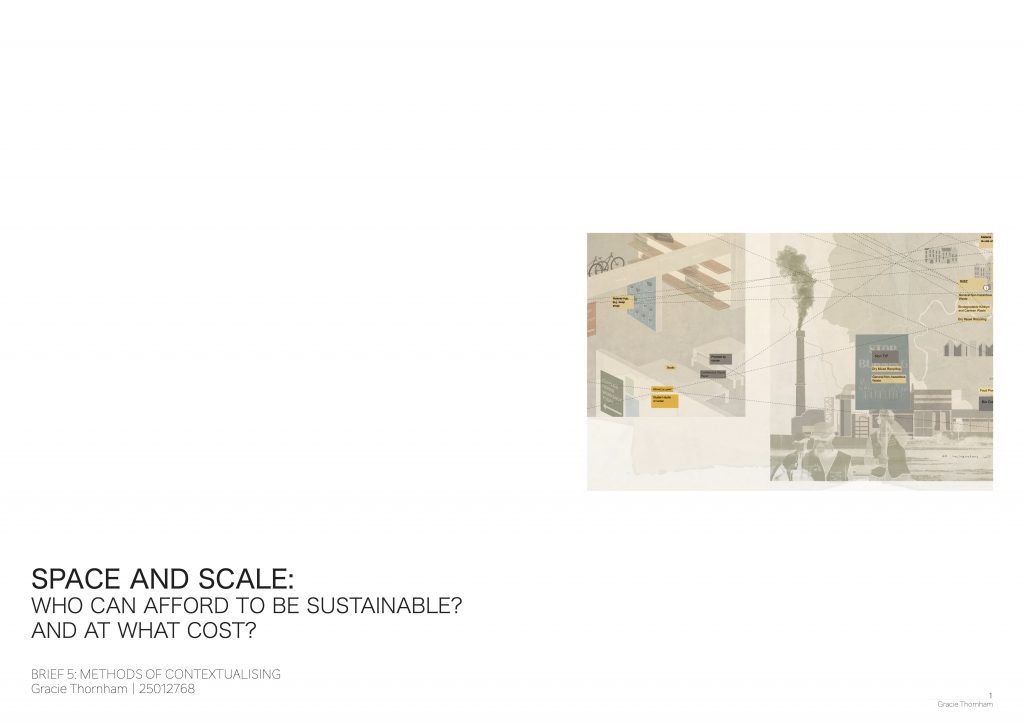
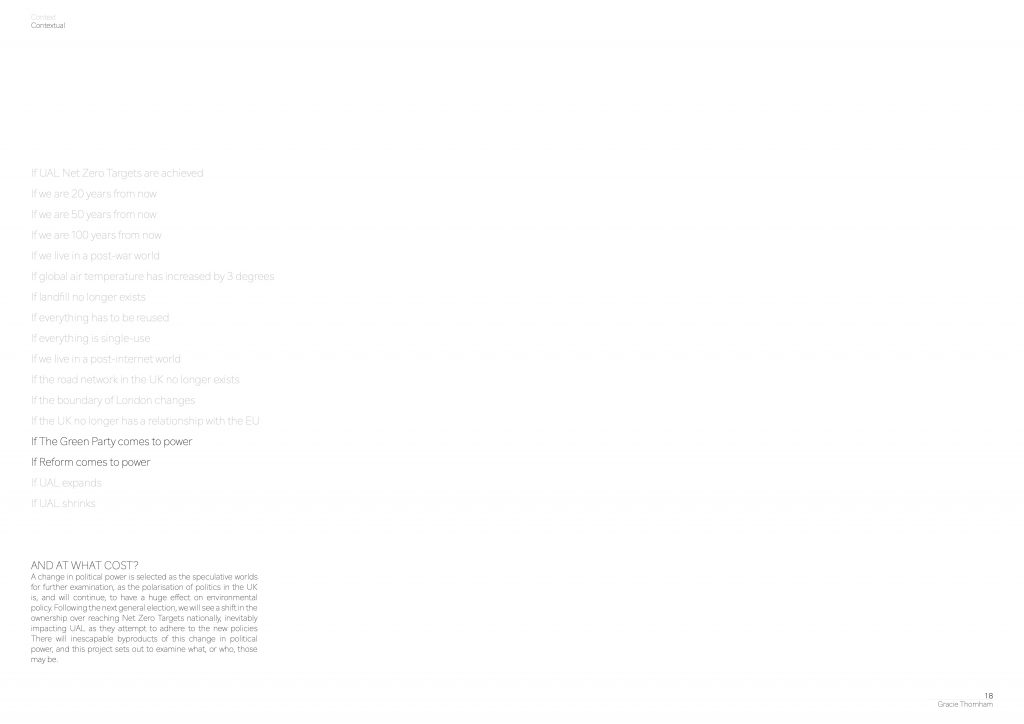
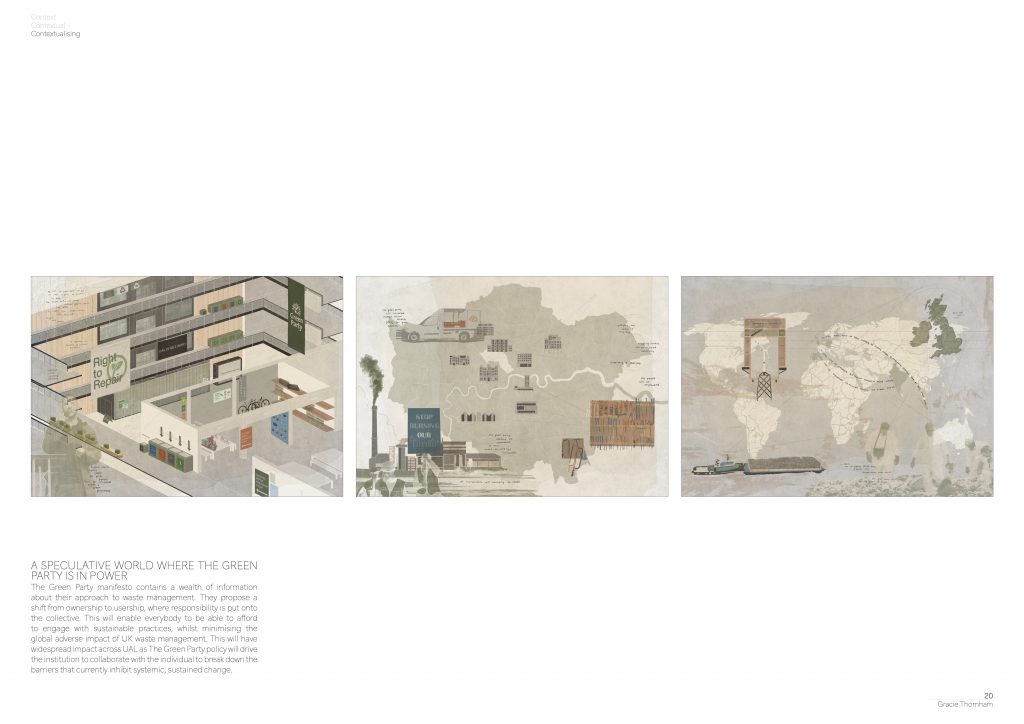
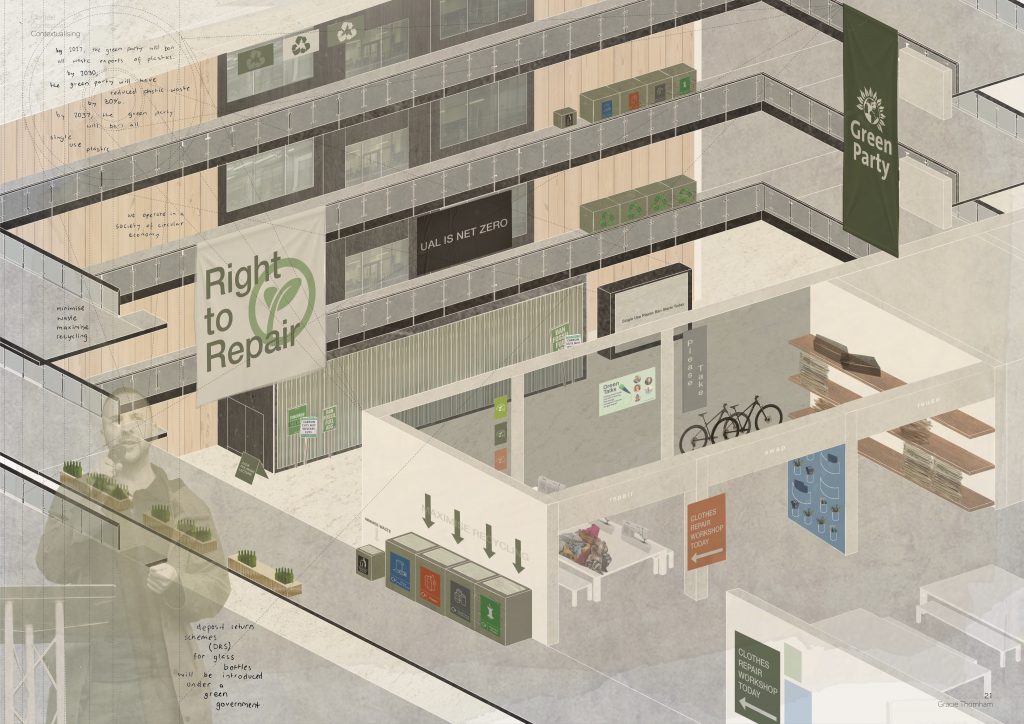
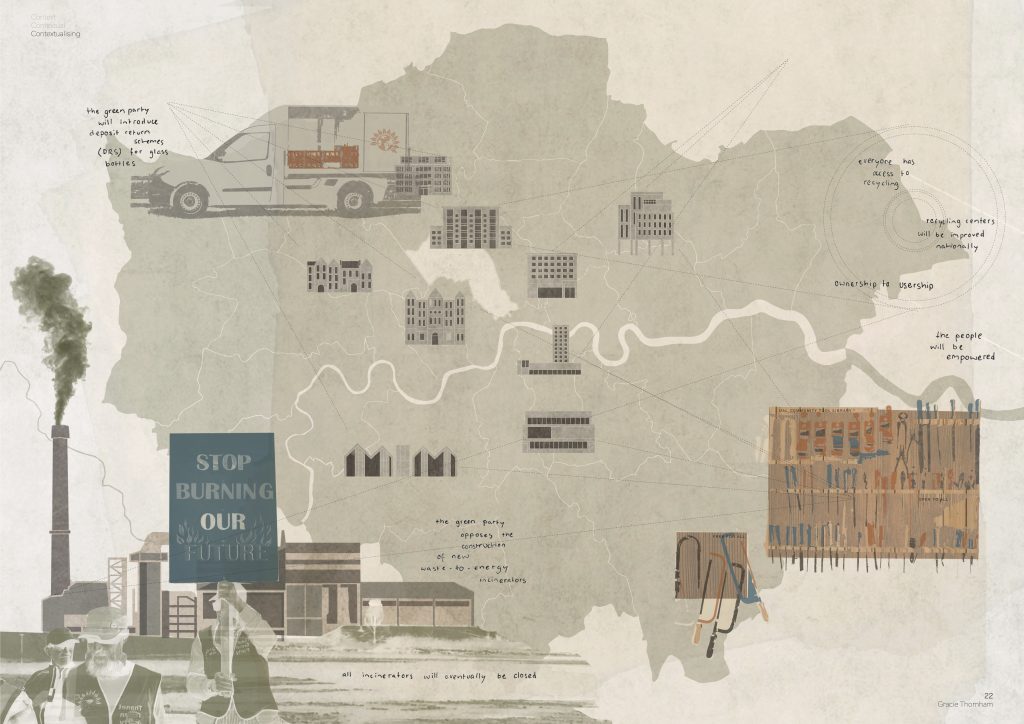
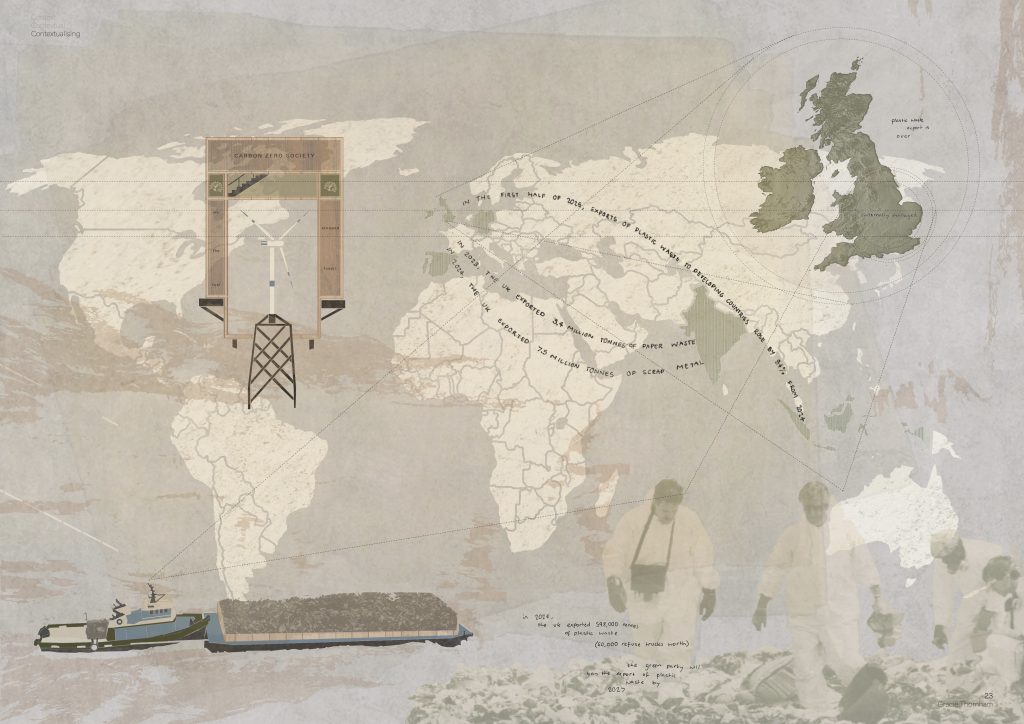
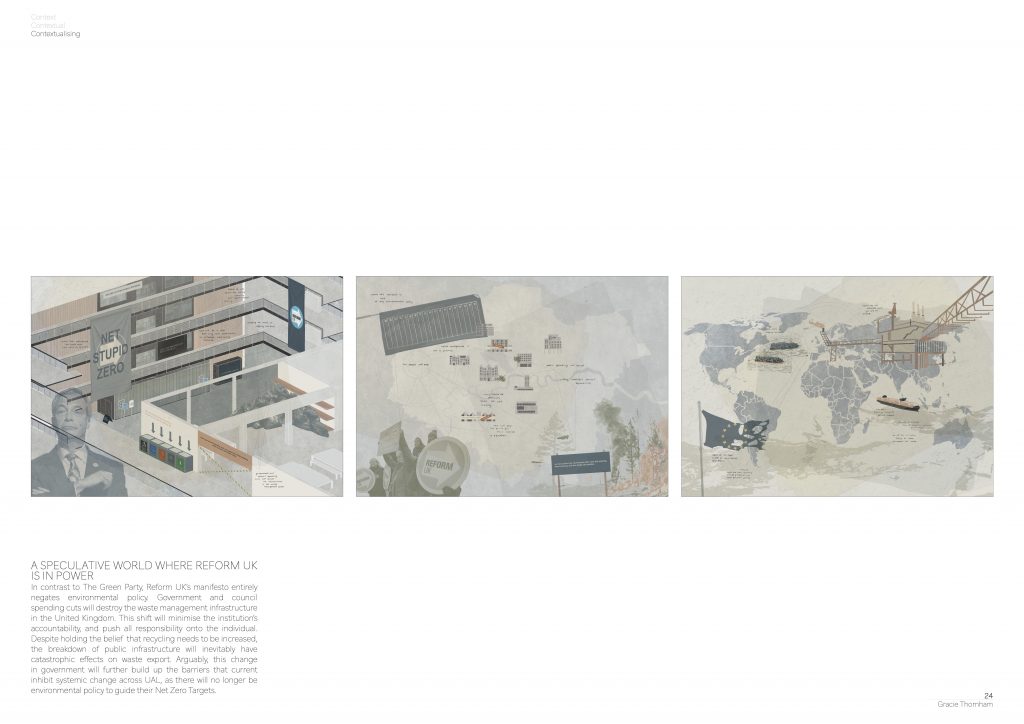
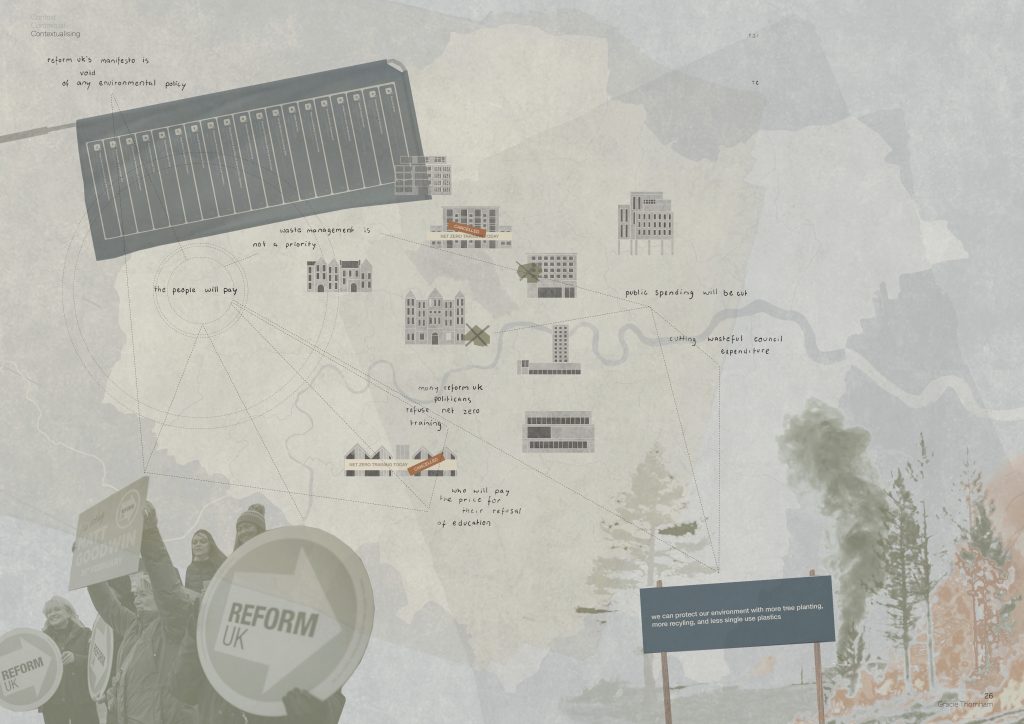
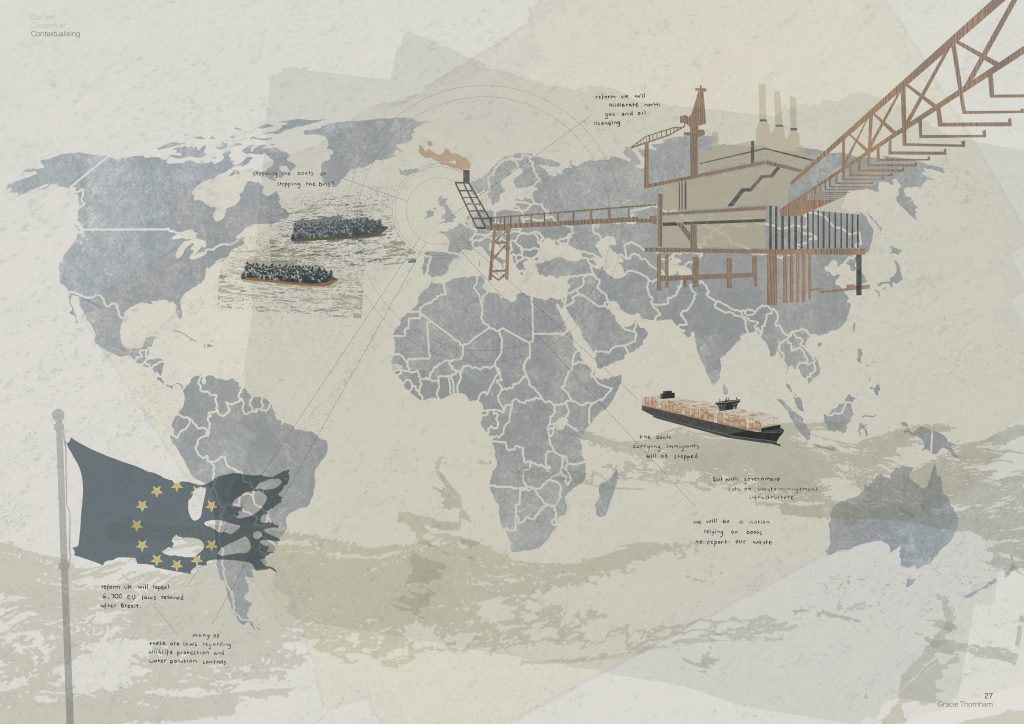
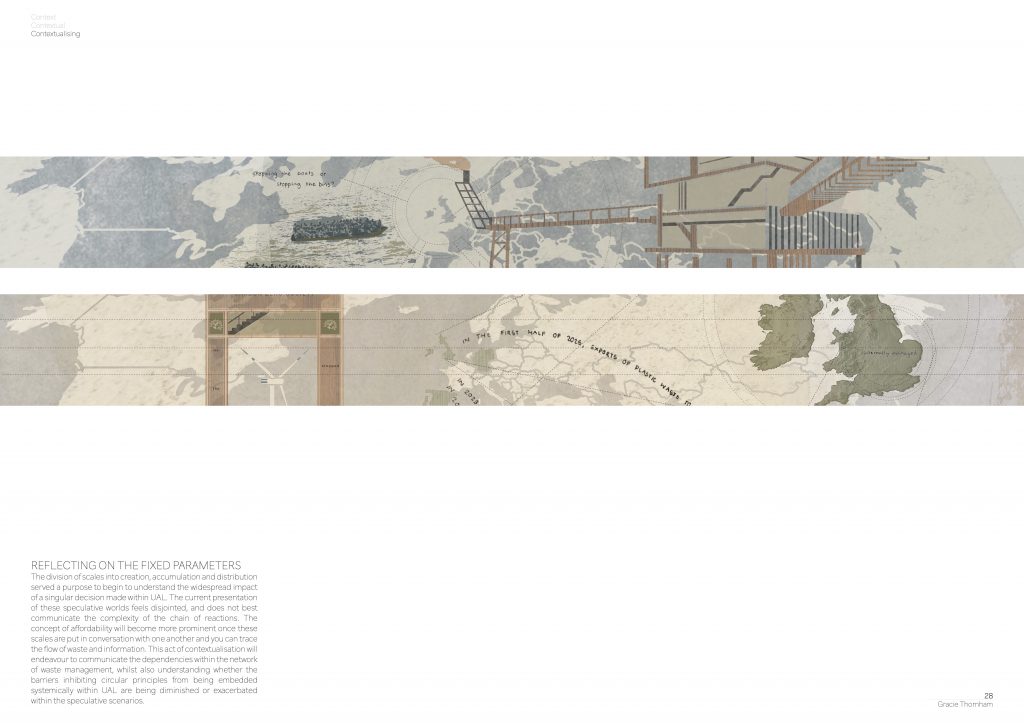
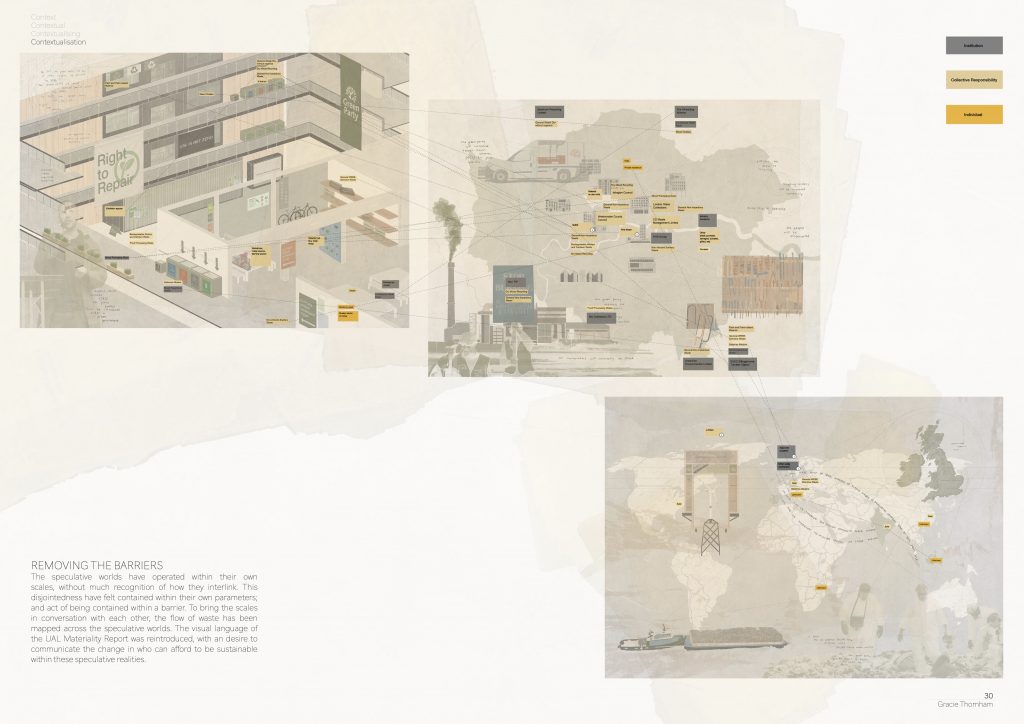
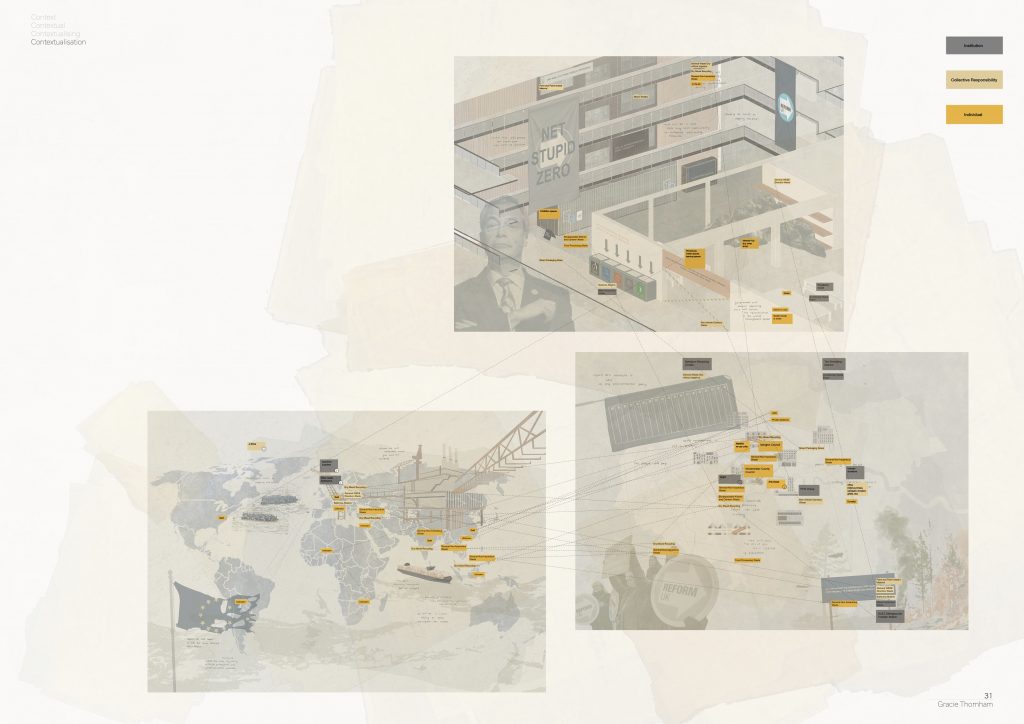
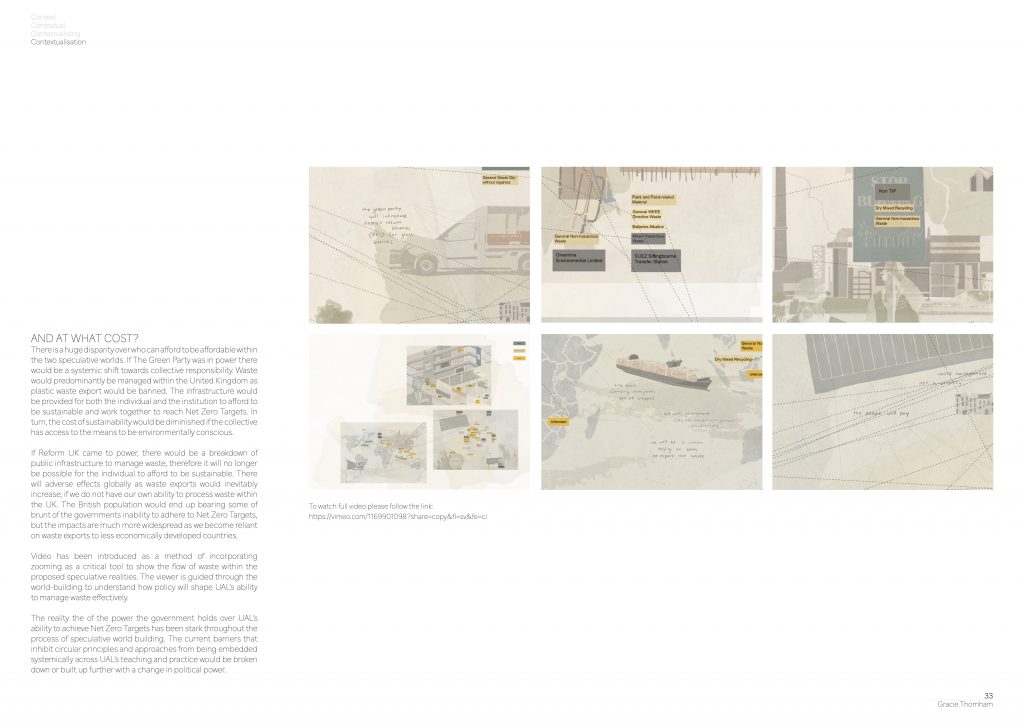
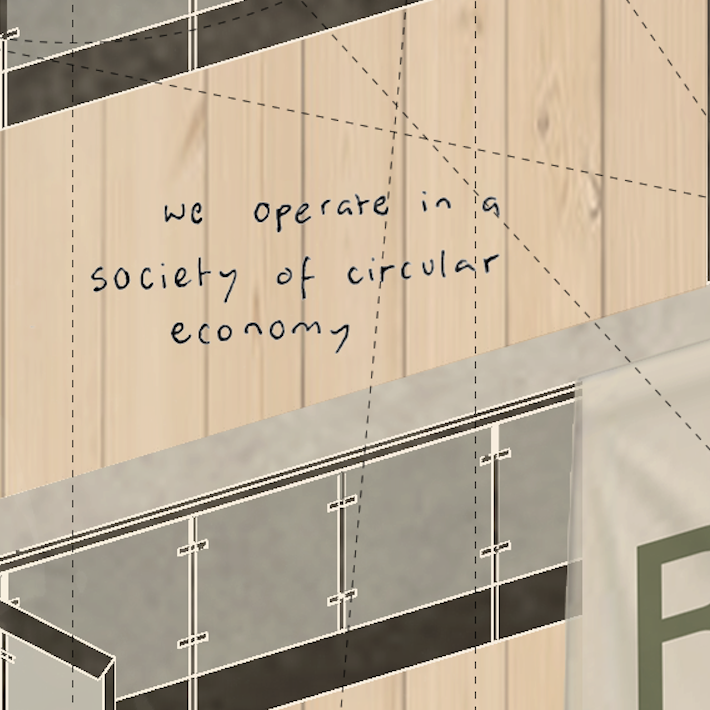
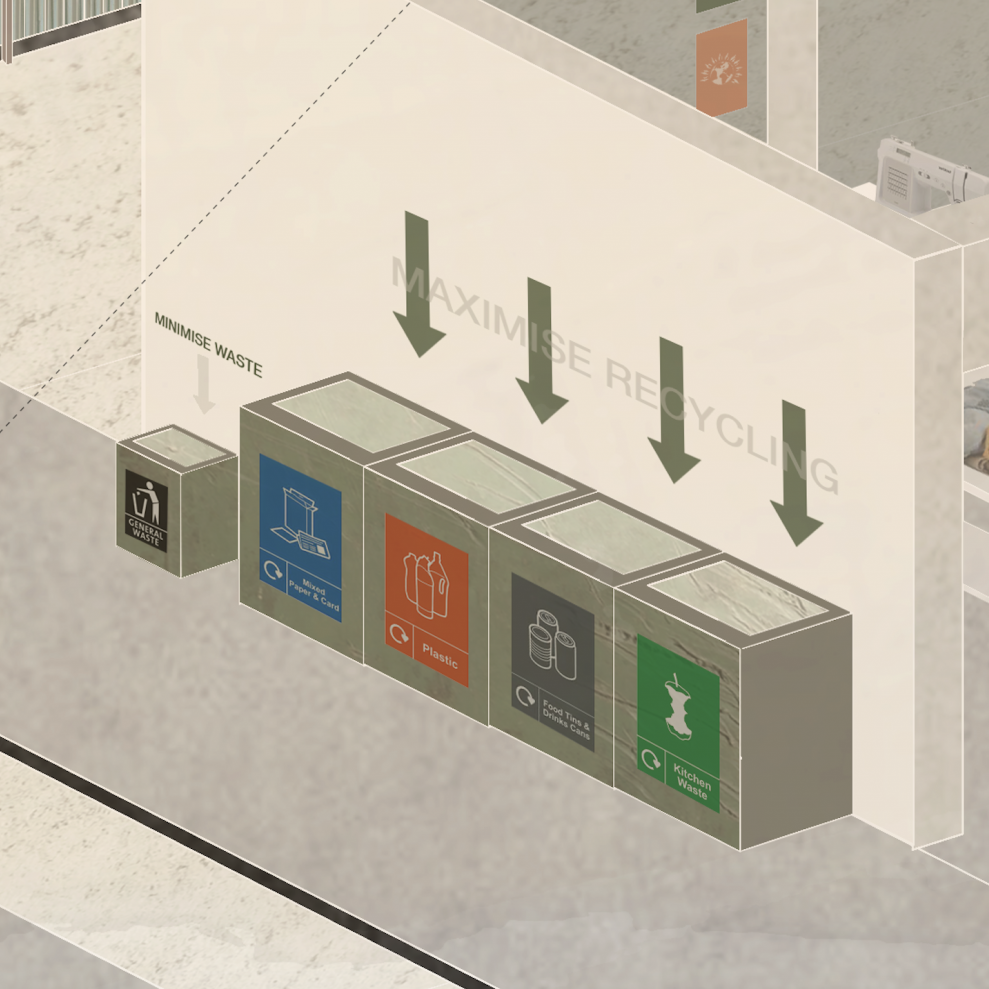
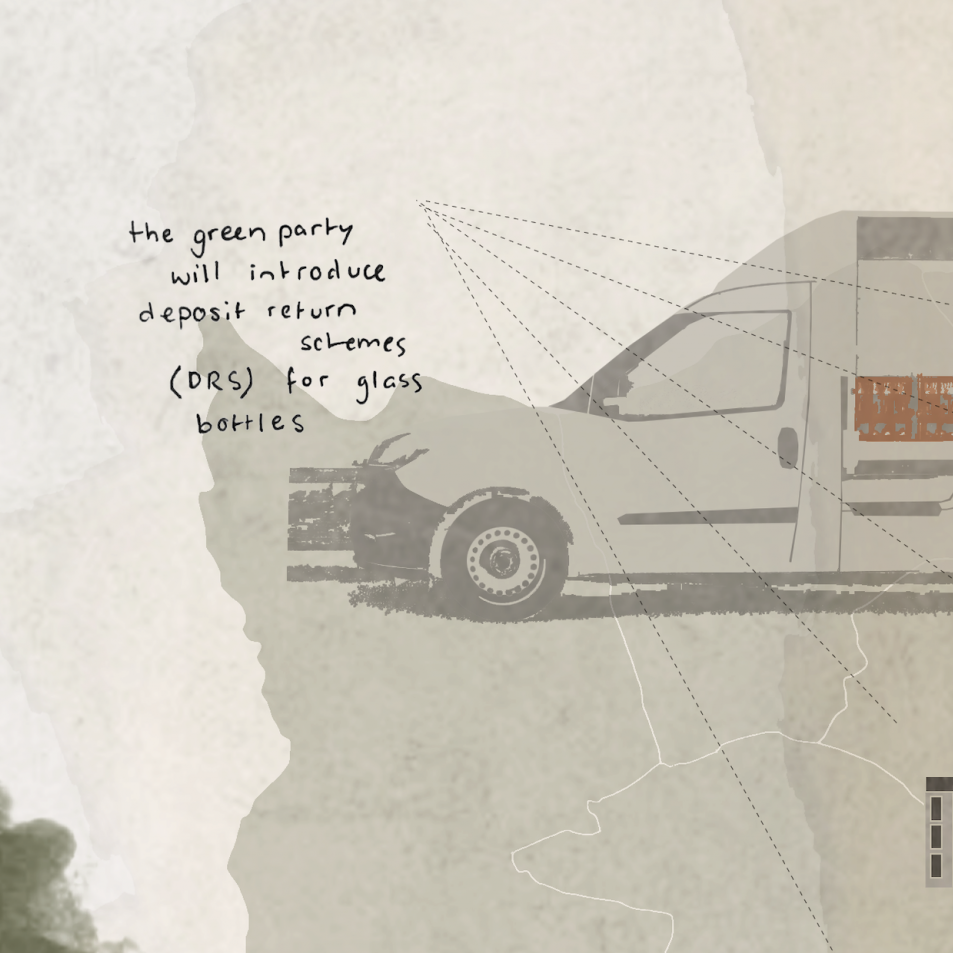
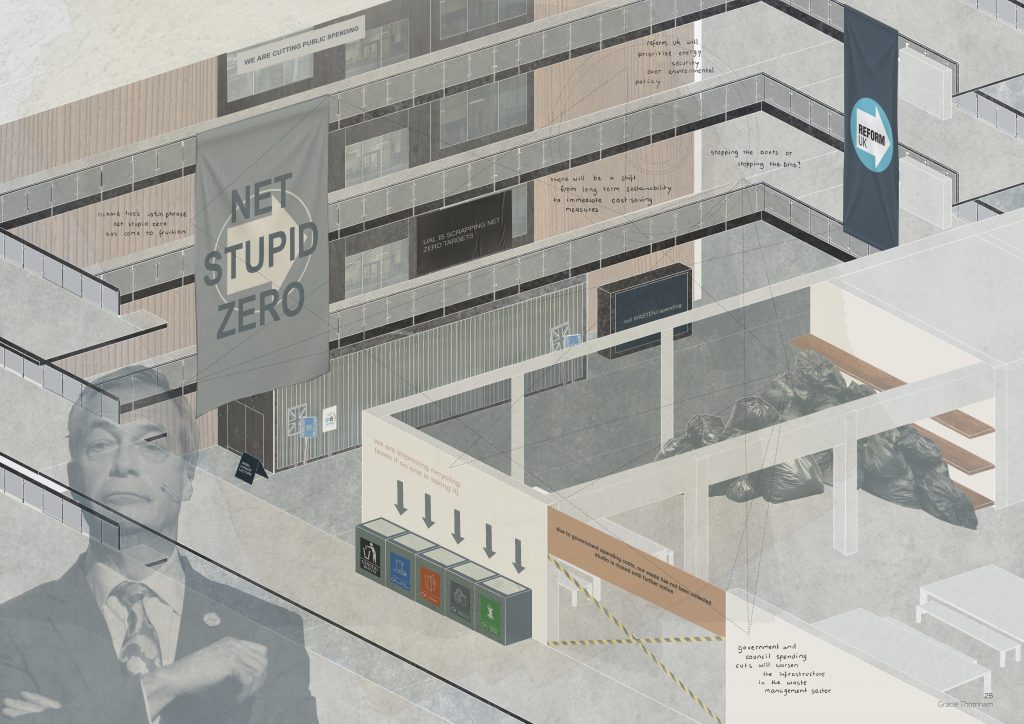
    To ground my speculative worlds in the current political climate, I thoroughly researched Green Party’s and Reform UK’s political manifestoes. In this blog post I have mapped how this has translated onto my speculative world illustrations. 

    GREEN PARTY:


    Circular Economy: ‘Green MPs will advocate for a circular economy that reduces the waste of resources’ (Green Party, 2024).


    Minimise Waste, Maximise Recycling: ‘Volumes minimised and recycling maximised. Prioritise reduction of waste and maximise recycling’ (Green Party, no date).


    Deposit Return Schemes: ‘implementing an all-in Deposit Return Scheme (DRS) for recycling and reuse’ (Clarity, 2025).


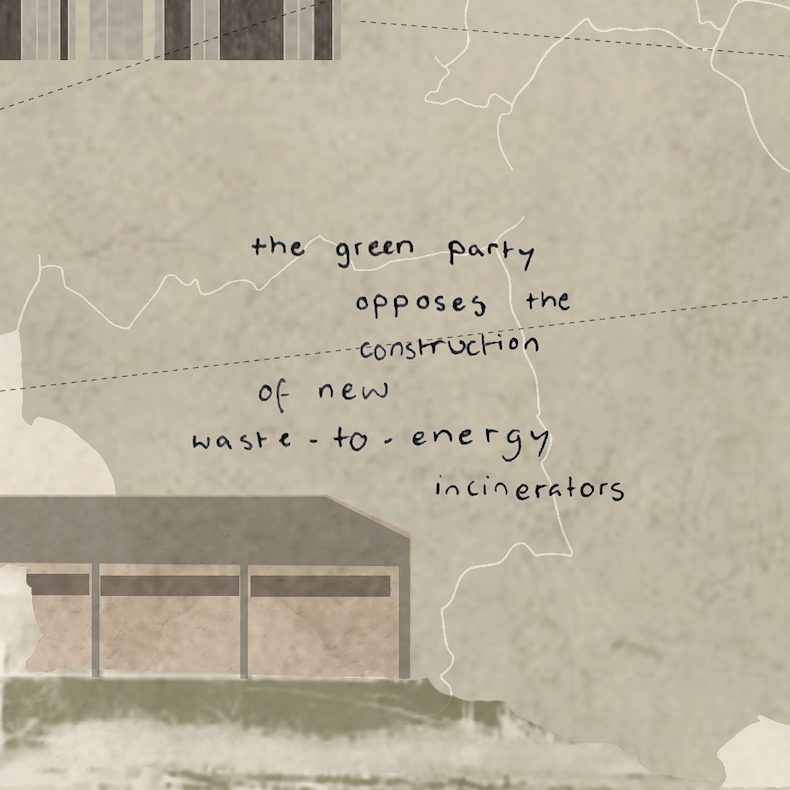
    Opposes construction of new waste-to-energy incinerators: ‘Greens say “no more incineration” of waste’ (Green Party, 2024).


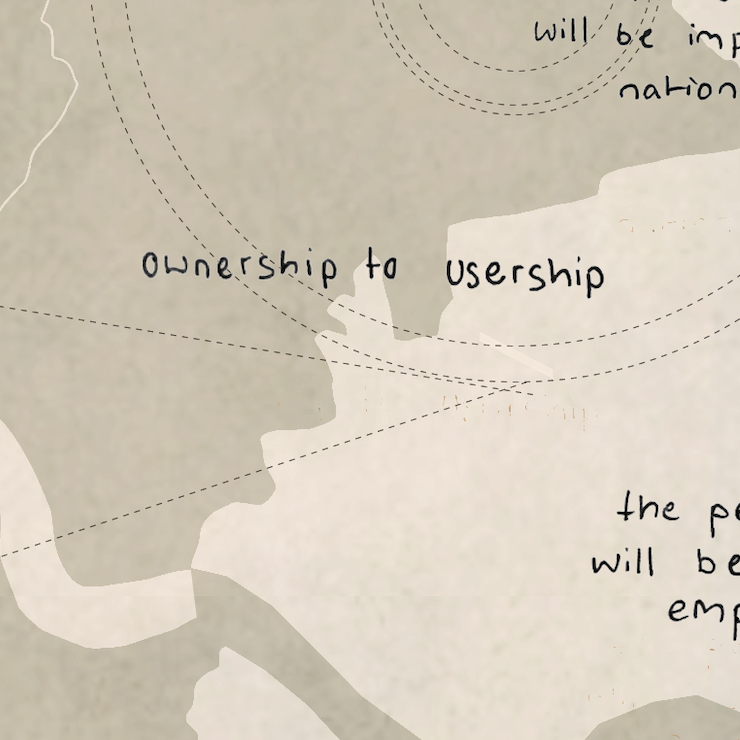
    Ownership to Usership: ‘The Green Party is committed to the public ownership of public services, so they are run to serve us all, rather than to increase the wealth of shareholders’ (Green Party, no date).


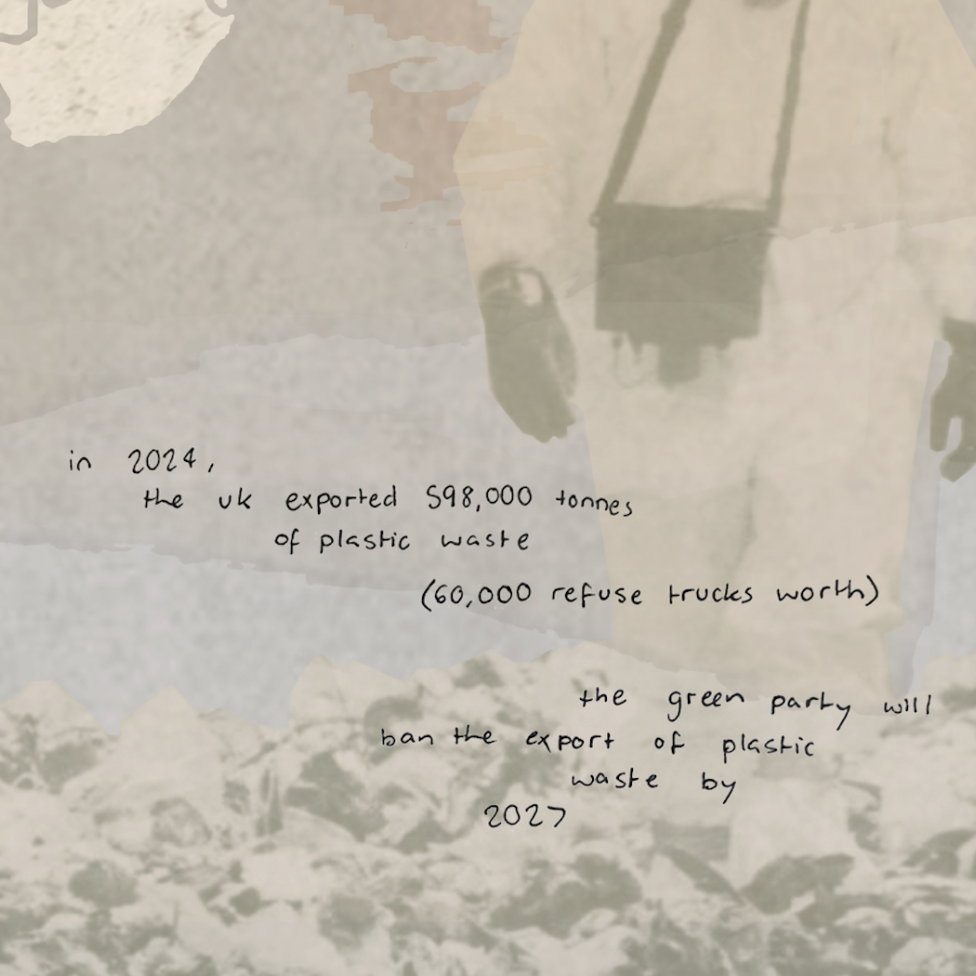
    Waste Export of Plastic Ban: ‘Alongside this, commit to a complete ban on all plastic waste exports by 2027 at the latest, and ending approvals for new incineration facilities’ (Green Party, 2024).


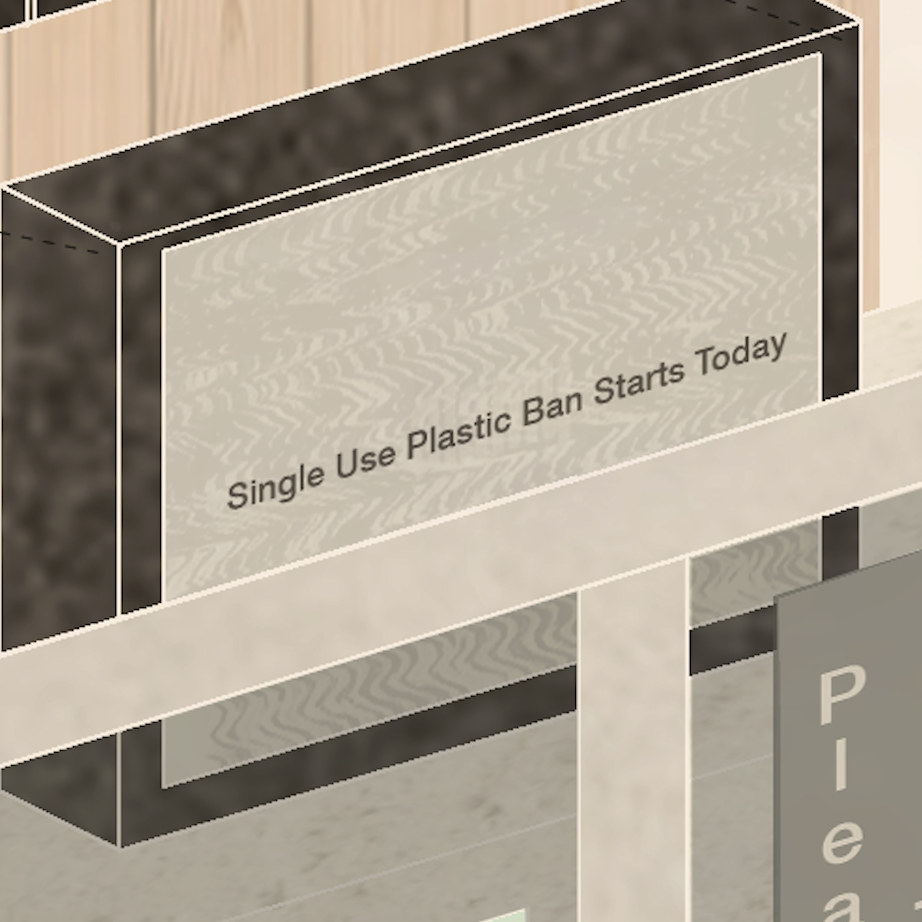
    Decreasing Single-Use Plastic: ‘We will also increase the scope of bans on the production of single-use plastics’ (Green Party, 2024).

    REFORM UK:


    Government and Council Spending Cuts: ‘Deputy leader Richard Tice said the party would need to cut “wasteful government spending” and “useless regulations” (Chartered Institution of Tax, 2025).


    Prioritise Energy Security: ‘Reform UK will prioritise energy security, expand domestic energy production, and scrap policies that drive bills higher while making Britain more dependent on foreign energy’ (Reform UK, no date).


    Net Stupid Zero: ‘Reform would scrap ‘net stupid zero’ policies’ (BBC, 2025).


    Manifesto void of Environmental Policy: ‘Our Policies’ (Reform UK, no date).


    Net Zero Alternative: ‘They state that instead of net zero, we can protect our environment with “more tree planting, more recycling and less single use plastics”’ (Greenpeace, no date).


    Accelerate North Sea Gas and Oil Licensing: ‘Start fast-track licences of North Sea gas and oil’ (Greenpeace, no date).


    Repeal EU Retained Laws: ‘Legislate to Scrap EU Regulations with Immediate Effect. Britain still has over 6,700 retained EU laws, which we will rescind’ (Greenpeace, no date).

    Reference List:

    BBC (2025) Reform would scrap ‘net stupid zero’ policies – Tice. Available at: https://www.bbc.co.uk/news/articles/c62k75qp1edo. (Accessed 3 March 2026).

    Chartered Institution of Tax (2025) Reform UK: Party drops radical tax cut commitment. Available at: https://www.tax.org.uk/reform-uk-tax-nov25. (Accessed 3 March 2026).

    Clarity (2025) What are the Main Political Parties’ Stances on Packaging EPR?. Available at: https://clarity.eco/environment/what-are-the-main-political-parties-stance-on-packaging-epr/. (Accessed 3 March 2026).

    Green Party (no date) Creating a Fairer, Greener Economy. Available at: https://greenparty.org.uk/about/our-manifesto/creating-a-fairer-greener-economy/. (Accessed 3 March 2026).

    Green Party (2024) Greens say “no more incineration” of waste. Available at: https://greenparty.org.uk/2024/10/15/greens-say-no-more-incineration-of-waste/. (Accessed 3 March 2026).

    Green Party (2024) Manifesto for a Fairer, Greener Country. Available at: https://greenparty.org.uk/app/uploads/2024/06/Green-Party-2024-General-Election-Manifesto-Long-version-with-cover.pdf. (Accessed 3 March 2026).

    Green Party (no date) Torridge Green Party Local Manifesto. Available at: https://torridge.greenparty.org.uk/about-us/883-2/. (Accessed 3 March 2026).

    Greenpeace (no date) Reform manifesto: a contract with the polluters. Available at: https://www.greenpeace.org.uk/resources/reform-manifesto-analysis/. (Accessed 3 March 2026).

    Reform UK (no date) Our Policies. Available at: https://www.reformparty.uk/policies. (Accessed 3 March 2026).

  • Prompt Five

    PART ONE

    A statement that articulates how your group’s explorations helped you to reflect on, deepen, or shape your own position as a practitioner in context of climate justice and the UAL Net Zero plan (being as specific as possible).

    The group project has been an equally reflective and expansive personal exercise in shaping my own position as a practitioner in the context of climate justice. Following the end of the group project, I have pursed an individual investigation to deepen the critical commentary with an impetus to reach a greater level of cohesion and conclusion within the body of work.

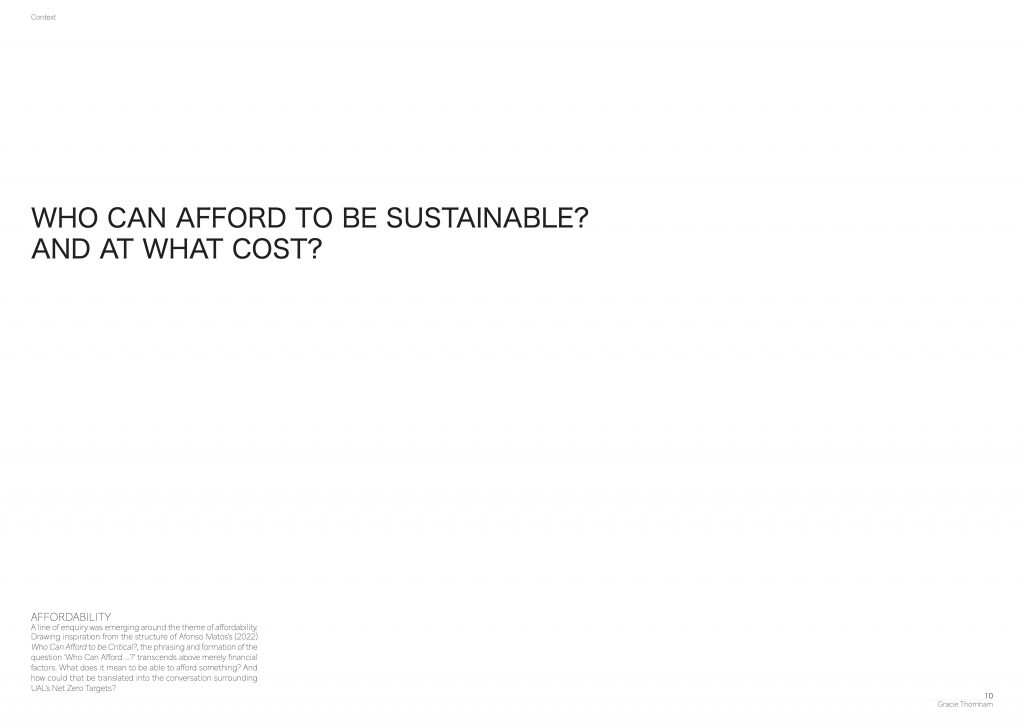
    The exploration concerns itself with the critical question ‘Who can affordable to be sustainable? And at what cost?’. Through experimentation focused on world-building, the group iteratively developed speculative scenarios which reimagined UAL’s infrastructure for waste management in the future. The project sat at the intersection of architecture, place-making and communication design. The process has strengthened my own comprehension of the practical ways in which I can translate my architectural skillset into the field of communication design to promote social, political, or in this case, climate justice.

    I currently work for Boehm Lynas, a small architectural practice rooted in environmentally conscious design. In my daily work, I regularly encounter the language used within the UAL Climate Action Plan, but exclusively within an architectural context. The group project has consolidated my understanding of the jargon surrounding climate justice, and expanded my application of the terminology outside the field of architecture. 

    Within my professional work, I have a nuanced appreciation of the social, political and climate implications of urban design. Environmental concerns guide all aspects my architectural work, yet I had not extensively considered how this ethos may apply to my practice within graphic design. This oversight is arguably due to the disparity in the tangibility of environmental impact within urban versus graphic design. The discipline of architecture is confined within the parameters of environmental policy, whereas graphic design requires self-initiated adherence to Net Zero Targets.  

    The project has been an act of contextualising in itself; not merely in terms of the representation of the UAL Net Zero data, but as a critical reflection on my position as practitioner. The work has expanded my perception of my responsibility as a designer, as I transition from an architectural context into a interdisciplinary practice. 

    PART TWO

    An annotated bibliography consisting of 6 references that shaped your response to the brief, including: 

    2 texts from the reading list 

    2 texts that you find outside the reading list 

    2 design practices/projects.

    Berners-Lee. M. (2022) The Carbon Footprint of Everything. London: Profile Books.

    Although The Carbon Footprint of Everything (Berners-Lee, 2022) did not directly influence the outcomes of the group project, it was a vital text to develop our understanding of the wider theme of carbon emissions. Berners-Lee (2022) succinctly contextualises carbon emissions within everyday life, creating a robust foundational knowledge of the data. This reading was paramount to make the datasets more tangible. The text ensured my carbon literacy and enabled me to digest the statistics, and contextualise their qualitative size.

    Bertolotti-Bailey S. (2015) Towards a Critical Faculty (Only an Attitude of Orientation). Liverpool: The Serving Library.

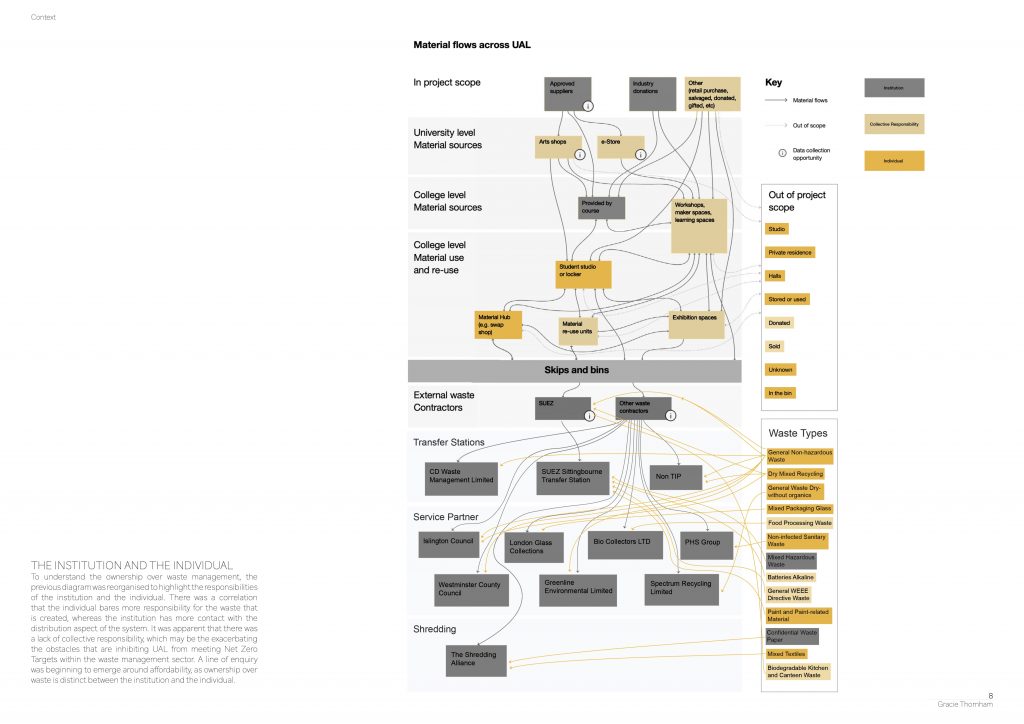
    Stewart Bertolotti-Bailey’s (2015) Towards a Critical Faculty was an influential text within the Methods of Contextualising brief. The group wanted to effectively and critically challenge the role of UAL as an institution against the scale of the impact of decisions made by the individual. Our initial experimentation looked into the power structures and hierarchies within UAL, but without consideration on the relationship between the institution and the individual. This was not particularly successful as it disregarded the complexity of climate justice, and reduced the impacts into arbitrary categories. 

    Reflecting on Towards a Critical Faculty (Bertolotti-Bailey, 2015)encouraged a pivot in our thinking and refined our line of enquiry to more productively challenge the authority within UAL, whilst simultaneously retaining sensitivity towards the nuanced complexity of the subject. At this stage, we repositioned our project to create a critical line of enquiry that examined the role of the institution and the individual within the decisions made regarding waste management. 

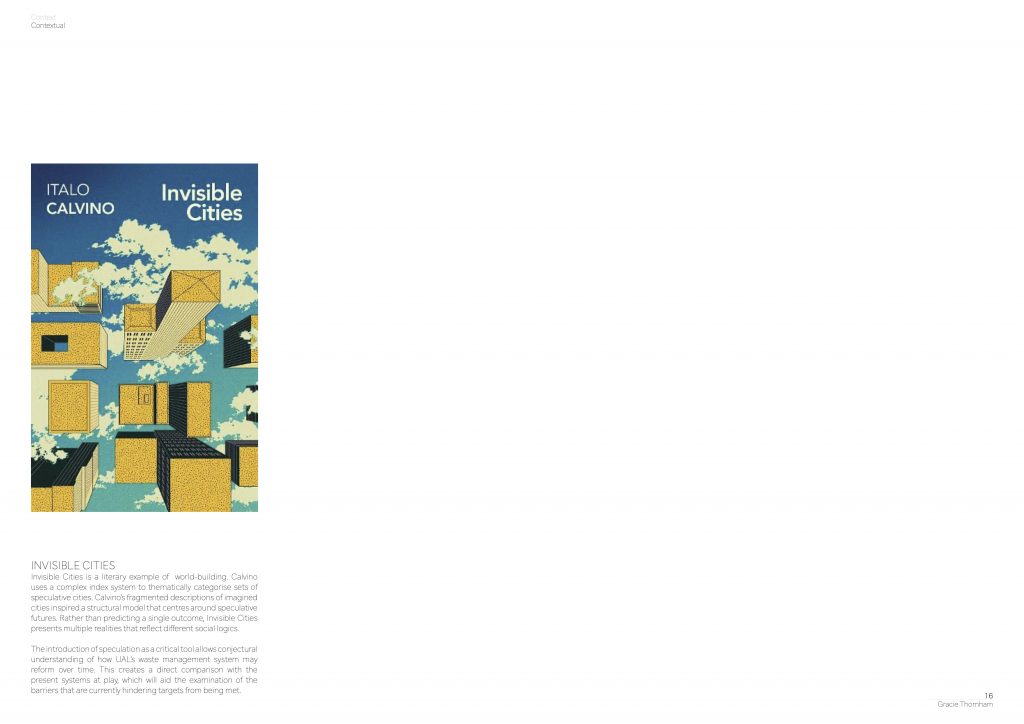
    Calvino, I. (1972) Invisible Cities. Translated from the Italian by W. Weaver. London: Vantage Books.

    Italo Calvino’s (1972) Invisible Cities was arguably the most useful academic reference in the development of our critical investigation into UAL’s waste management under the proposed Net Zero Plan. Similarly to Anna Tsing’s (2020) Feral Atlas, Invisible Cities (Calvino, 1972) is centred around world-building, in this case within a literary context. The notion of creating a complex network of fictitious cities helped establish a framework for our own line of enquiry. The introduction of creating speculative worlds encouraged our group to iterate quickly, imagining the impact of UAL’s waste management strategy through the multiple different lenses. This research relinquished our thinking from the initial reductive experiments, which utilised chess as a metaphor to examine the data, and further contextualised our investigation in the complex network of dependencies within climate justice. 

    Eames, C. and Eames. R. (1977) Powers of Ten and the Relative Size of Things in the Universe [Film]. Eames Office, Los Angeles.

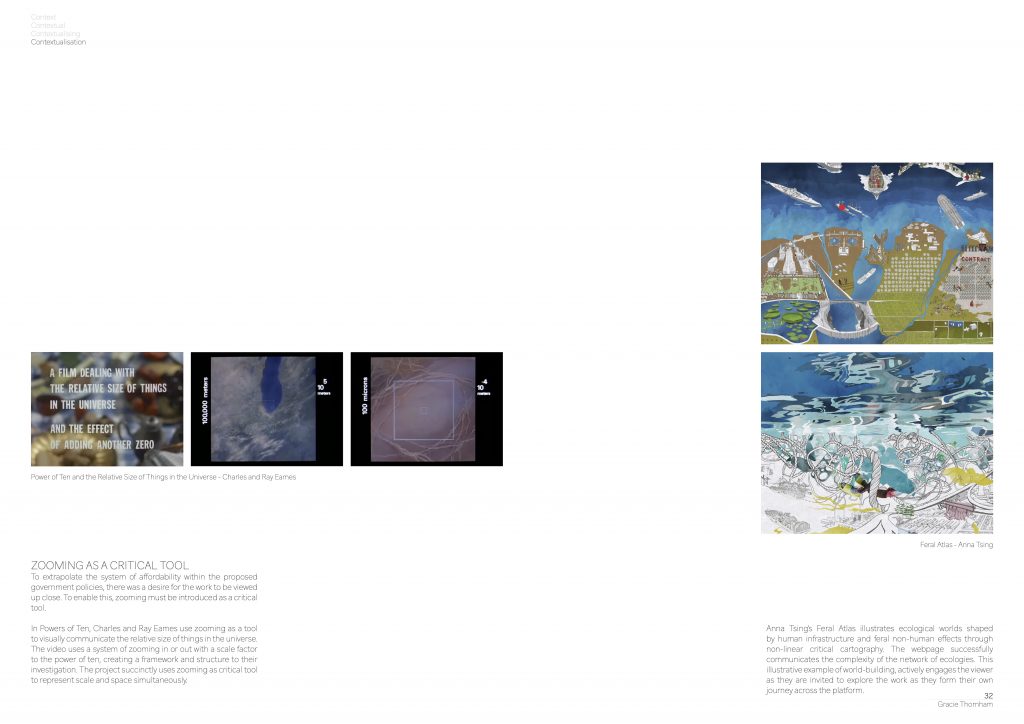
    Charles and Ray Eames (1977) astutely depict the relationship between scale and space through their film Powers of Ten. Throughout the group stage of the project, zooming was introduced as a critical tool to contextualise the scales of our world-building exercises. This was achieved through creating a folding publication, which zooms out in scale with each unfold. There was an motivation to put the micro scale of Central St Martins in conversation with the macro scale of the global impacts of UAL’s waste management. 

    The group exploration into zooming as a critical tool felt fairly rudimentary, therefore Powers of Ten (Eames, 1977) was revisited during my individual reflection of the project. Powers of Ten (Eames, 1977) was an important visual reference as it challenged the thinking around the medium in which the findings would be presented. The introduction of film unfixed the project from the staticity of the illustrations, and reframed the dialogue of the project into a space that could explore temporality, place-making and the scale of the social impact in one cohesive outcome.

    Matos, A. (2022) Who can afford to be critical?: An Inquiry Into What We Can’t Do Alone, as Designers, and Into What We Might Be Able to Do Together, as People. Eindhoven: Set Margins’.

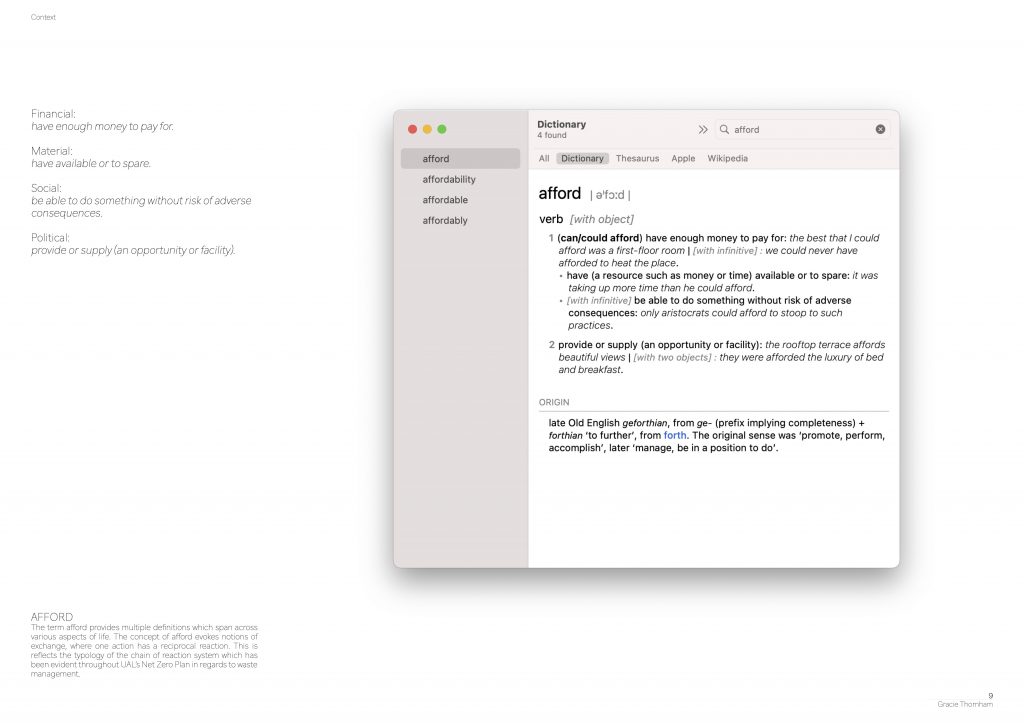
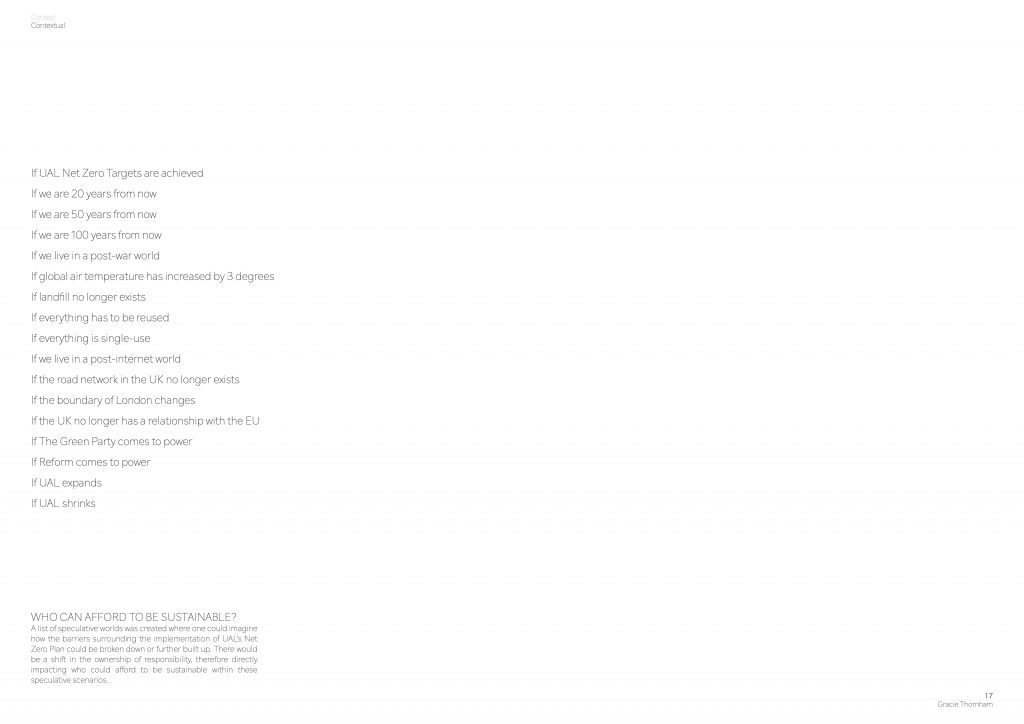
    Phrasing our Methods of Contextualising exploration around a critical question allowed the work to be intentional and concise. Drawing inspiration from Who can afford to be critical? (Matos, 2022), we consolidated our initial research into the question of ‘Who can afford to be sustainable?’. The idea of affordability raises multiple different concerns that transcend above financial. We were collectively interested in the social and political repercussions of decisions. 

    The phrasing of our question was iteratively revised, to reflect the shift in our line of enquiry. We came to the critical question: ‘Who can afford to be sustainable? And at what cost?’. Afonso Matos’s (2022) Who can afford to be critical? was instrumental in the consolidation of our research, as the linguistic structure of the title of the book directly informed our method of approach to the group project. 

    The project concerns itself with the wider impacts of decisions made by both institution and individual within UAL, in an attempt to reveal, and challenge, the current systems of power and consequence. 

    Tsing, A. (2020) Feral Atlas. Available at:  https://feralatlas.org/ (Accessed: 18 February 2026).
    Feral Atlas (Tsing, 2020) successfully communicates the complexity of the ecological network, whilst maintaining the ease of the data consumption. The academic papers and statistics are hidden within a intricate index of ecologies, allowing the viewer to form their own journey through the platform as they access and interact with different data sets and information. Within the group project, there was an impetus to consider the viewer within the context of the work, and from the outset we imagined how the work could be meaningfully interacted with. 

    Feral Atlas (Tsing, 2020) acted as a key visual reference, due to the strong sense of world-building within the illustrative style. Within the graphics, space and scale are distorted, creating a speculative reality with a reordered hierarchy of ecologies. The themes of hierarchy, world-building and speculative realities remained central within our group exploration, as we critically investigated the role of the institution and the individual within a wider network of environmental and social consequences stemming from climate change.

    Similarly to Ray and Charles Eames’ (1977) Powers of Ten, Feral Atlas (Tsing, 2020) utilises zooming as a method to contextualise space and scale. The viewer is invited to enlarge the illustrations to reveal further details about the ecologies. This method of contextualising was touched upon within our group project, and further examined within my individual restructuring of the body of work. 

    Reference List:

    Berners-Lee. M. (2022) The Carbon Footprint of Everything. London: Profile Books.

    Bertolotti-Bailey S. (2015) Towards a Critical Faculty (Only an Attitude of Orientation). Liverpool: The Serving Library.

    Calvino, I. (1972) Invisible Cities. Translated from the Italian by W. Weaver. London: Vantage Books.

    Eames, C. and Eames. R. (1977) Powers of Ten and the Relative Size of Things in the Universe [Film]. Eames Office, Los Angeles.

    Matos, A. (2022) Who can afford to be critical?: An Inquiry Into What We Can’t Do Alone, as Designers, and Into What We Might Be Able to Do Together, as People. Eindhoven: Set Margins’.

    Tsing, A. (2020) Feral Atlas. Available at:  https://feralatlas.org/ (Accessed: 18 February 2026).
  • Manifesto! // Reflection

    Stephanie Jin’s cross year studio Manifesto! offered an opportunity to reflect on how my practice has developed since I started at CSM. The workshop felt aptly timed within the course calendar, as I have been taking time to critically reflect on what I have learnt during Unit: 1 Methods. The manifesto I produced during the cross year studio was a reflection on my understanding of my own positionality. I decided to illustratively convey my manifesto, rather than leaving it purely textual. It drew inspiration from Mill & Jones (2019) Exile’s Letter in both form and colour palette.

    My interest lies at the intersection between graphic communication design and architecture. Prior to this course I had not considered how that may materialise into a critical practice. 

    Throughout Methods of Investigating and Methods of Cataloguing I applied my architectural skillset onto the field of graphic design, with an impetus to communicate complexity through mapping. This cultivated a wider interest in the practice of social cartography, which I hope I can revisit in the future whilst studying at CSM. 

    The first two briefs primarily investigated architectural mapmaking as a graphic design tool. To further entangle the two disciplines of graphic design and architecture, I decided to translate an architectural theory onto a graphic design process during Methods of Translating. This was a pivotal moment in the development of the position of my practice, as I visually illustrated practical methods to intertwine my interests.

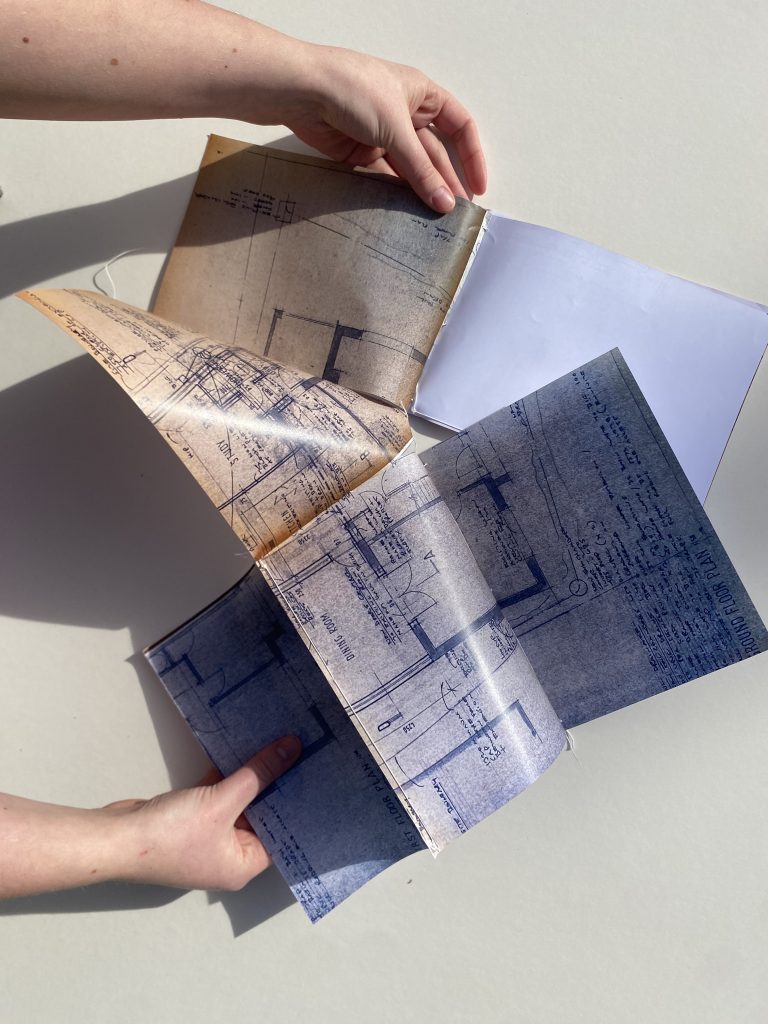
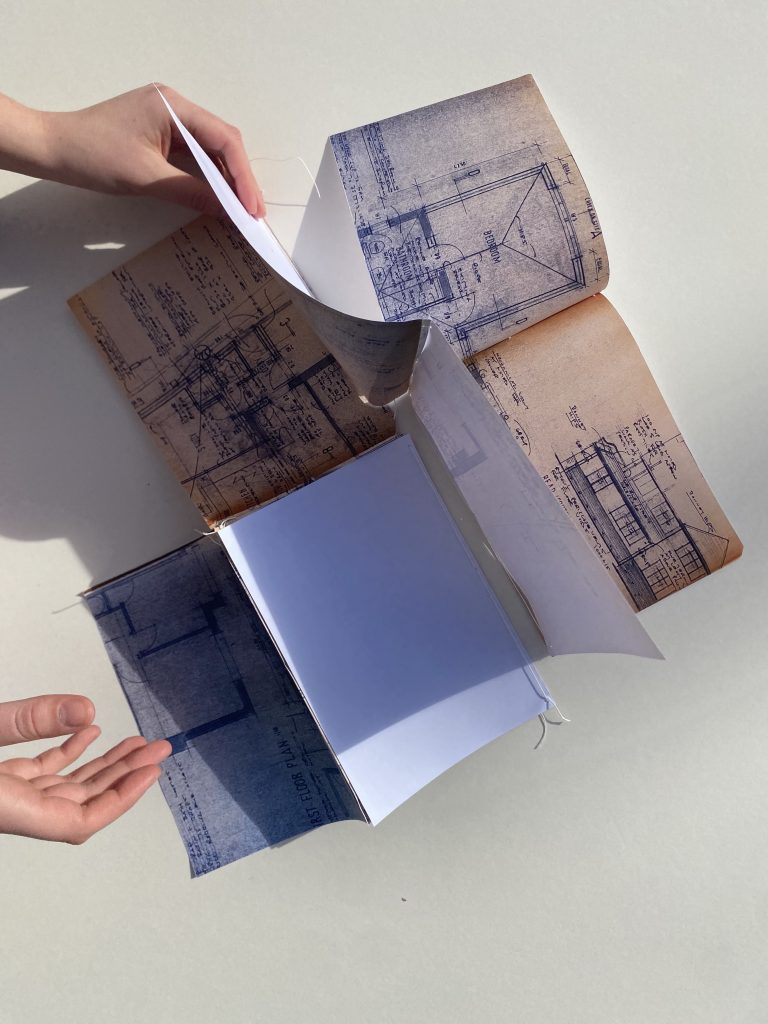
    After tentatively exploring my position as a designer in the first term, I began to break down the defined boundaries of graphic design and architecture within the Methods of Iterating project. Through the process of bookbinding conventional architectural drawings, the line between graphic design and architecture became even more blurred. I started to consider the disciplines as indistinct; I lost the ability to discern where graphic design finishes and architecture begins. 

    The Methods of Contextualising project aided the consolidation of my position as a designer. The speculative world building reflected my new-found understanding that architecture and graphic design are one in the same: where both disciplines are acts of world building, construction, communication, placemaking and speculation. I look forward to consolidating, warping and reimagining my position as a designer next semester. 

    Reference List:

    Mill, A. and Jones. L. (2019) Exile’s Letters. Oslo: Mill & Jones.

  • Reflection on the Project

    The group project addressed the critical question ‘Who can afford to be sustainable? And at what cost?’. The project can be accessed here.

    I have decided to develop the body of work further using the extra time provided from my adjusted deadline. I am interested in the line of enquiry that emerged during the project. I will explore the critical questions that the project addressed more thoroughly. Through a more detailed analysis of UAL’s waste strategy, I have attempted to weave together the threads of the group project. This restructured and developed body of work can be found here.

  • Group Body of Work

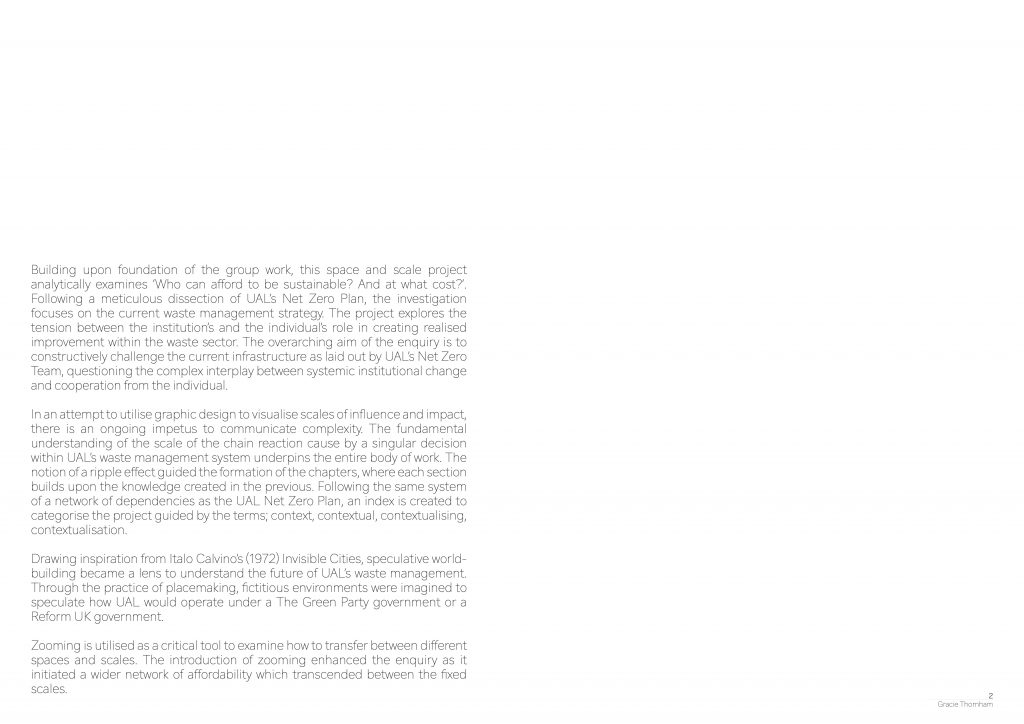
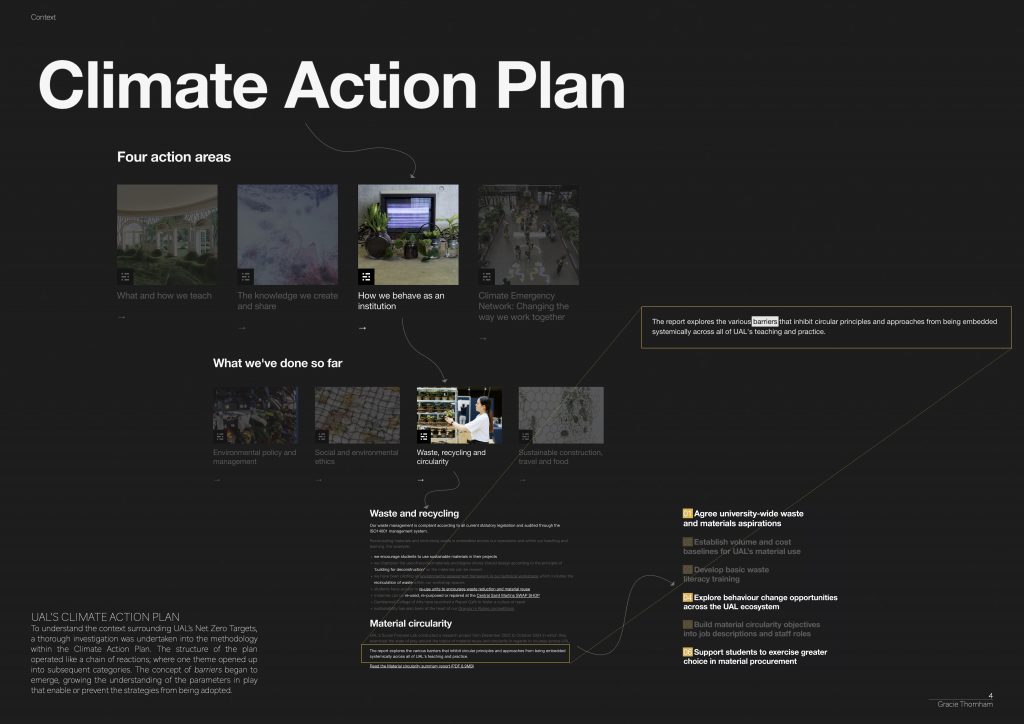
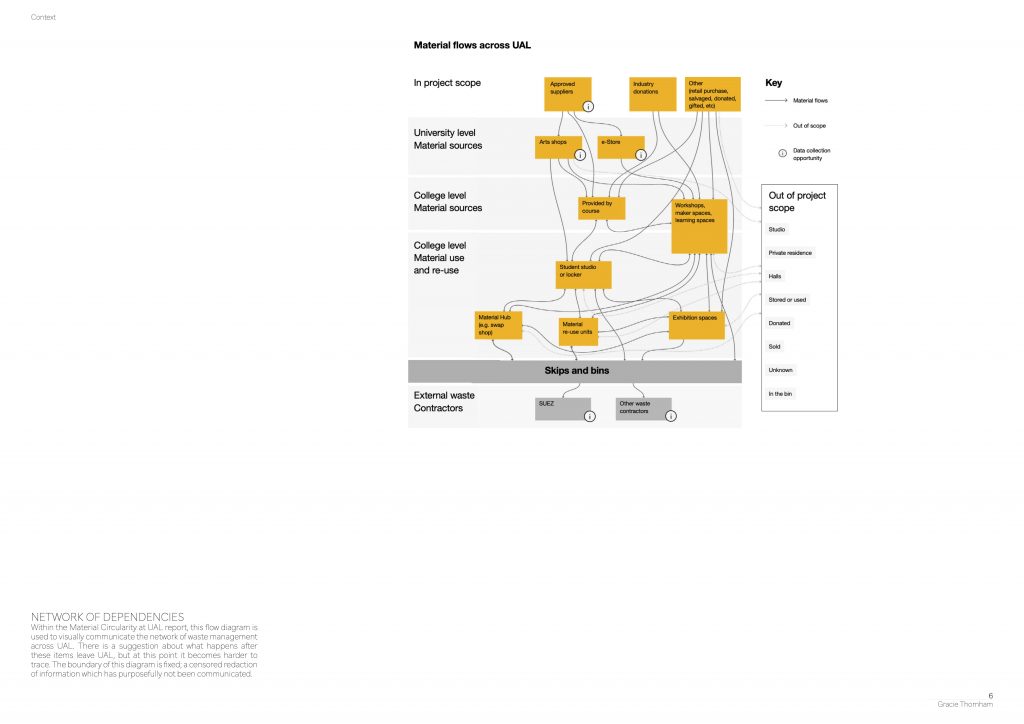
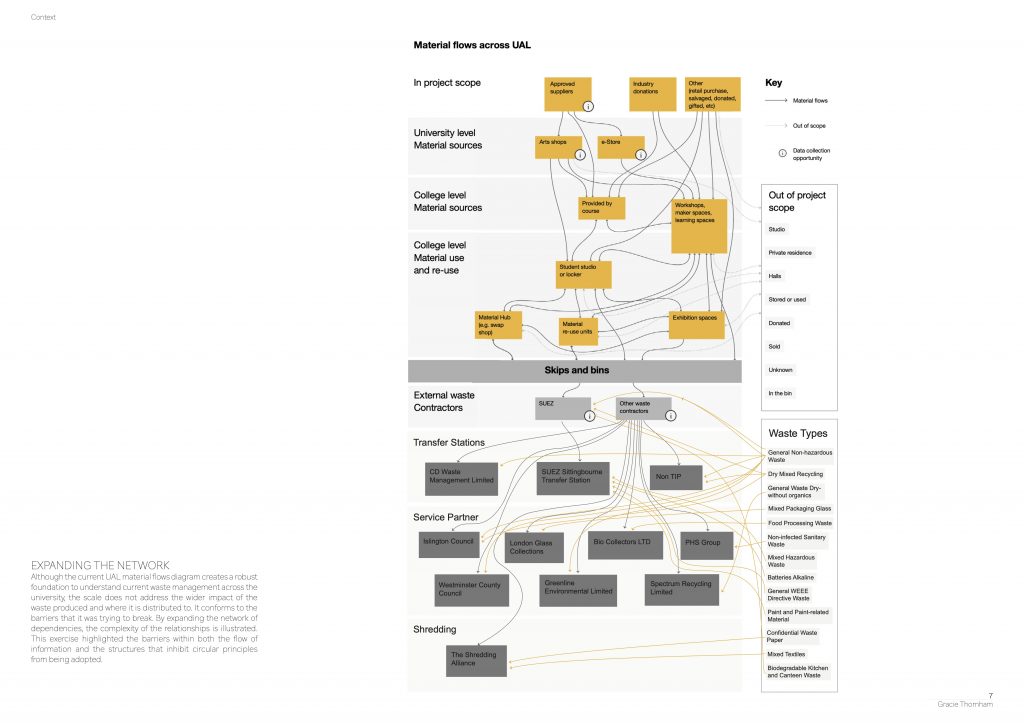
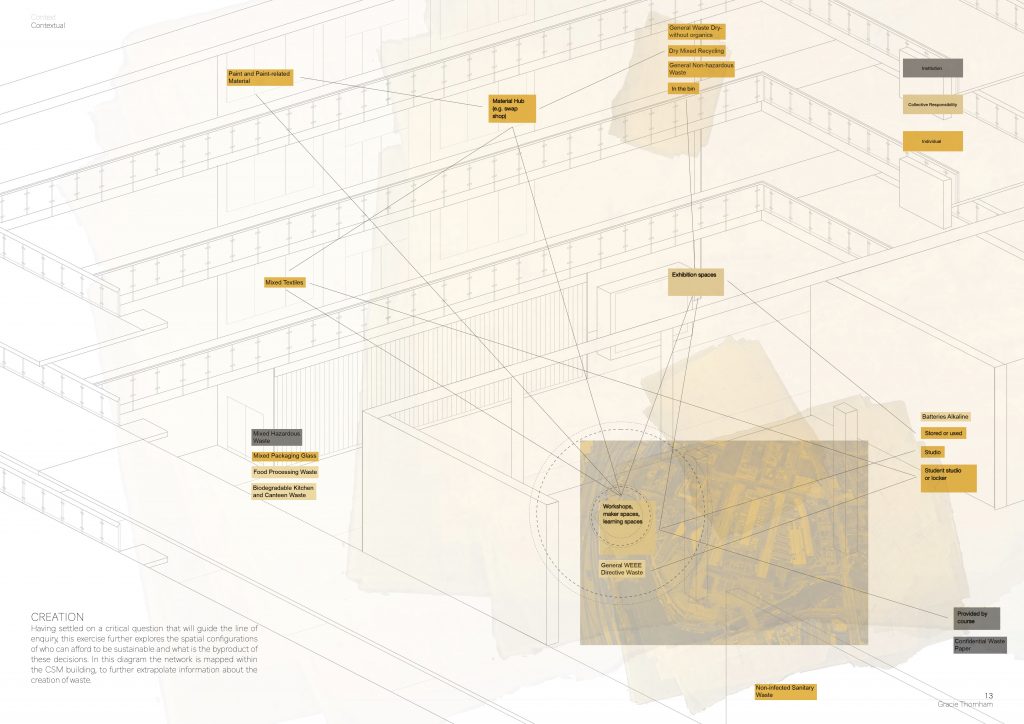
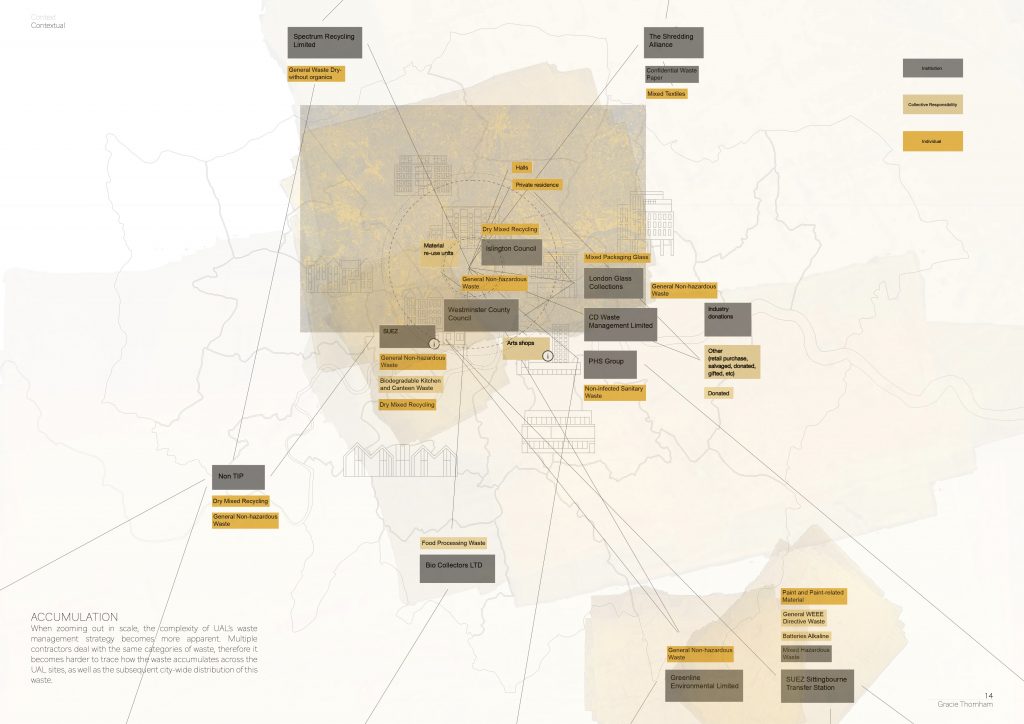
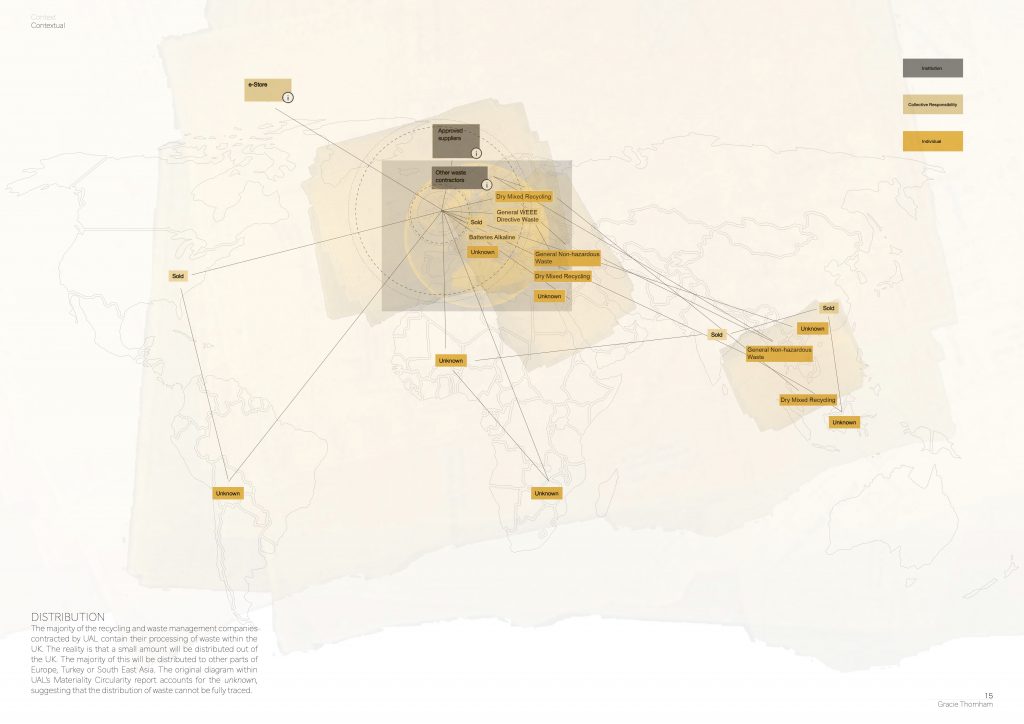
    Our space and scale project analytically examines “Who can afford to be sustainable? And at what cost?”. Following a meticulous dissection of UAL’s Net Zero Plan, we decided to focus our investigation on the current waste management strategy. The project explores the tension between the institution’s and the individual’s role in creating realised improvement within the waste sector. We aimed to constructively challenge the current infrastructure as laid out by UAL’s Net Zero Team, questioning the complex interplay between systemic institutional change and cooperation from the individual.

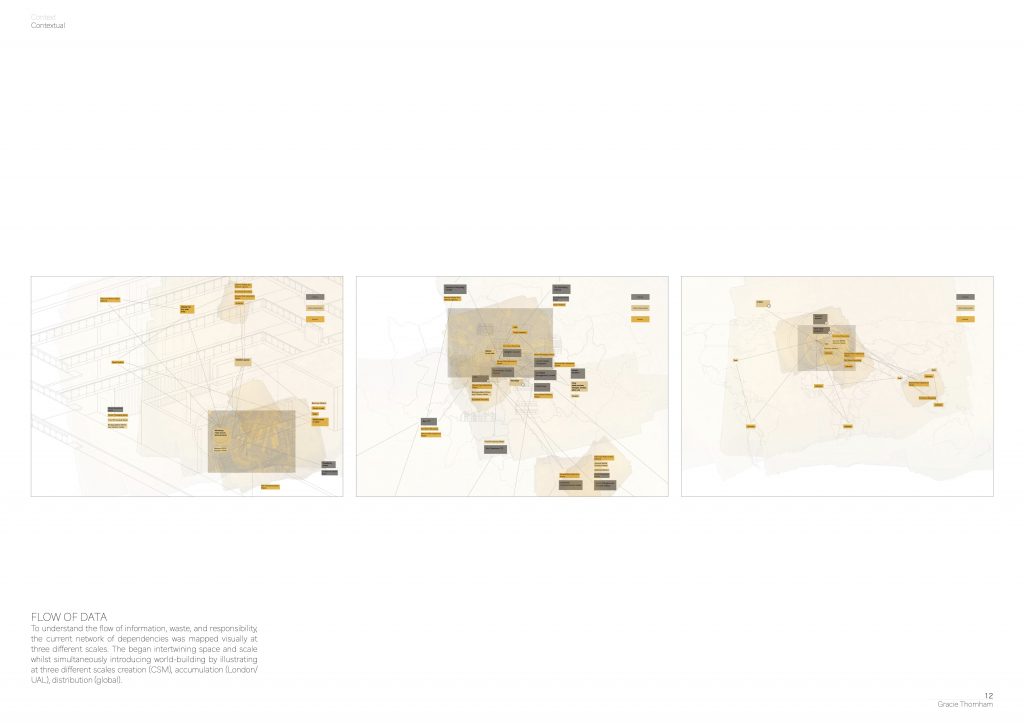
    Zooming was utilised as a critical tool to examine our work as we transferred between different spaces and scales. The introduction of zooming enhanced our enquiry as it initiated a further dimension of temporality into our work, whilst prioritising interactivity and self-guided discovery for the audience.

    Drawing inspiration from Italo Calvino’s (1972) Invisible Cities, speculative world-building became a lens to understand the future of UAL’s waste management. Through the practice of placemaking, we imagine how UAL could operate within the fictitious environments created: a speculative post-internet world, a speculative post-war world, a speculative world where landfill no longer exists, and, a speculative world where The Green Party is in power.

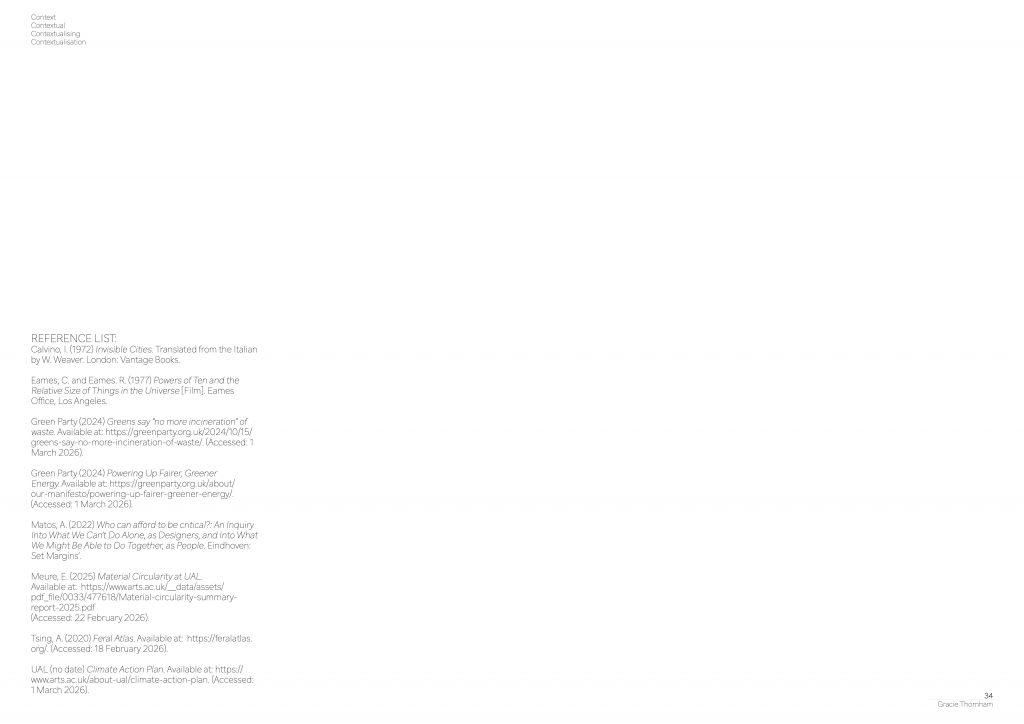
    In an attempt to utilise graphic design to visualise scales of influence and impact, there was an ongoing impetus to communicate complexity. The fundamental understanding of the scale of the chain reaction cause by a singular decision within UAL’s waste management system underpins the entire body of work. The notion of a ripple effect guided the formation of the chapters, where each section builds upon the knowledge created in the previous. Following the same system of a network of dependencies, an index is created to categorise the project guided by the terms; context, contextual, contextualising, contextualisation.


    Within the following document, our names are listed on the bottom left of the page. These are highlighted to reflect the different group members that contributed to the work on the respective page.

    Reference List:

    Calvino, I. (1972) Invisible Cities. Translated from the Italian by W. Weaver. London: Vantage Books.

    Eames, C. and Eames. R. (1977) Powers of Ten and the Relative Size of Things in the Universe [Film]. Eames Office, Los Angeles.

    Matos, A. (2022) Who can afford to be critical?: An Inquiry Into What We Can’t Do Alone, as Designers, and Into What We Might Be Able to Do Together, as People. Eindhoven: Set Margins’.

    Meure, E. (2025) Material Circularity at UAL. Available at: https://www.arts.ac.uk/__data/assets/ pdf_file/0033/477618/Material-circularity-sum- mary-report-2025.pdf (Accessed: 22 February 2026).

    Tsing, A. (2020) Feral Atlas. Available at:  https://feralatlas.org/ (Accessed: 18 February 2026).
  • Week 1 & 2 Process

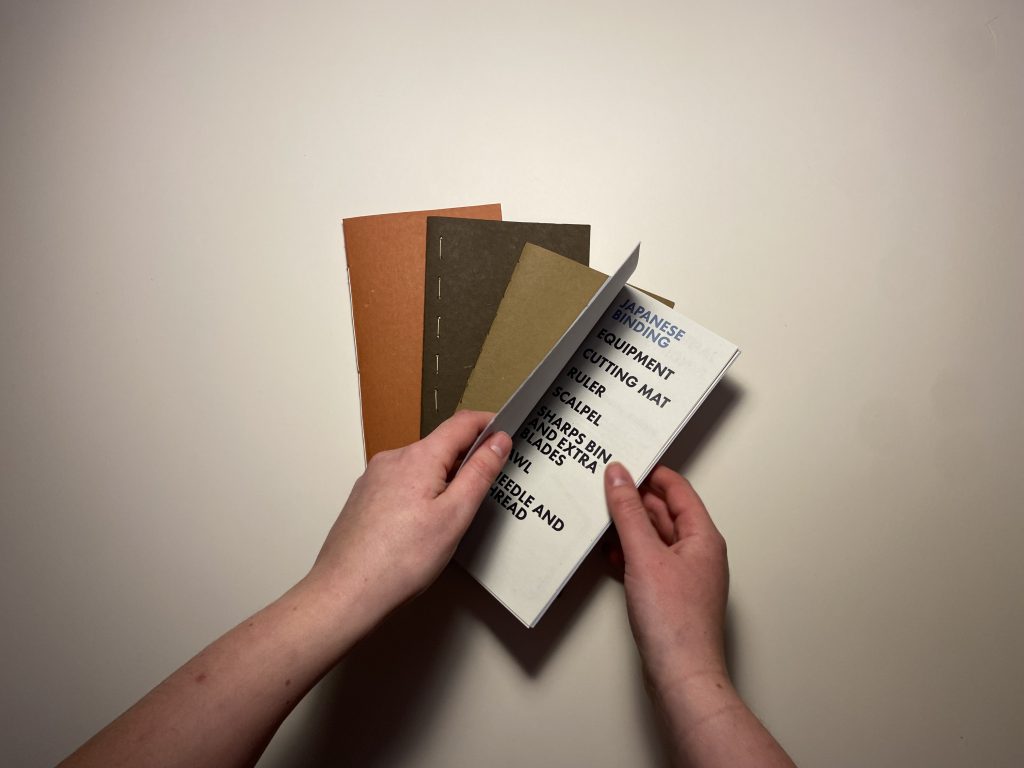
    The language surrounding bookbinding has guided my iterative experimentation into three distinct chapters. The first chapter looks at ‘The Bind’. This body of work is characterised by building foundational knowledge about specialist bindings, specifically Singer Sewn, Side Sewn, Japanese Binding and Three Hole Sewn.

    Fig. 1. Exploration guided by ‘The Bind’.

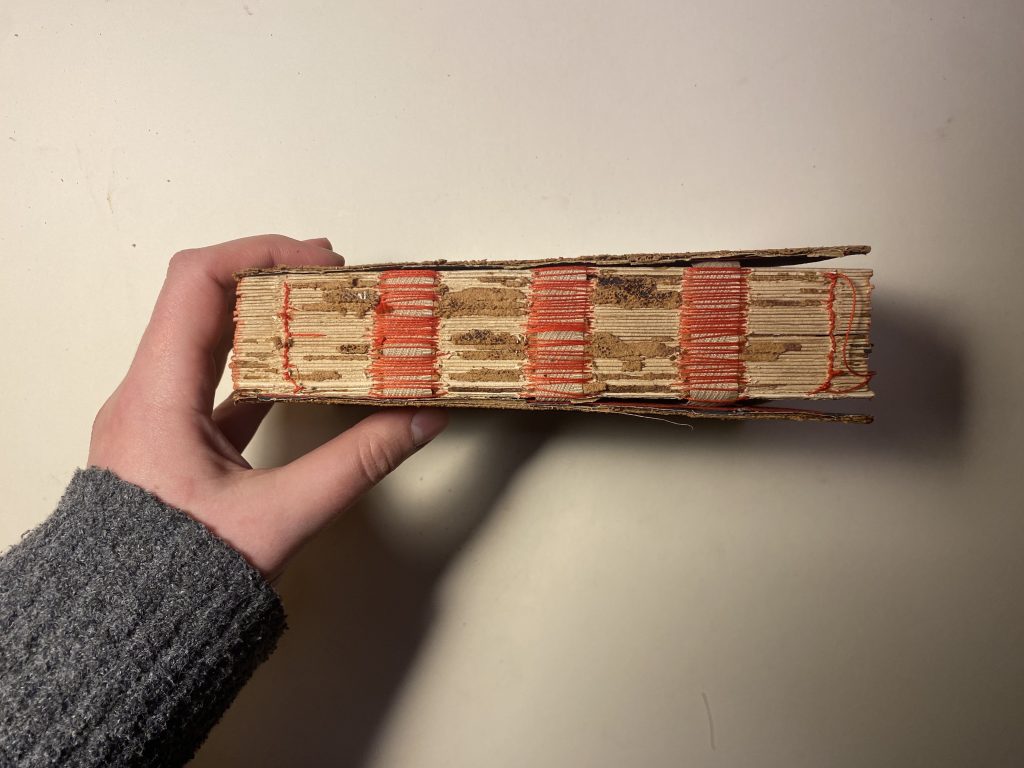
    The second chapter investigates the role of ‘The Binder’ more thoroughly. The binder is often overlooked within the practice of bookbinding, which is being exacerbated by the growth of industrial book manufacturing. The trace that the binder once would have left from their craftsmanship is being standardised, automated, and consequently, eradicated.

    Fig. 2. Exploration guided by ‘The Binder’.

    The third chapter engages with the concept of ‘The Bound’. The term ‘bound’ has many different meanings. The definitions of relevance to this project are:

    1. ‘a territorial limit; a boundary’

    2. ‘going or ready to go towards a specified place’

    3. ‘past and past participle of bind’.

    I investigated what processes are bound within bookbinding (according to the second definition of the word).

    Fig. 3. Exploration guided by ‘The Bound’.

    The language surrounding my work has helped to iteratively rephrase the critical questions I am attempting to answer throughout my studio project.

  • Week 4 Process

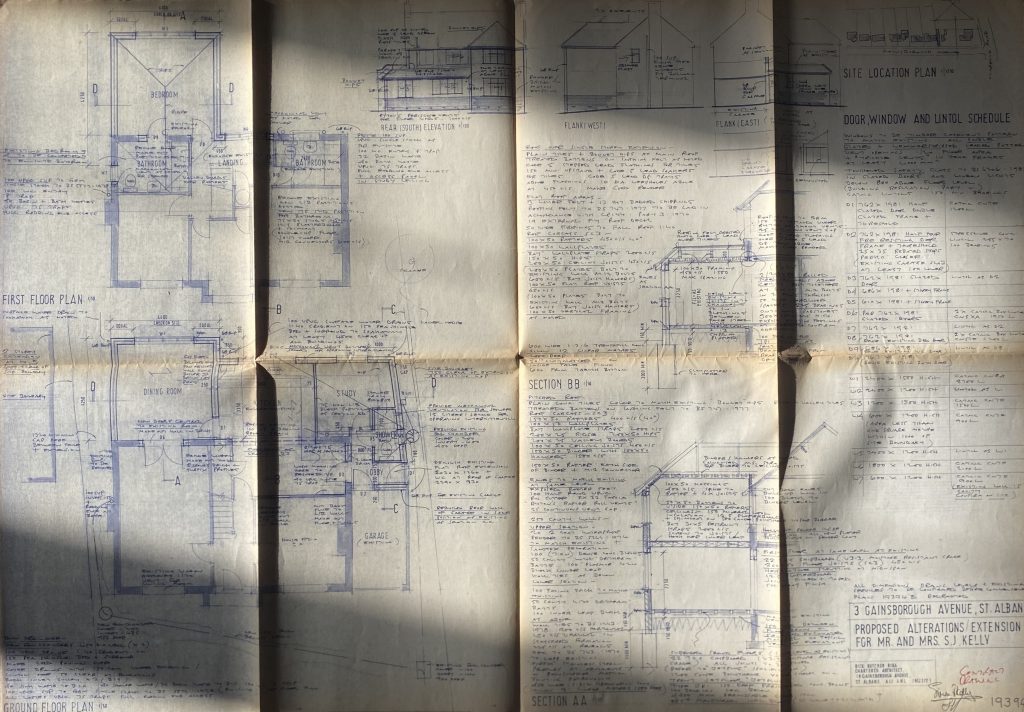
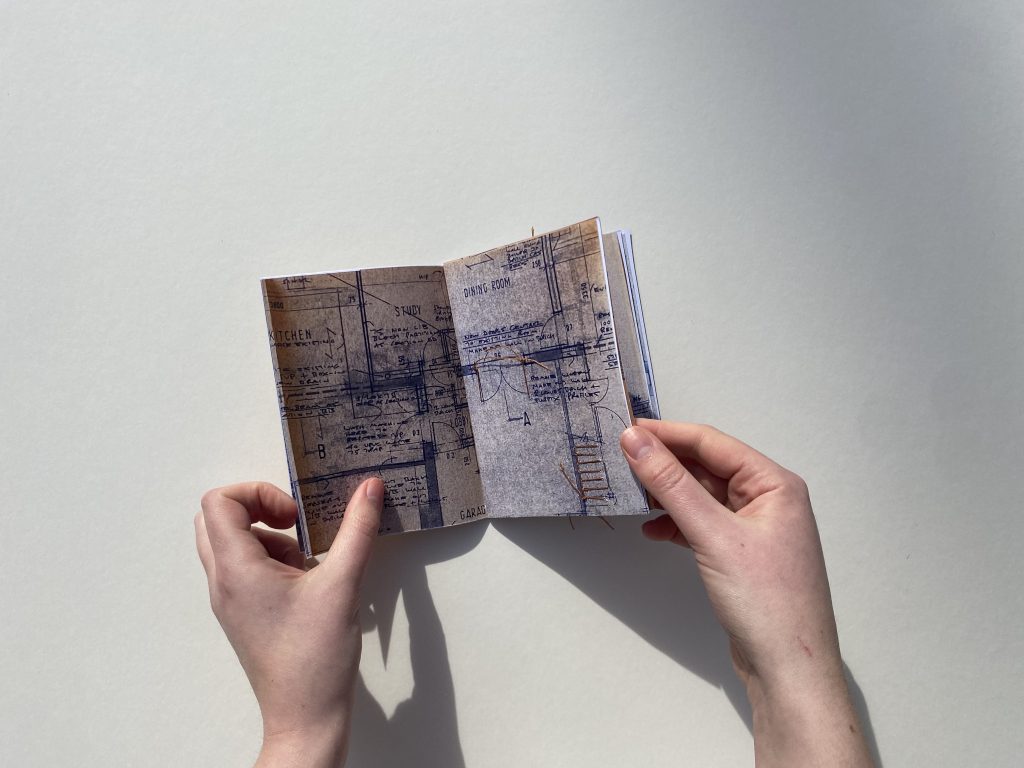
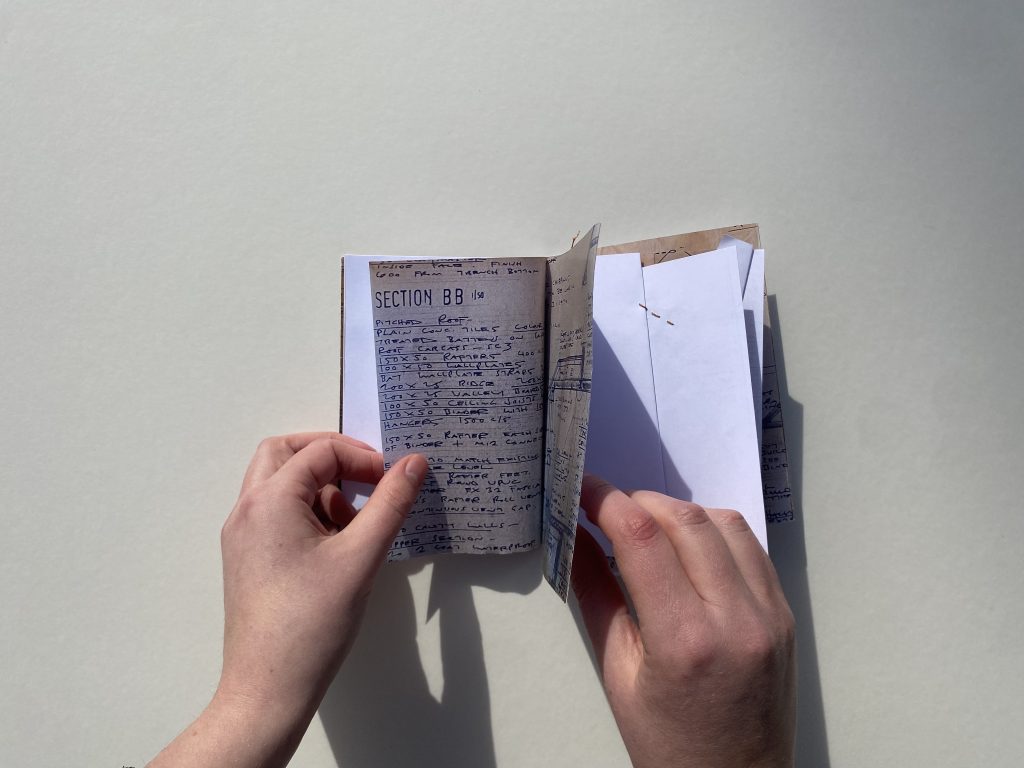
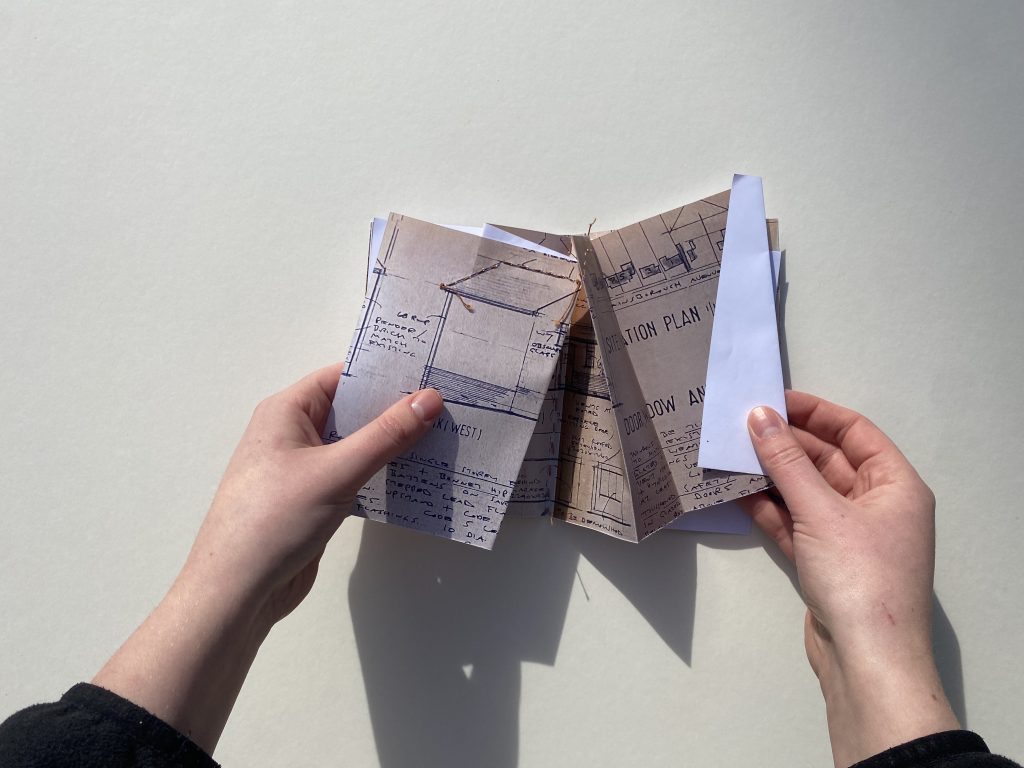
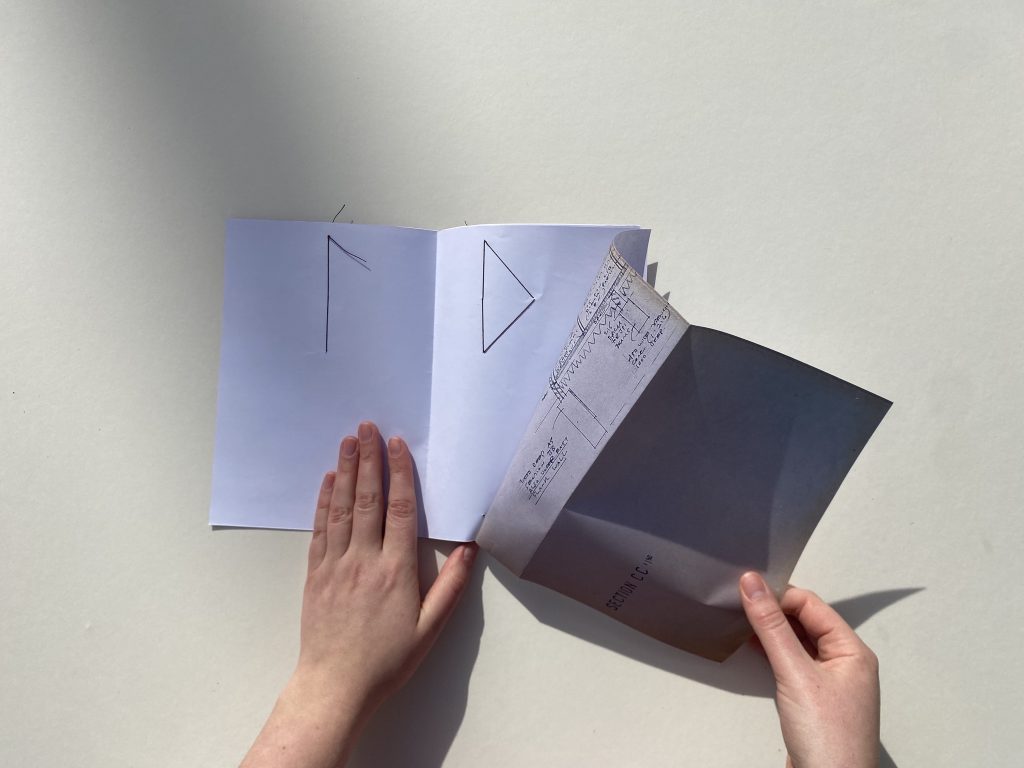
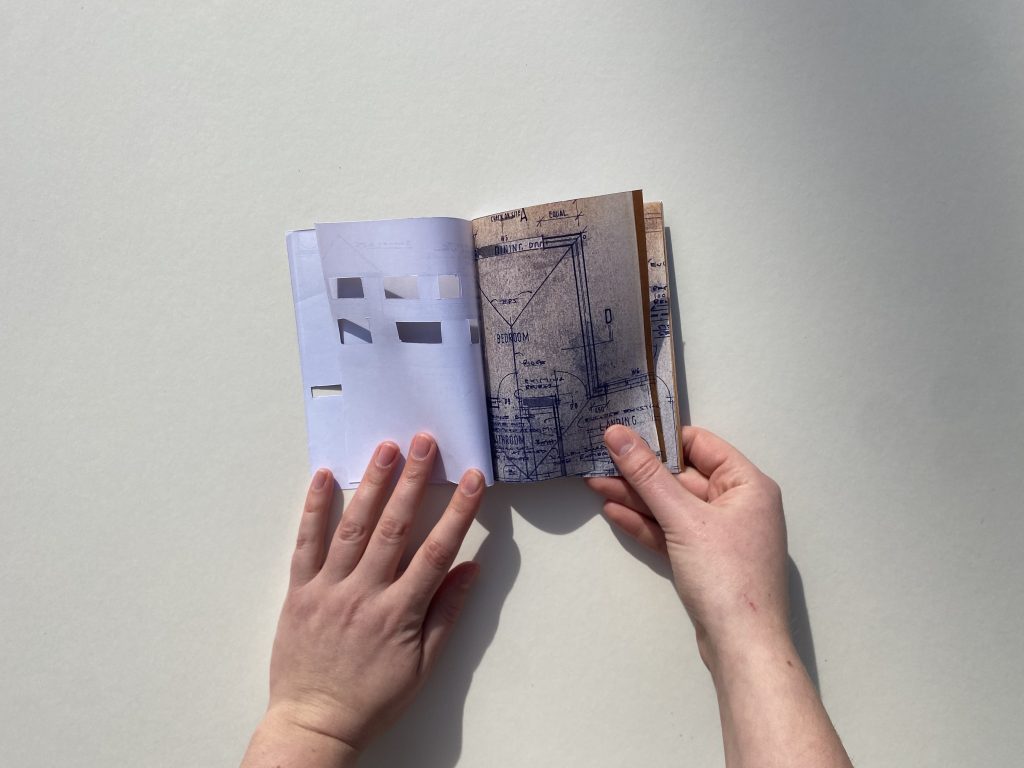
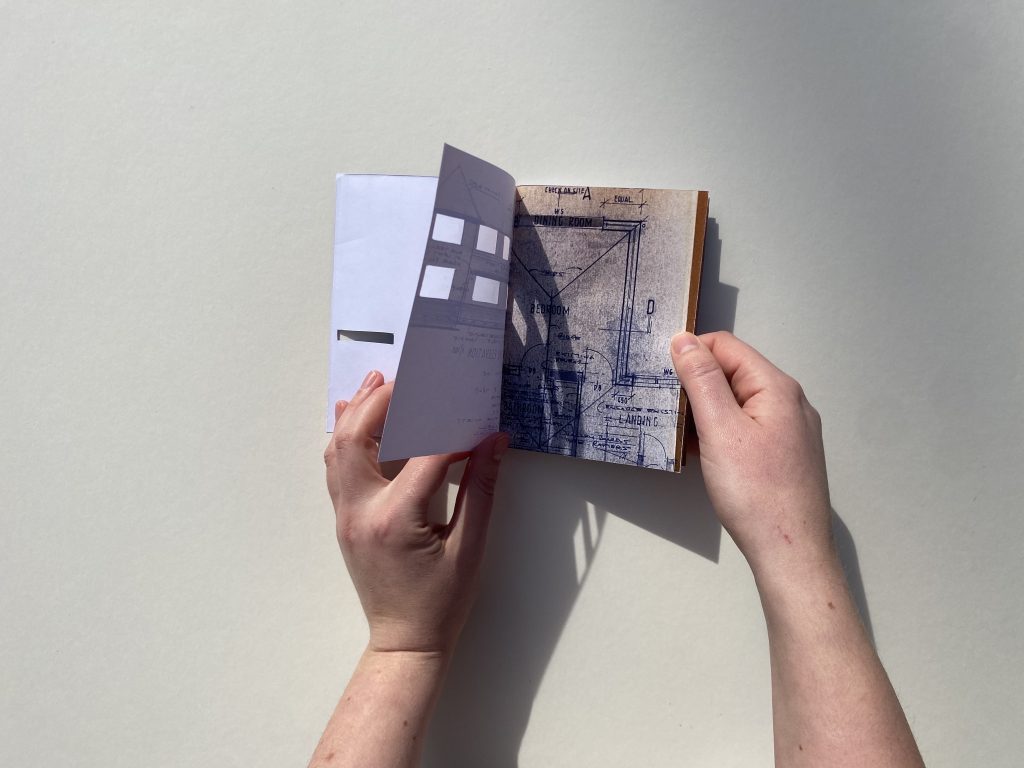
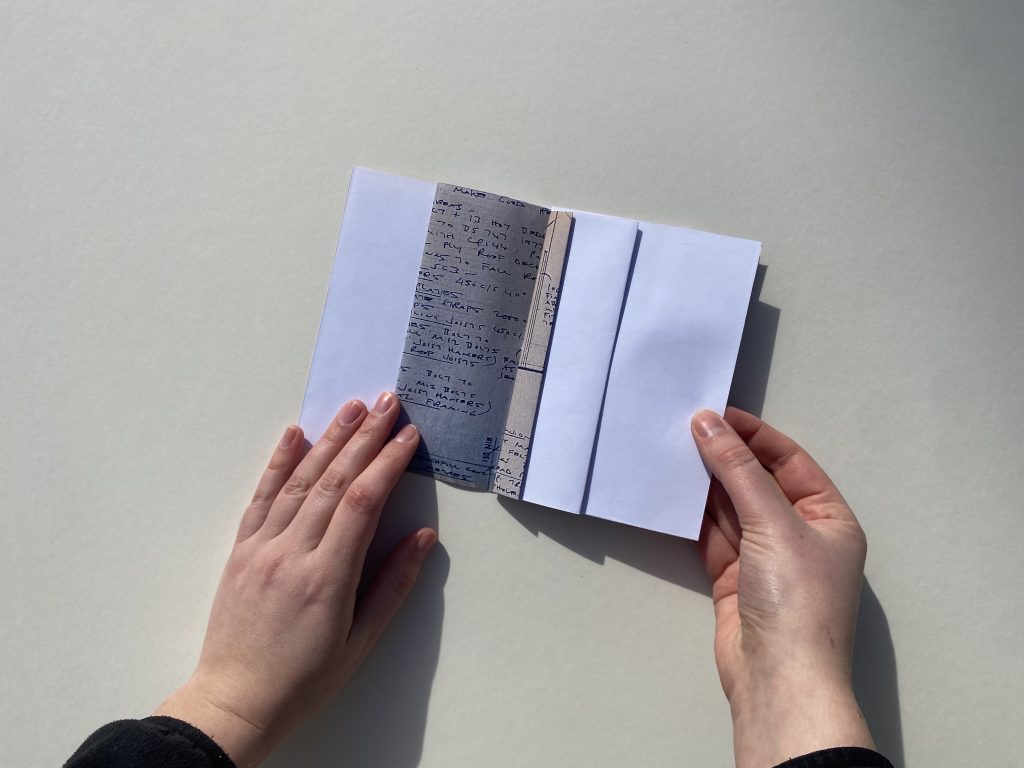
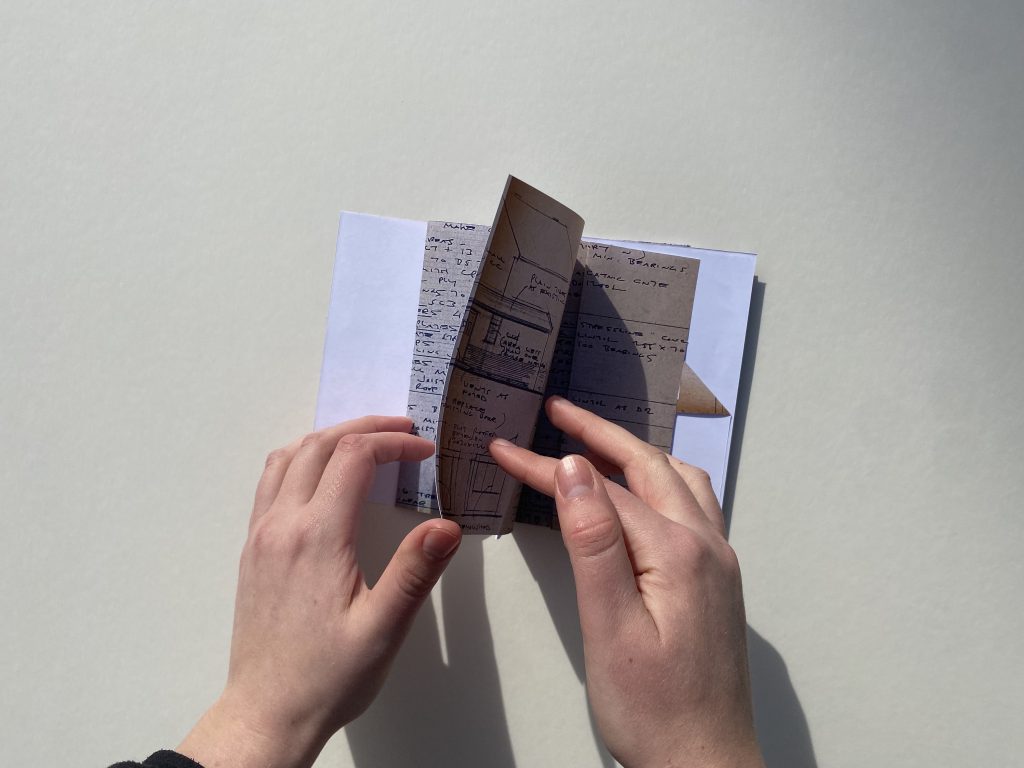
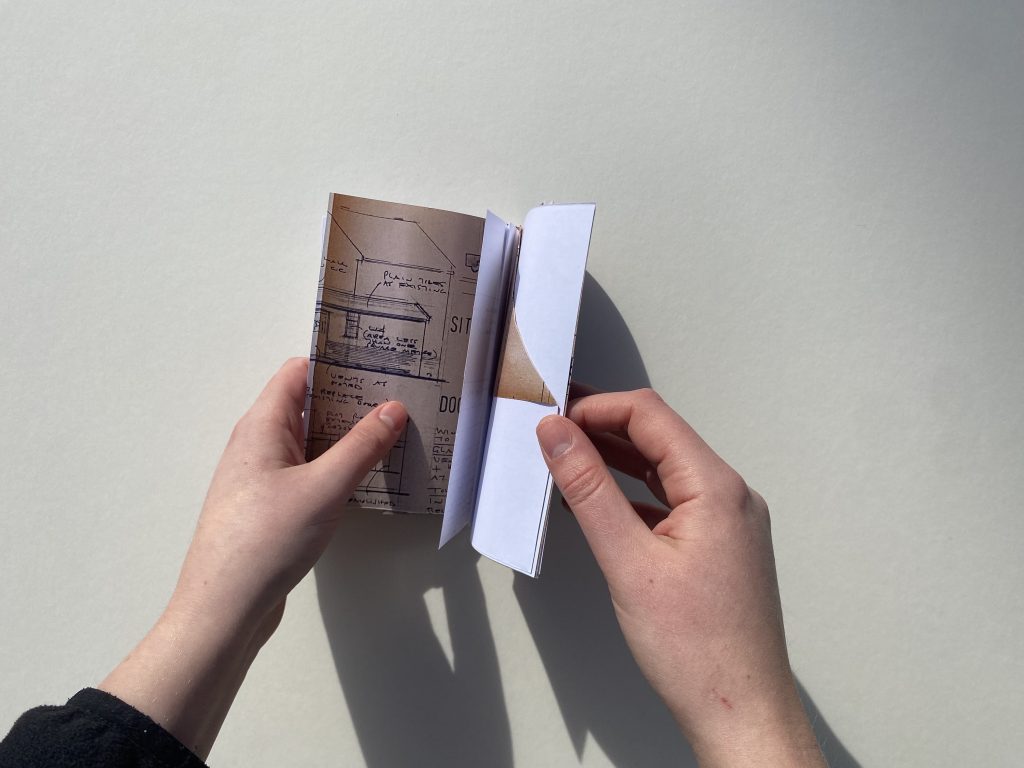
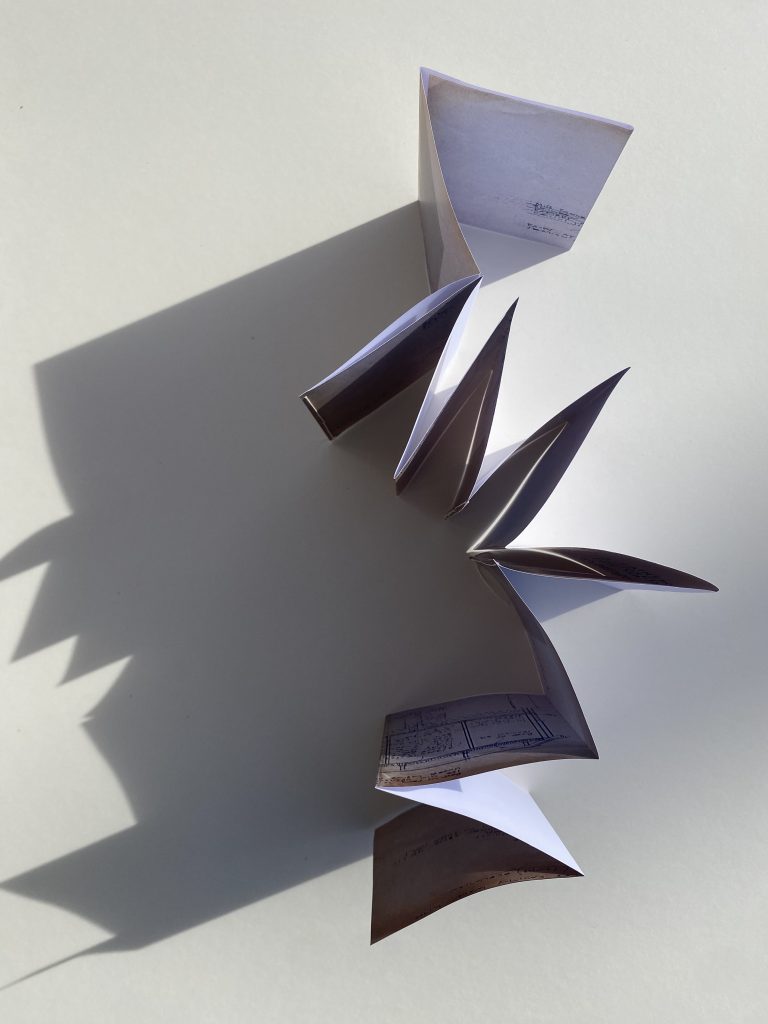
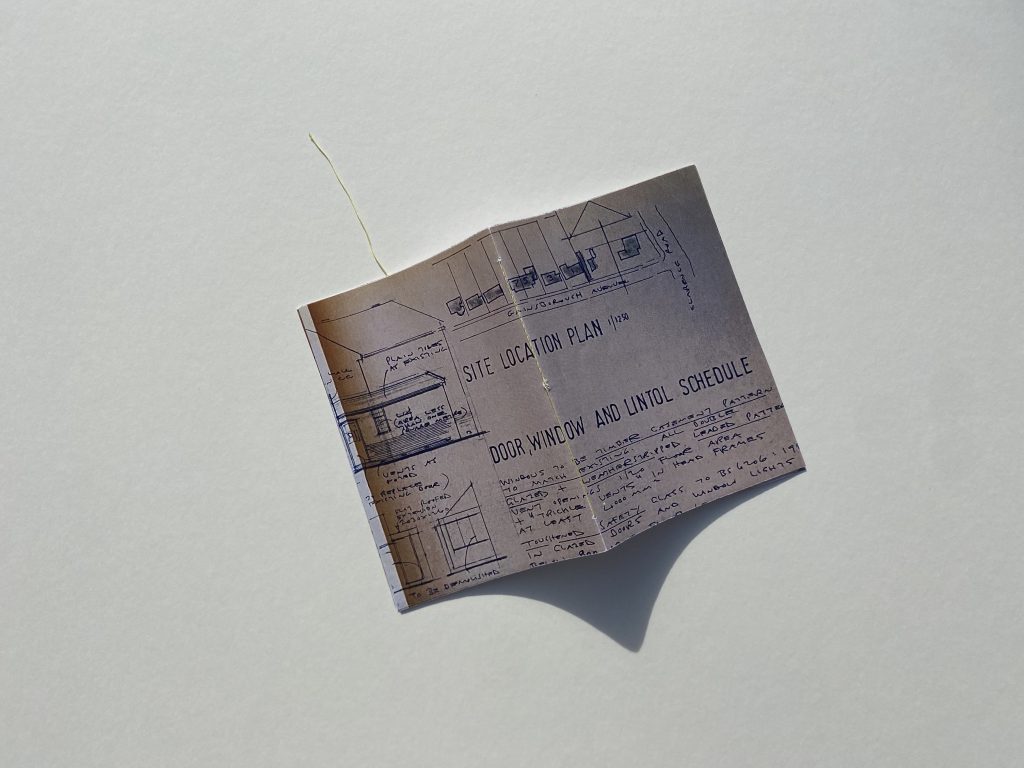
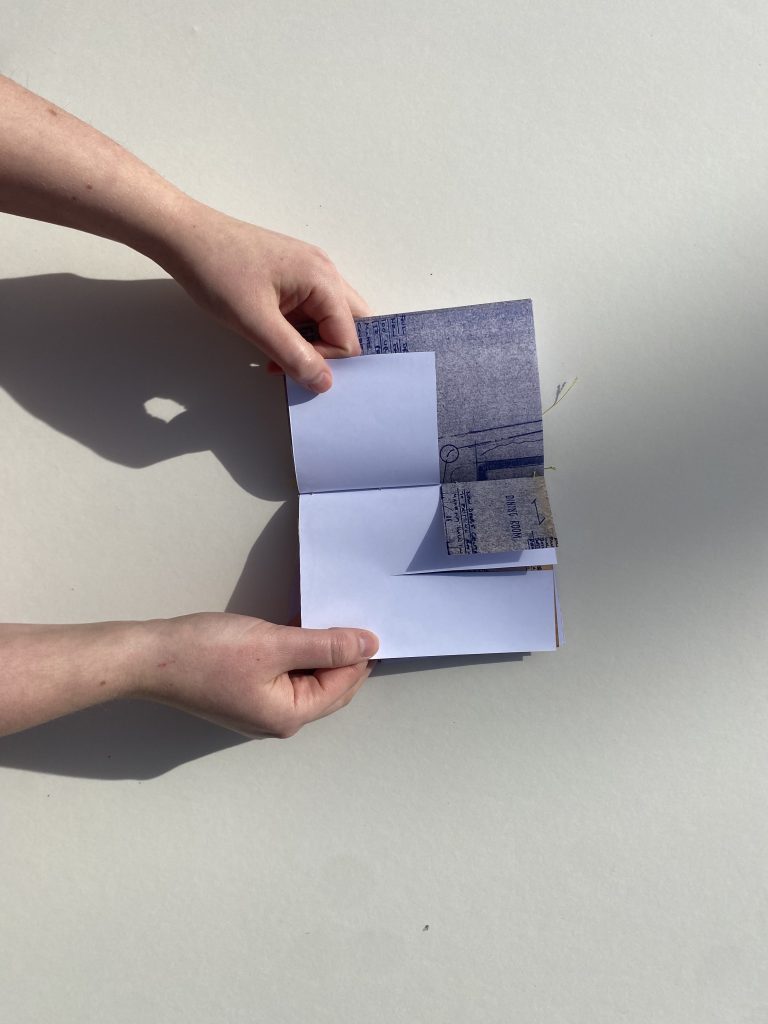
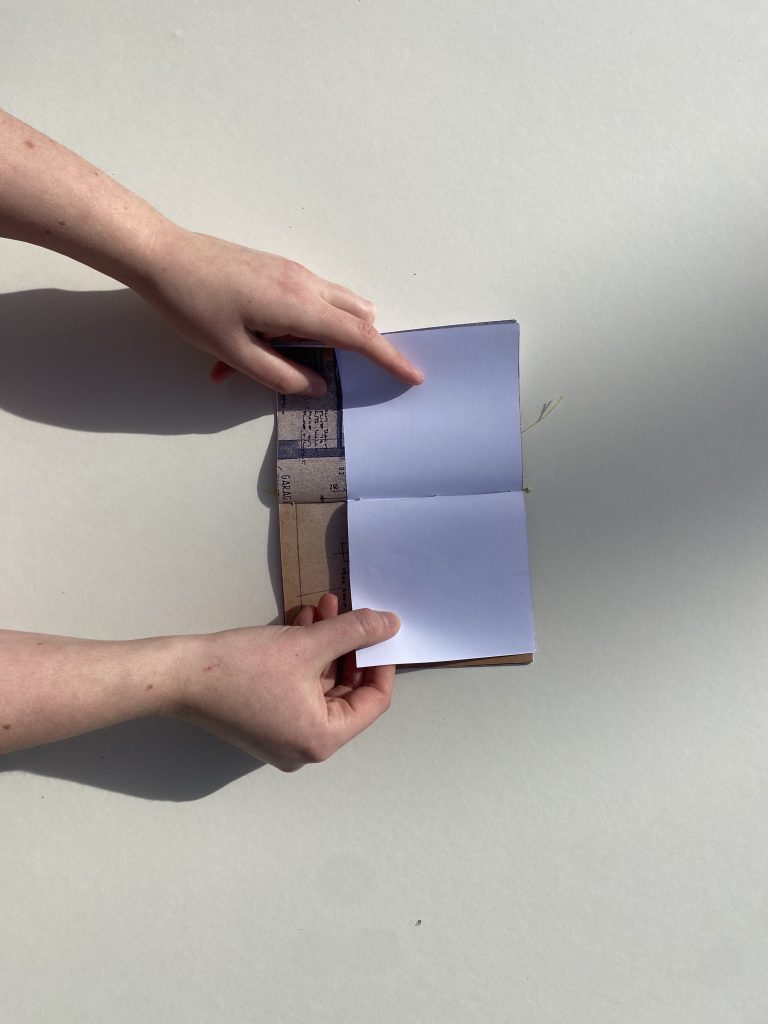
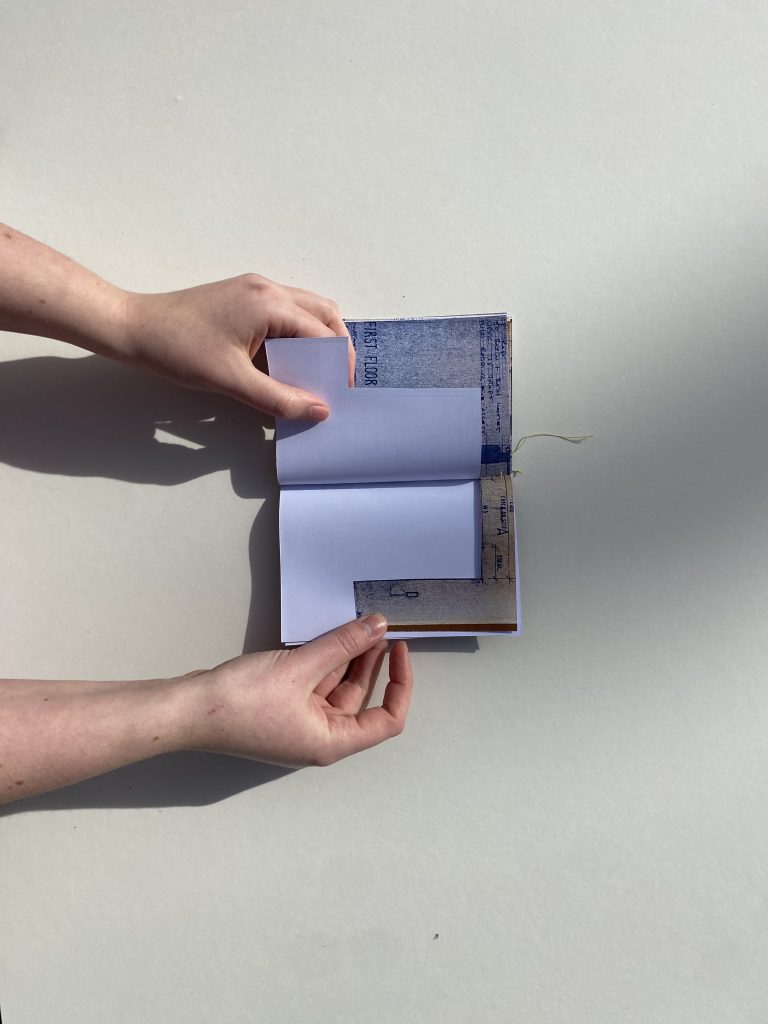
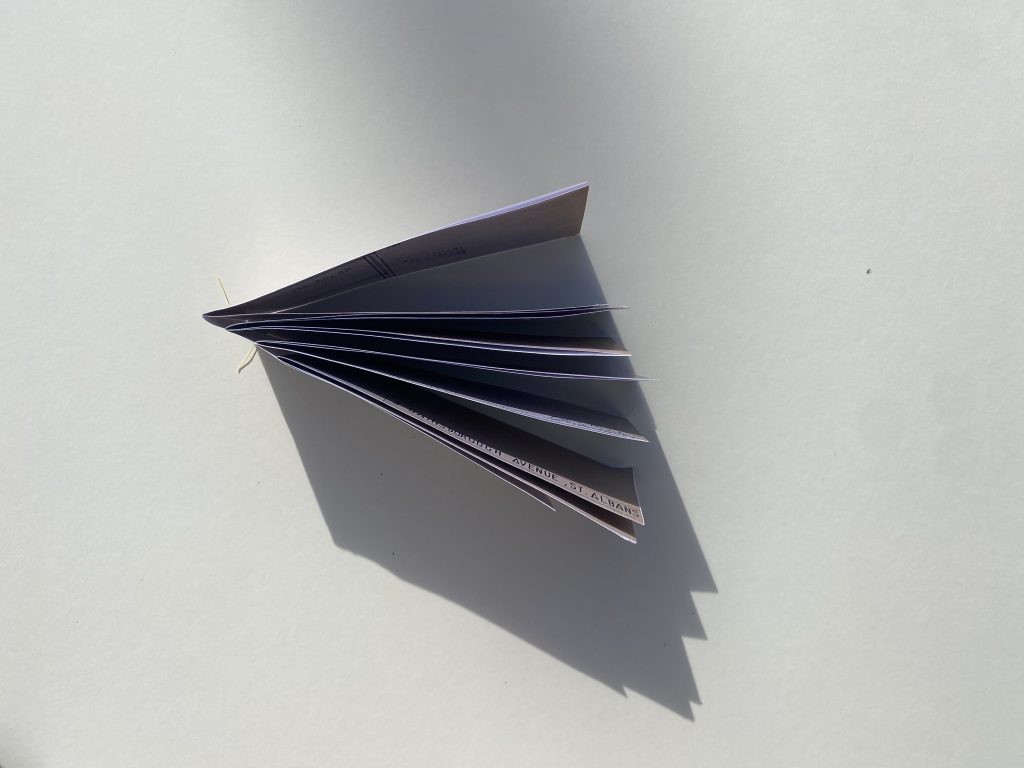
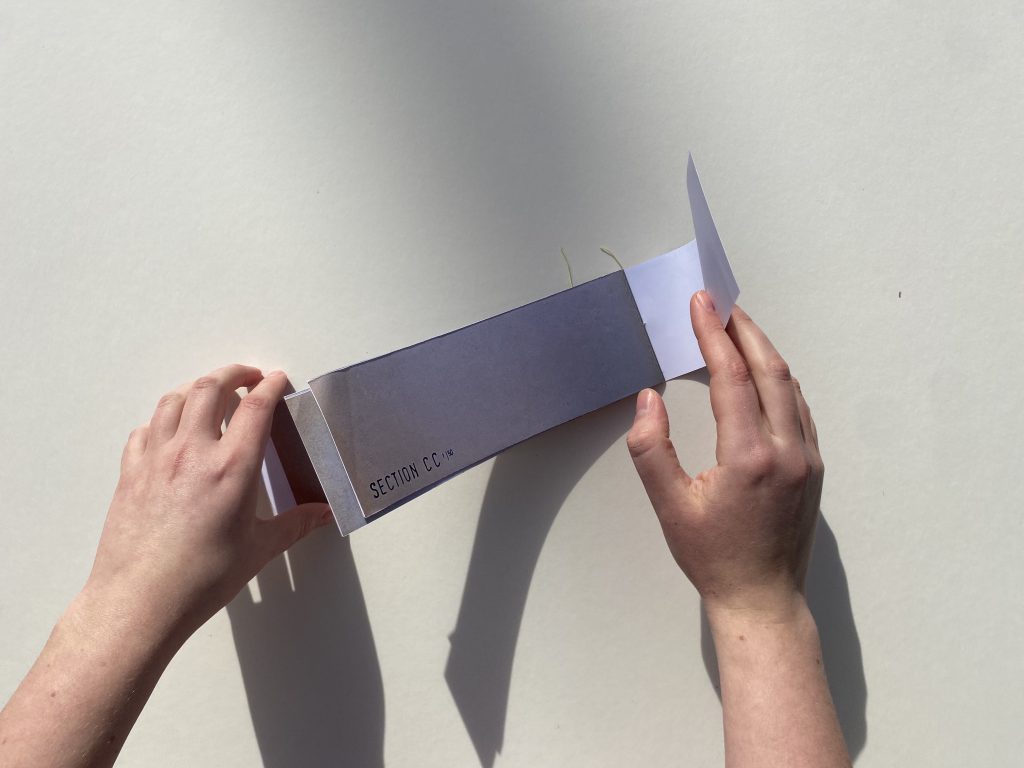
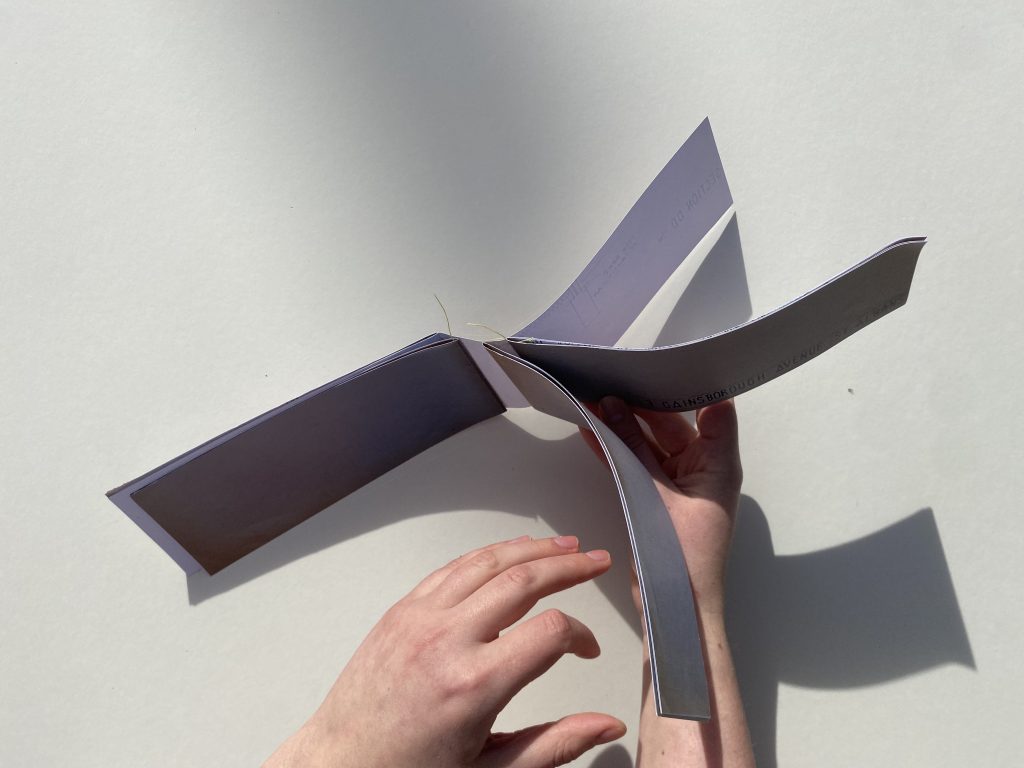
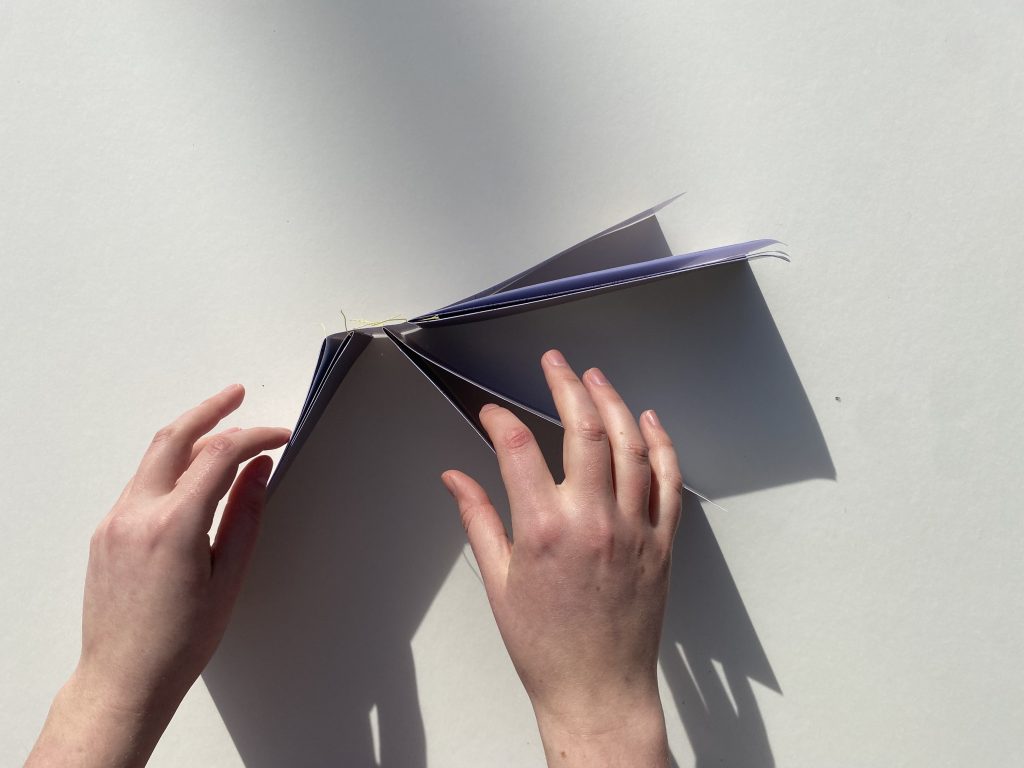
    Working quickly and intuitively, 12 iterations were created by binding the architectural drawings of my family home under the lens of the selected terms; constraint, trace, trace, sequence and friction.

    This blog post acts as a catalogue of the iterative experiments into the bound outcomes within bookbinding.

    CONSTRAINT

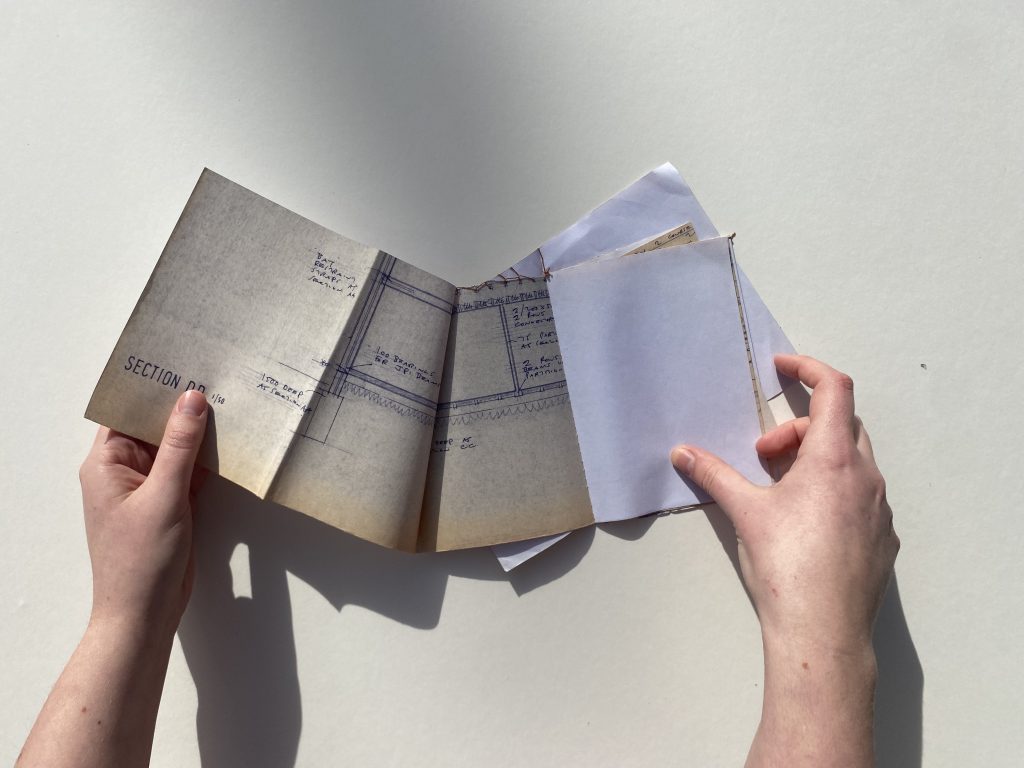
    The first set of experiments looked into the term constraint. Here, the pages were folded and bound so that the sectional drawings were partially concealed, forcing the reader to engage more deeply with the object to view the content.

    The second iteration saw the binding following moments of constraint within the architecture of the home, as well as the architectural notation. Dimensions on the drawing are bound, as they cannot be changed, therefore they are amplified here within the binding itself.  

    Similarly to the first experiment, this interpretation of constraint focused on the folding of the paper to constrain the knowledge that was visible. The notion of constraint was stitched into the investigation as the binding followed fixed architectural elements, such as the roofline of the building.

    TRACE

    Building upon the techniques used in the first set of iterations, this experiment exclusively bound the drawings together along the spaces within the home that my family have altered since moving in. Trace of human life, and our own experience of the house, has fuelled this trial. 

    Similarly to the previous investigation, this iteration adopts a similar methodology, albeit looser. This means that the binding is not so rigid and is further away from our understanding of conventional bookbinding practices.

    Within architecture, trace has an alternate meaning which can be defined by  the  structure used to subdivide windows into sections. In this spirit, this  inquiry focuses on tracing the locations of the windows in plan onto over  areas of the building.

    SEQUENCE

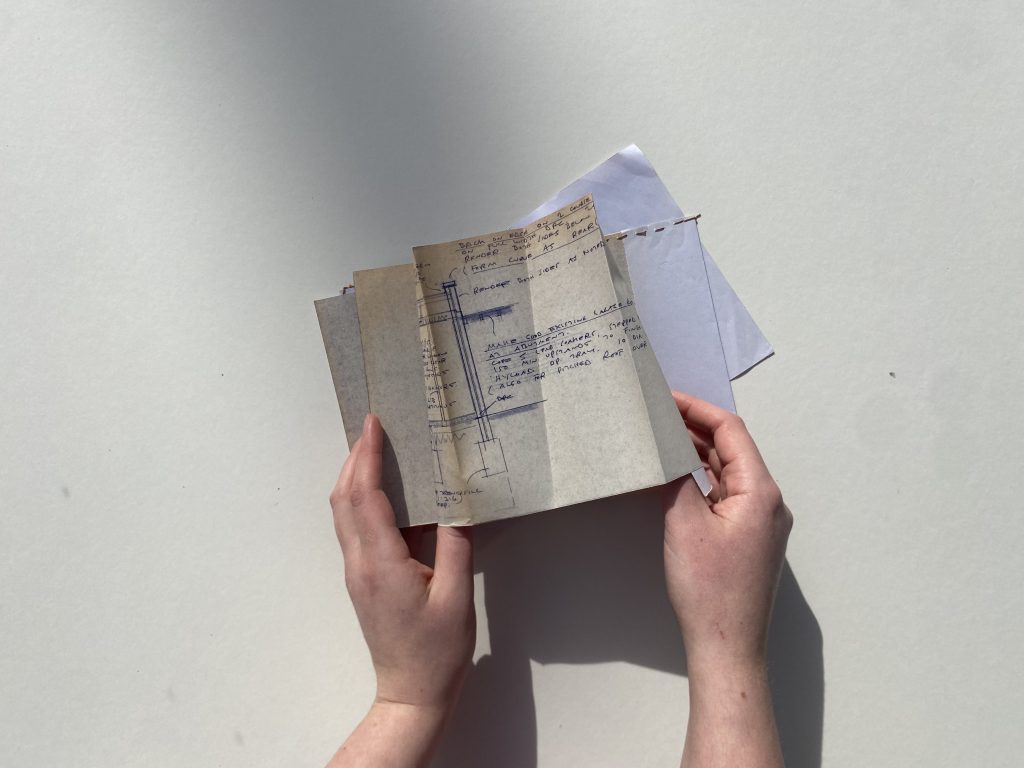
    Folding is a key process within bookbinding, and heavily alters the readers experience of the book. The folding of this publication sequences the information, concealing large portions of the drawings.

    Interpreting the term more literally, this trial sequentially binds together the pages of the booklet in a concertina format. 

    Within architecture, sequence is defined by the ordered progression of spaces, experiences or elements within a building. This iterative investigation follows the natural entrance sequence around my family hone, initially entering at the front door, moving through the ground floor, then traversing the stairs and exploring the first floor. The binding of the architectural plan amplified this sequential journey through the space.

    FRICTION

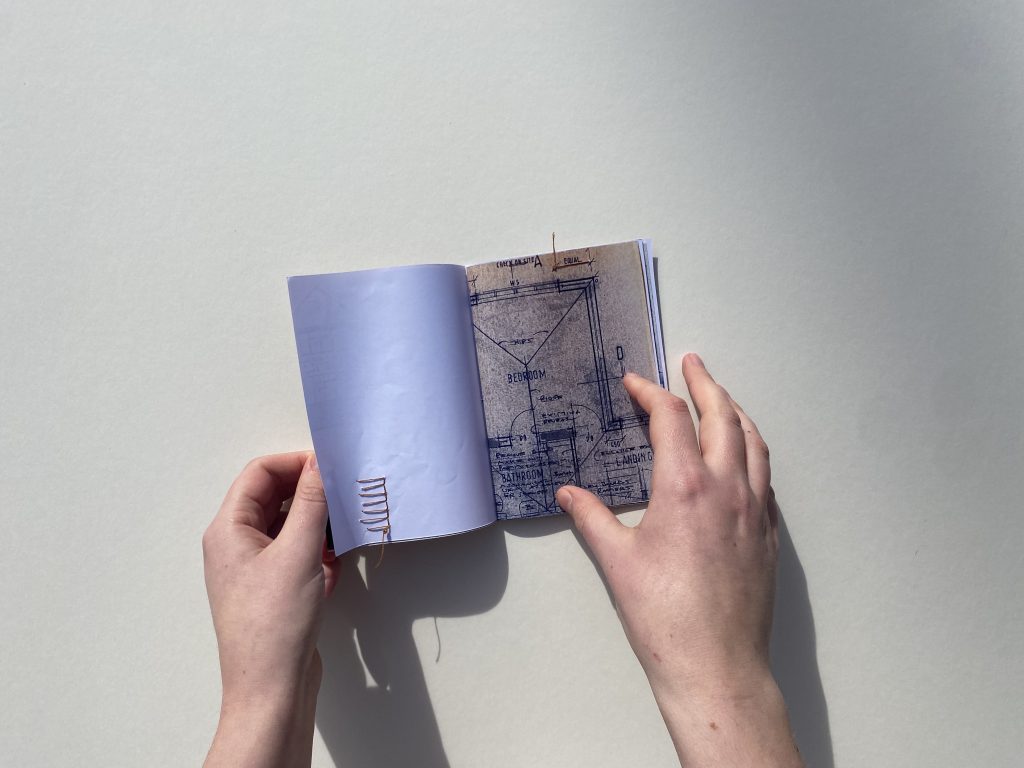
    The first iteration looked into the friction caused by the process of binding itself. A three hole sewn technique was used to bind the pages together. The publication was subsequently taken apart and put back together ten times, revealing the friction caused by the process. 

    The second version of friction sliced the pages along lines that correlated to friction within the architecture, such as level changes, external boundaries and roof eaves.

    The final iteration creates friction as the pages are turned, as the binding is displaced every few pages. The booklet does not turn easily, creating friction between the object and the reader. 

  • References

    Paul Bailey delivered an exceptional cross year studio, focused on the theme Text & Writing. We were tasked with three quick exercises, which explored who we are in conversation with, through our projects and practices. Ahead of the session, we were asked to select ten key references that are influencing our current practice, alongside a brief statement about the impact they have on our work.

    Banham, R. (1955) ‘The New Brutalism,’ The Architectural Review, 118 (708), pp. 335-361. 

        The architectural theory proposed by Reyner Banham in ‘The New Brutalism’ (1955) was translated into the field of type design in my previous studio project. 

        Rams, D. (2021) Ten Principles for Good Design. Munich: Prestel Publishing.

          A key text which is guiding current experimentation into whether design can be both honest and unobtrusive. 

          Fenner Paper. (2009) Size, Format, Stock. Tonbridge: Fenner Paper.

            This publication is the starting point for my current studio project which is reflecting on the skill and craftsmanship of bookbinding.

            Gysin, B. and Boroughs. W. (1978) The Third Mind. New York: The Viking Press.

              This text is a reflection on techniques introduced by William Boroughs. His cut-up technique has been adopted and reimagined within my iterative exercises to resequenced the bookbinders tools.

              McLachlan, F. et al. (2015) Colour Strategies in Architecture. Translated by I. Boyd White. Basel: Farbstrategien in der Architektur. 

                My interest lies as the intersection between architecture and communication design. Colour Strategies in Architecture explores graphical representations of conventional architectural concepts.

                Steyerl, H. (2012) ‘In Defense of the Poor Image’ in The Wretched of the Screen. Berlin: Sternberg Press, pp. 31-45. 

                  The writing style of Steyerl is accessible, yet the fundamental arguments are vastly complex and interwoven into topical social issues.

                  Mill, A. and Jones. L. (2019) Exile’s Letters. Oslo: Mill & Jones.

                    Exile’s Letters is another example of interdisciplinary design, with a focus on both graphics and architecture. There is strong relation between the text and illustrations.

                    Forensic Architecture. (2024) The Grenfell Tower Fire: Situated Testimonies. Available at:  https://forensic-architecture.org/investigation/the-grenfell-tower-fire-situated-testimonies (Accessed: 25 January 2026).
                      The practice has a continues and sustained influence over my practice, as they perfectly marry architecture and graphic design with a focus on social justice. 

                      Anderson, B. (2006) ‘Census, Map, Museum’ in Imagined Communities. London: Verso, pp.163-185. 

                        This was a key text that is presentative of a turning point within my own writing, as I grasped the concept of creative writing within the field of graphic communication design. 

                        Tsing, A. (2020) Fetal Atlas. Available at:  https://feralatlas.org/ (Accessed: 25 January 2026).
                          Anna Tsing reimagined collective idea around what academic literature is, with the illustration and composition of the atlas guiding the user to different article and journals.

                          FIRST EXPERIMENT

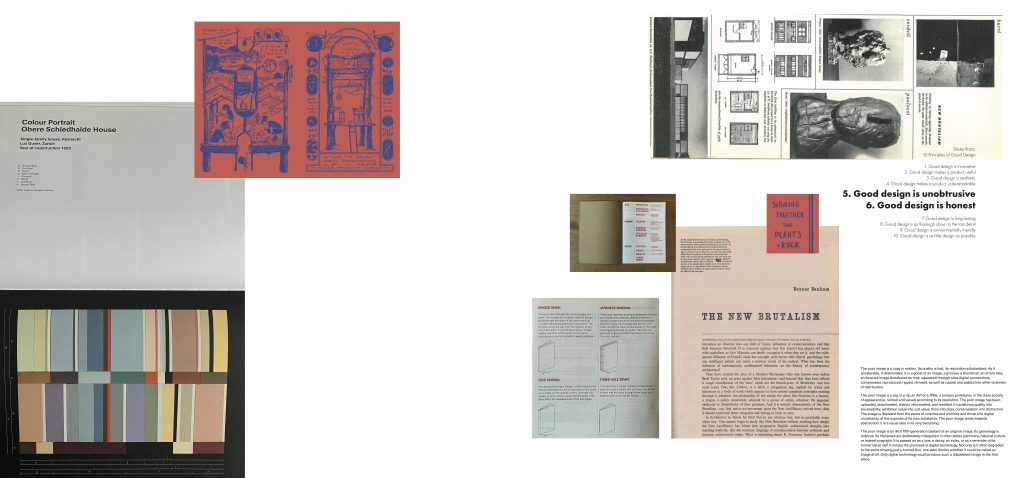
                          The first experiment challenged us to create a tableau with pages, clippings, extracts, photographs and diagrams from our selected references.

                          Fig. 1. Tableau created to illustrate key references that are currently influencing my work.

                          SECOND EXPERIMENT

                          The second experimented turned the focus into creating a slideshow of key extracts of text. I decided to put the texts in conversation with one another by introducing new references on the right side of each slide. 

                          Fig. 2. Slideshow created to guide viewer through important passages of the selected references.

                          THIRD EXPERIMENT

                          The third experiment refined the notion of putting the references in conversation with one another by pulling out key words that reoccur across the texts. 


                          The workshop with Paul Bailey was a practical approach to identify and reflect on the references that are currently influencing my work. Each piece of writing that I consume acts as a footnote within my life and helps mould my creative practice.

                          Reference List:

                          Anderson, B. (2006) ‘Census, Map, Museum’ in Imagined Communities. London: Verso, pp. 163-185. 

                          Banham, R. (1955) ‘The New Brutalism,’ The Architectural Review, 118 (708), pp. 335-361. 

                          Fenner Paper. (2009) Size, Format, Stock. Tonbridge: Fenner Paper.

                          Forensic Architecture. (2024) The Grenfell Tower Fire: Situated Testimonies. Available at:  https://forensic-architecture.org/investigation/the-grenfell-tower-fire-situated-testimonies (Accessed: 25 January 2026).
                          Gysin, B. and Boroughs. W. (1978) The Third Mind. New York: The Viking Press.
                          McLachlan, F. et al. (2015) Colour Strategies in Architecture. Translated by I. Boyd White. Basel: Farbstrategien in der Architektur.

                          Mill, A. and Jones. L. (2019) Exile’s Letters. Oslo: Mill & Jones.

                          Rams, D. (2021) Ten Principles for Good Design. Munich: Prestel Publishing.

                          Steyerl, H. (2012) ‘In Defense of the Poor Image’ in The Wretched of the Screen. Berlin: Sternberg Press, pp. 31-45. 

                          Tsing, A. (2020) Fetal Atlas. Available at:  https://feralatlas.org/ (Accessed: 25 January 2026).