Paul Bailey delivered an exceptional cross year studio, focused on the theme Text & Writing. We were tasked with three quick exercises, which explored who we are in conversation with, through our projects and practices. Ahead of the session, we were asked to select ten key references that are influencing our current practice, alongside a brief statement about the impact they have on our work.
Banham, R. (1955) ‘The New Brutalism,’ The Architectural Review, 118 (708), pp. 335-361.
The architectural theory proposed by Reyner Banham in ‘The New Brutalism’ (1955) was translated into the field of type design in my previous studio project.
Rams, D. (2021) Ten Principles for Good Design. Munich: Prestel Publishing.
A key text which is guiding current experimentation into whether design can be both honest and unobtrusive.
Fenner Paper. (2009) Size, Format, Stock. Tonbridge: Fenner Paper.
This publication is the starting point for my current studio project which is reflecting on the skill and craftsmanship of bookbinding.
Gysin, B. and Boroughs. W. (1978) The Third Mind. New York: The Viking Press.
This text is a reflection on techniques introduced by William Boroughs. His cut-up technique has been adopted and reimagined within my iterative exercises to resequenced the bookbinders tools.
McLachlan, F. et al. (2015) Colour Strategies in Architecture. Translated by I. Boyd White. Basel: Farbstrategien in der Architektur.
My interest lies as the intersection between architecture and communication design. Colour Strategies in Architecture explores graphical representations of conventional architectural concepts.
Steyerl, H. (2012) ‘In Defense of the Poor Image’ in The Wretched of the Screen. Berlin: Sternberg Press, pp. 31-45.
The writing style of Steyerl is accessible, yet the fundamental arguments are vastly complex and interwoven into topical social issues.
Mill, A. and Jones. L. (2019) Exile’s Letters. Oslo: Mill & Jones.
Exile’s Letters is another example of interdisciplinary design, with a focus on both graphics and architecture. There is strong relation between the text and illustrations.
Forensic Architecture. (2024) The Grenfell Tower Fire: Situated Testimonies. Available at: https://forensic-architecture.org/investigation/the-grenfell-tower-fire-situated-testimonies (Accessed: 25 January 2026).
The practice has a continues and sustained influence over my practice, as they perfectly marry architecture and graphic design with a focus on social justice.
Anderson, B. (2006) ‘Census, Map, Museum’ in Imagined Communities. London: Verso, pp.163-185.
This was a key text that is presentative of a turning point within my own writing, as I grasped the concept of creative writing within the field of graphic communication design.
Tsing, A. (2020) Fetal Atlas. Available at: https://feralatlas.org/ (Accessed: 25 January 2026).
Anna Tsing reimagined collective idea around what academic literature is, with the illustration and composition of the atlas guiding the user to different article and journals.
FIRST EXPERIMENT
The first experiment challenged us to create a tableau with pages, clippings, extracts, photographs and diagrams from our selected references.
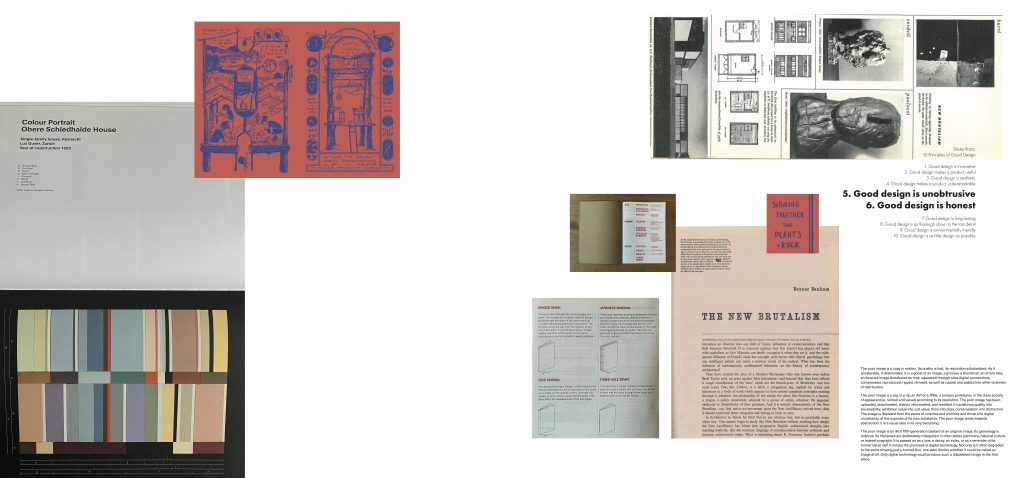
SECOND EXPERIMENT
The second experimented turned the focus into creating a slideshow of key extracts of text. I decided to put the texts in conversation with one another by introducing new references on the right side of each slide.
THIRD EXPERIMENT
The third experiment refined the notion of putting the references in conversation with one another by pulling out key words that reoccur across the texts.
The workshop with Paul Bailey was a practical approach to identify and reflect on the references that are currently influencing my work. Each piece of writing that I consume acts as a footnote within my life and helps mould my creative practice.
Reference List:
Anderson, B. (2006) ‘Census, Map, Museum’ in Imagined Communities. London: Verso, pp. 163-185.
Banham, R. (1955) ‘The New Brutalism,’ The Architectural Review, 118 (708), pp. 335-361.
Fenner Paper. (2009) Size, Format, Stock. Tonbridge: Fenner Paper.
Forensic Architecture. (2024) The Grenfell Tower Fire: Situated Testimonies. Available at: https://forensic-architecture.org/investigation/the-grenfell-tower-fire-situated-testimonies (Accessed: 25 January 2026).
Gysin, B. and Boroughs. W. (1978) The Third Mind. New York: The Viking Press.
McLachlan, F. et al. (2015) Colour Strategies in Architecture. Translated by I. Boyd White. Basel: Farbstrategien in der Architektur.
Mill, A. and Jones. L. (2019) Exile’s Letters. Oslo: Mill & Jones.
Rams, D. (2021) Ten Principles for Good Design. Munich: Prestel Publishing.
Steyerl, H. (2012) ‘In Defense of the Poor Image’ in The Wretched of the Screen. Berlin: Sternberg Press, pp. 31-45.
Tsing, A. (2020) Fetal Atlas. Available at: https://feralatlas.org/ (Accessed: 25 January 2026).
Leave a Reply