EXTENDED CRITICAL ANAYLSES
Analysis 1: The Text
Perec, G. (1999) ‘Species of Spaces’, in Species of Spaces and Other Pieces. London: Penguin, pp. 46–56.
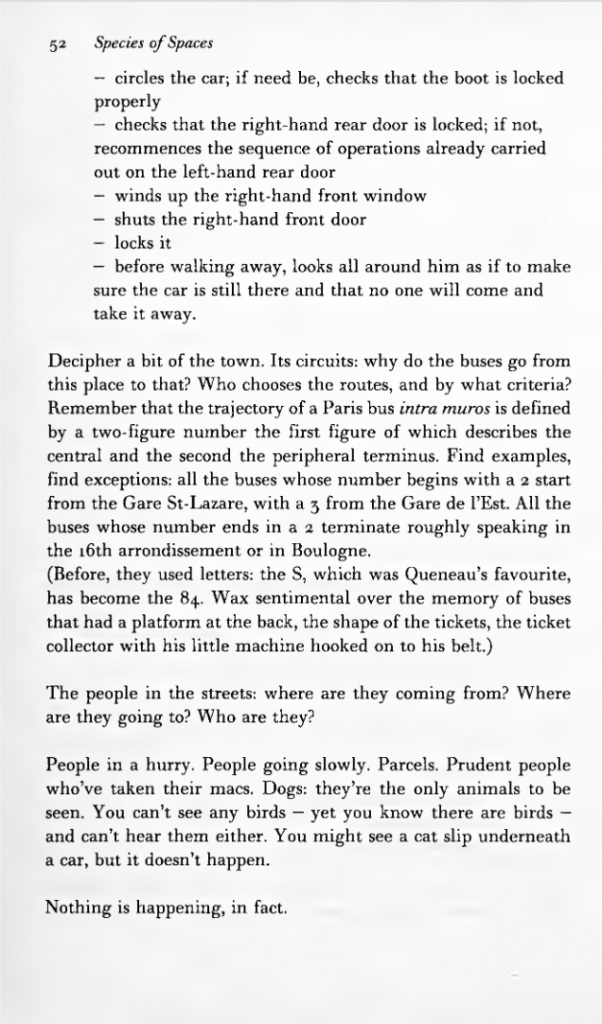
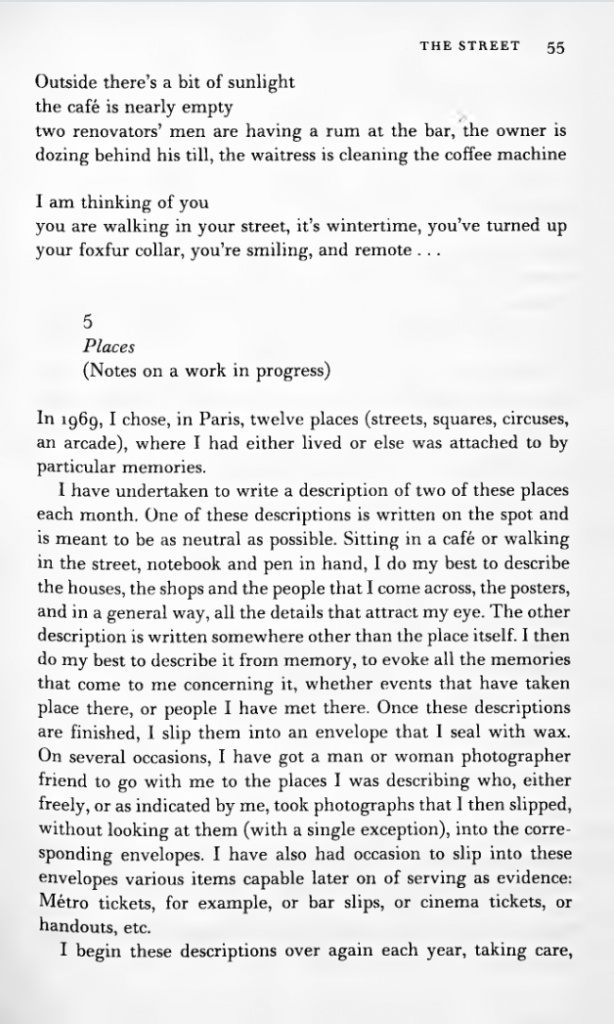
‘What I hope for from it, in effect, is nothing other than the record of a threefold experience of
ageing: of the places themselves, of my memories, and of my writing’ (Perec, 1999).
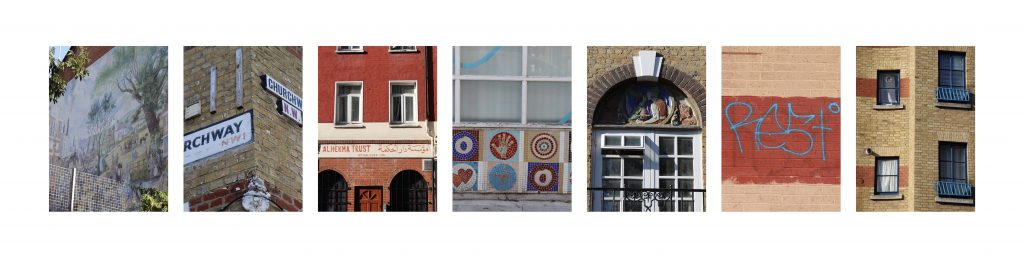
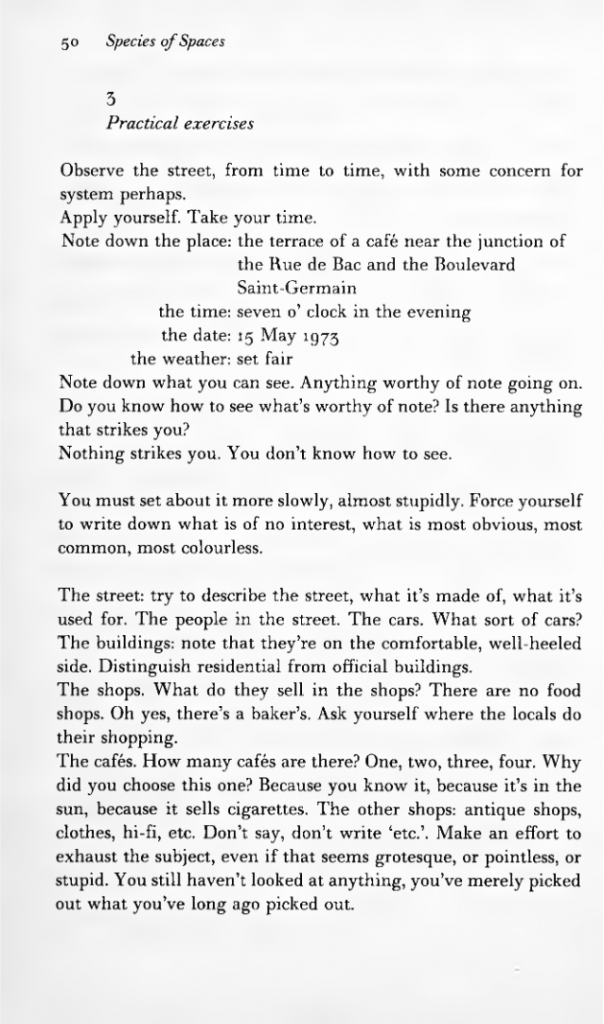
In ‘Species of Spaces’, Georges Perec (1999) considers the act of deciphering the city. Perec (1999) initially explores the architectural and spatial constraints that form The Street. This is evidenced through his methods of observation to ‘decipher to the city’ (Perec, 1999). The scope begins as street-wide and zooms to a scale where the minute details of people and space can be monitored.
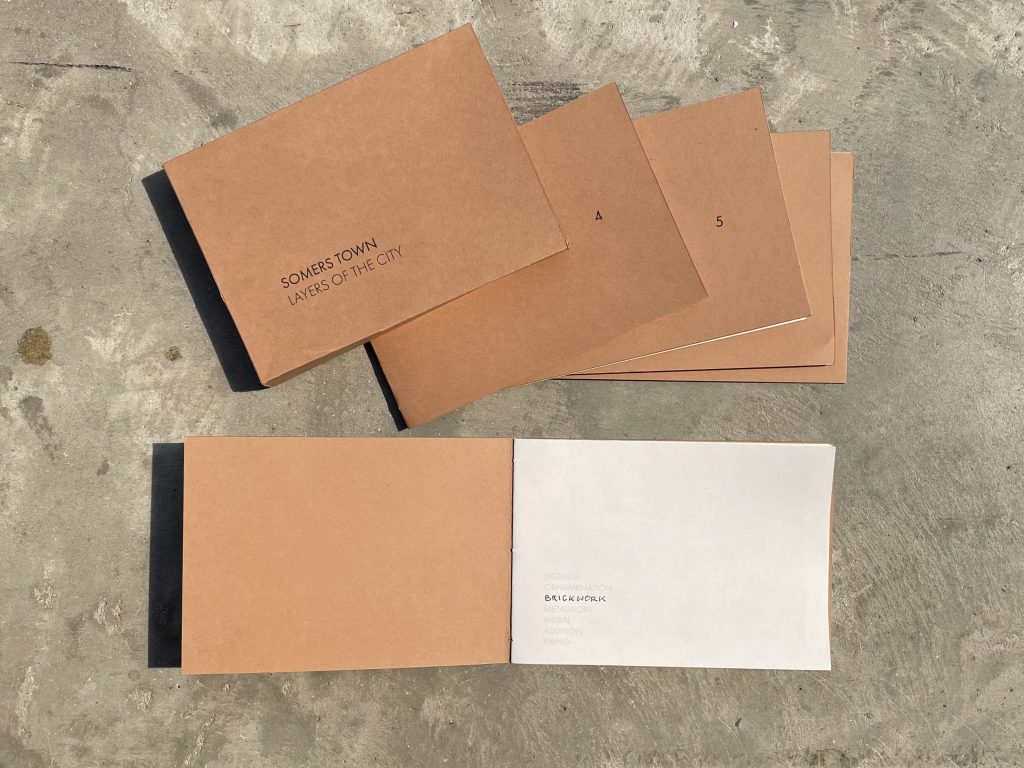
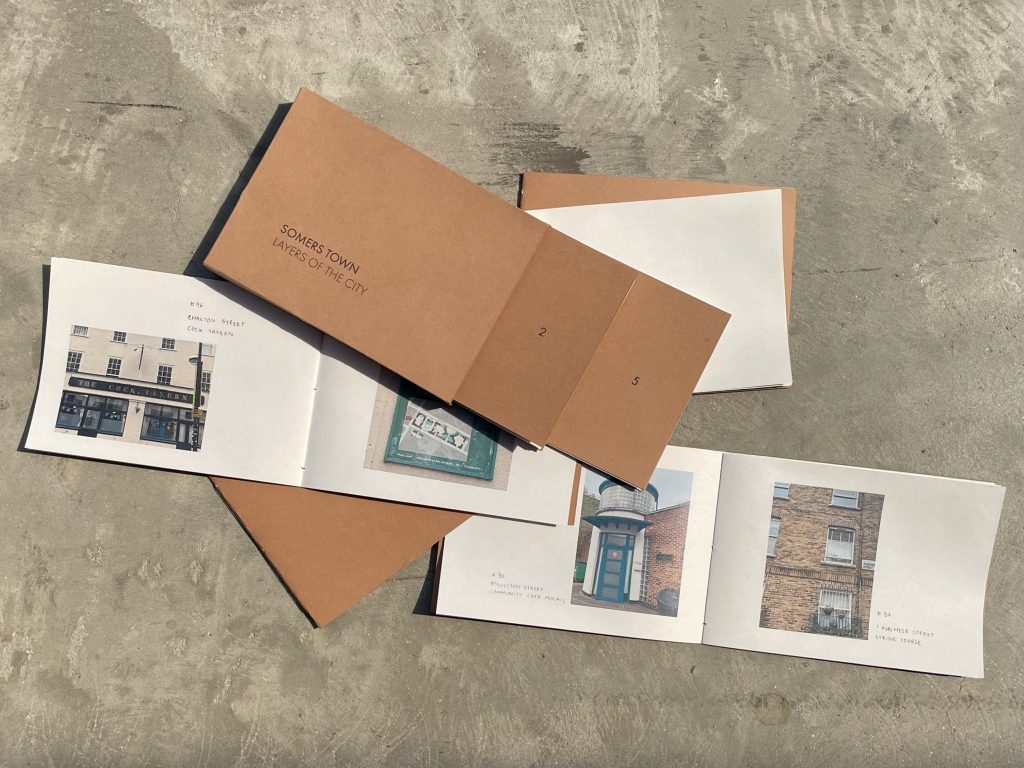
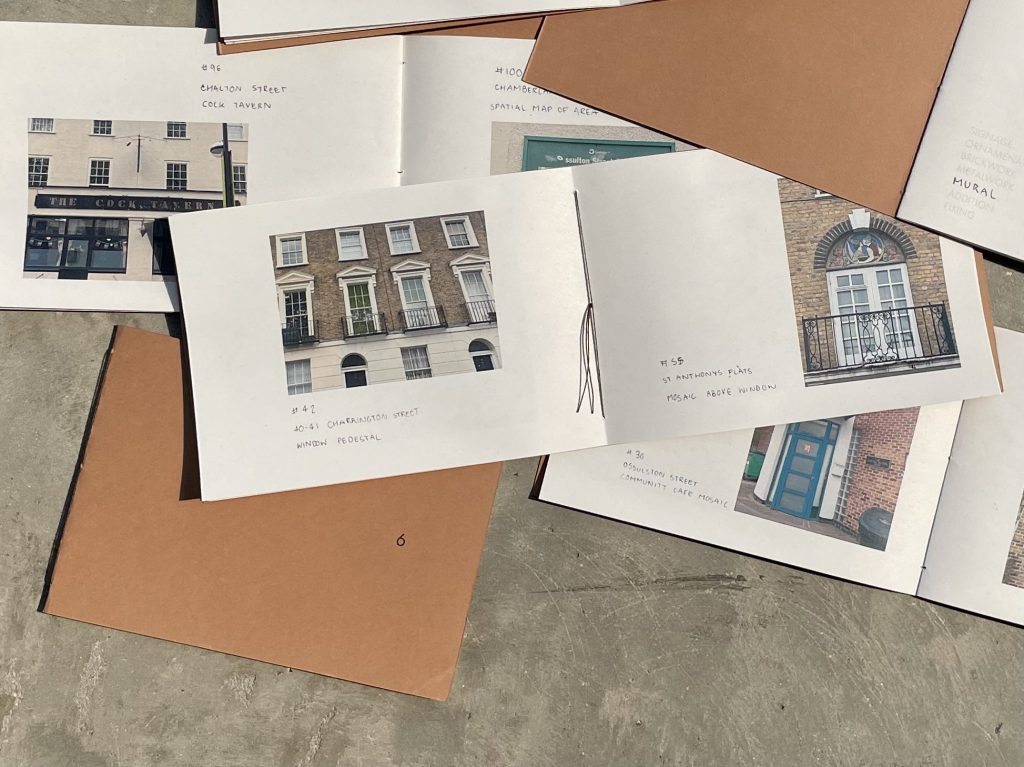
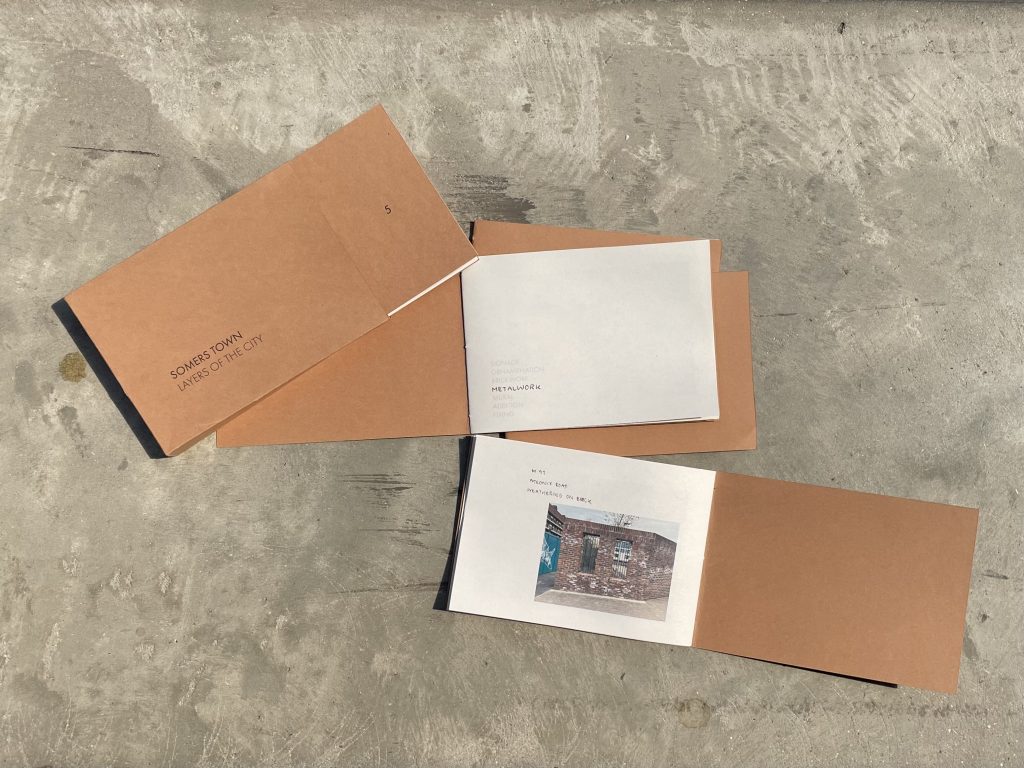
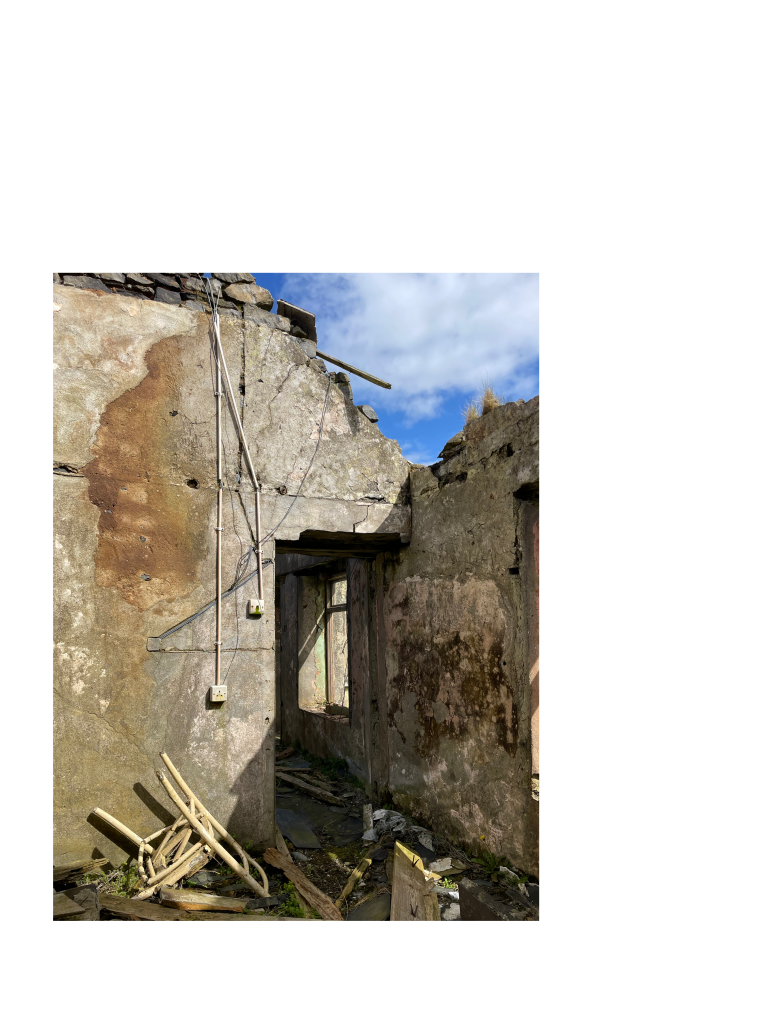
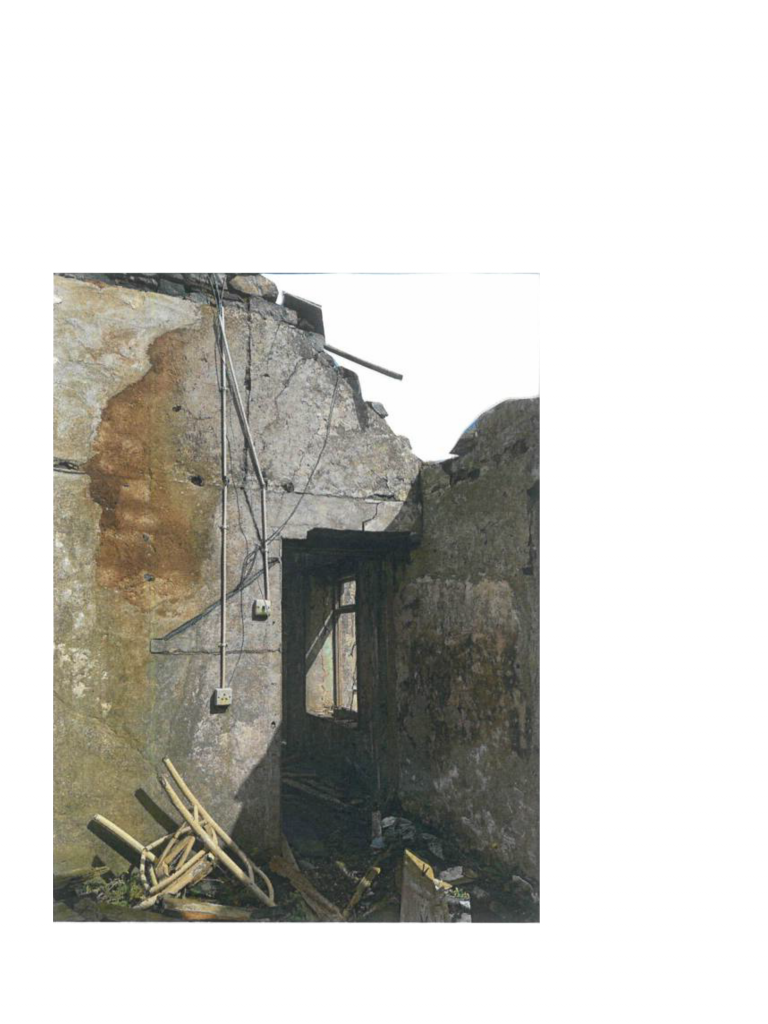
This position was critically explored through the early Position through Iterating investigation. Architectural palimpsests within the urban environment in Somers Town, London, were systematically collected and documented. Following Perec’s (1999) practical methods, as described under the third subchapter, did not yield insight into the history of the place and the lives that exist within the city. The observation was arguably surface-level and did not communicate the nuanced relationship between people and space.
In contradiction to Perec (1999), Barthes (1977) states ‘in the multiplicity of writing, everything is to be disentangled, nothing deciphered’. The act of deciphering suggests that observation is used to decode or understand, whereas the term of disentangling indicates an element of interpretation. When returning to the studio work, the emphasis changed from deciphering the city to disentangling the place. This pivot provided an opportunity to relocate the site of interest, and the subsequent investigation was repositioned in the context of the rural West Coast of Ireland.
Within the chapter, titled ‘Species of Spaces’, Perec (1999) uses a variety of writing structures. At the beginning of the passage the text follows a formal writing style, using traditional sentence structures in a justified layout. The form is reflective of the tone of the writing, which also follows a traditional prose structure. As the text progresses, the parameters of the writing seems to change in both form and rhetoric. Perec (1999) introduces practical exercises to decipher the city, adopting a bullet point writing structure. The text feels more disjointed as the sentences are abridged. Sentence length devolves, reaching a precipice in the third subchapter: ‘nothing is happening, in fact’. The tempo of the writing accelerates, emulating the pace of life within the city. This continues into the fourth subchapter. The fifth, and final, subchapter returns to a traditional writing structure, and the tempo of the text slows again. The pace of the narrative reflects the content, as considerate writing is introduced as a practical method to document the city.
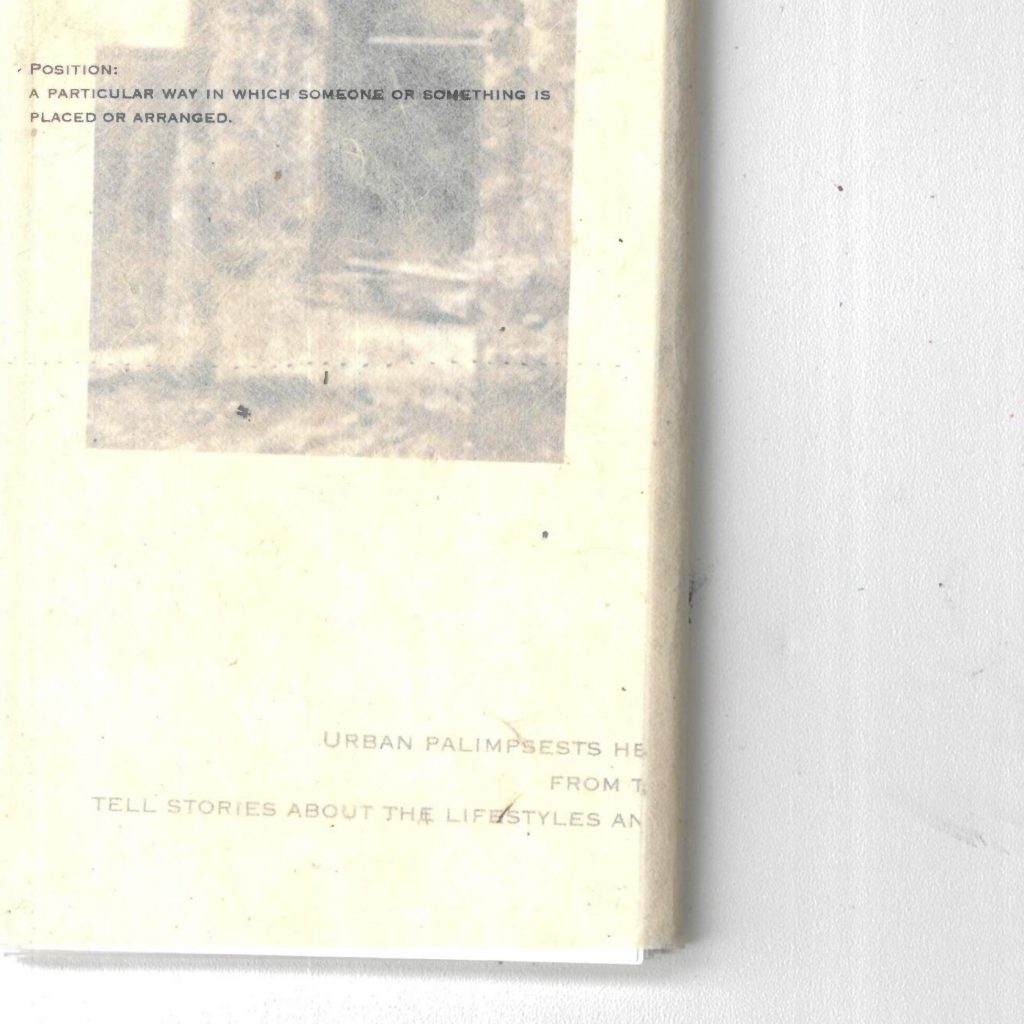
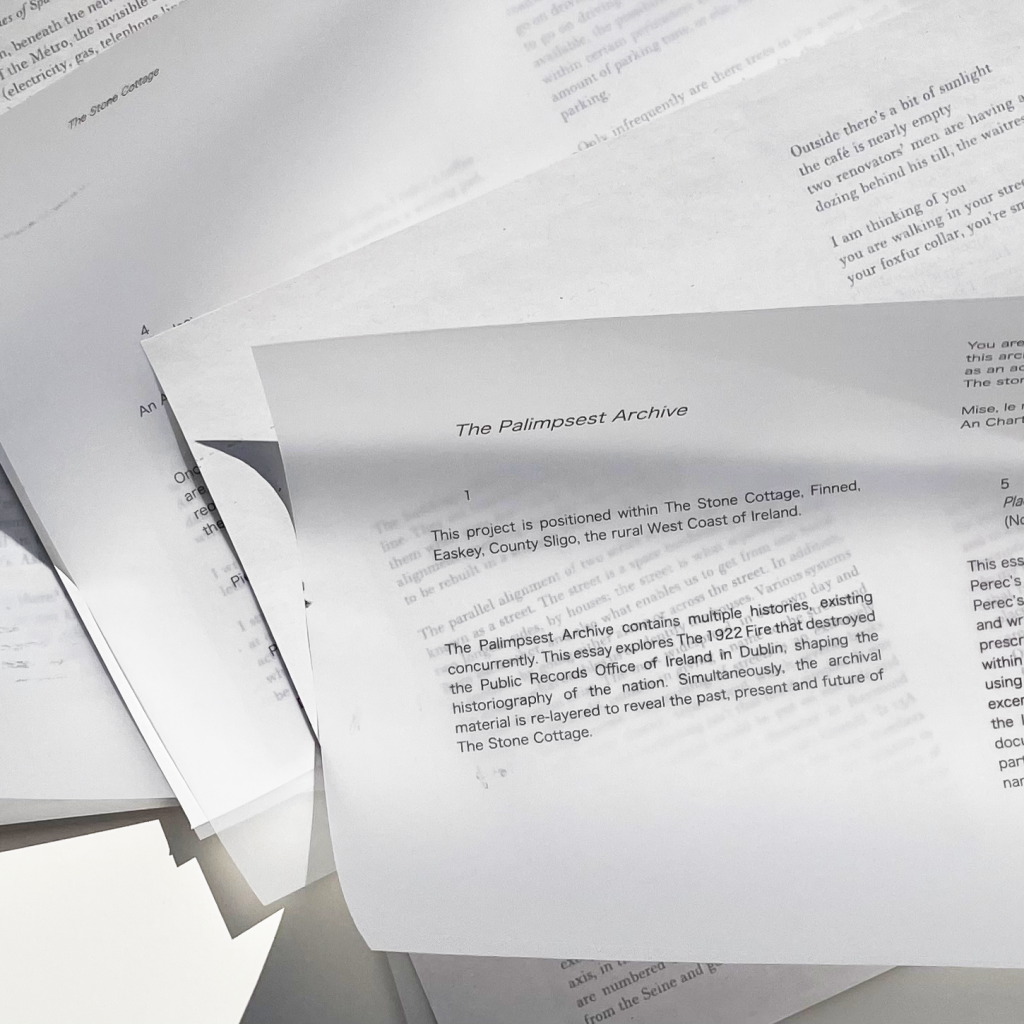
Perec’s (1999) ‘Species of Spaces’ was chosen as the primary reference within the studio enquiry, explored through the making prompt: circulate, distribute, or publish the reference—or some translation of it—via a different platform or economy. The Palimpsest Archive, created in the accompanying studio work, aims to emulate a similar tempo sequence as seen in ‘Species of Spaces’ (Perec, 1999). When the archive is opened, the documents are catalogued and ordered. As the user begins to interact with these documents, they become unbound and there is a sense of disarray. This disentanglement of the physical documents is a necessary process to disentangle the history of The Stone Cottage. This stage directly reflects Perec’s (1999) third and fourth subchapters. Similarly to Perec’s (1999) final chapter, the pace of the participatory archival process slows as the user regains control, as they position the documents in relation to one another.
Perec (1999) denotes the relationship between place, memory and writing as an effective record of the experience of ageing. These themes are inseparable as they all are dependent on one another. Place, memory and writing guide the studio work through a system of categorisation. Perec (1999) utilises a process where he writes, and a photographer captures. This exercise is repeated every month and logged within a time capsule. His own perception of space is sat side by side the photographers interpretation. The envelopes used within Perec’s (1999) living archive act as a container of the experience of ageing. Similarly, the archival box is used within the studio work to hold the history of The Stone Cottage. This method of recording challenges my existing perception of communication design, which is typically dominated by visuals used to distill complex information for public consumption. Perec (1999) demonstrates that a micro-intervention can be an equally valuable and legitimate method to communicate a position.
Analysis 2: The Project
OK-RM (2023) 555: Revisiting The Fashion Archive of Francisco Costa. New York: Rizzoli.
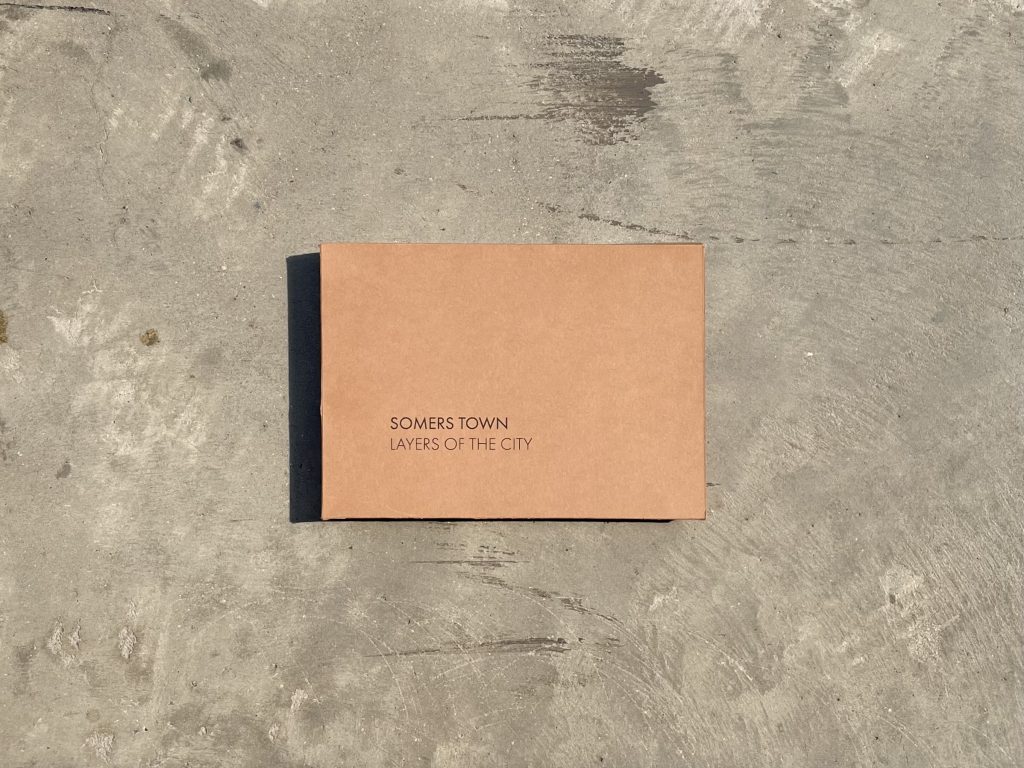
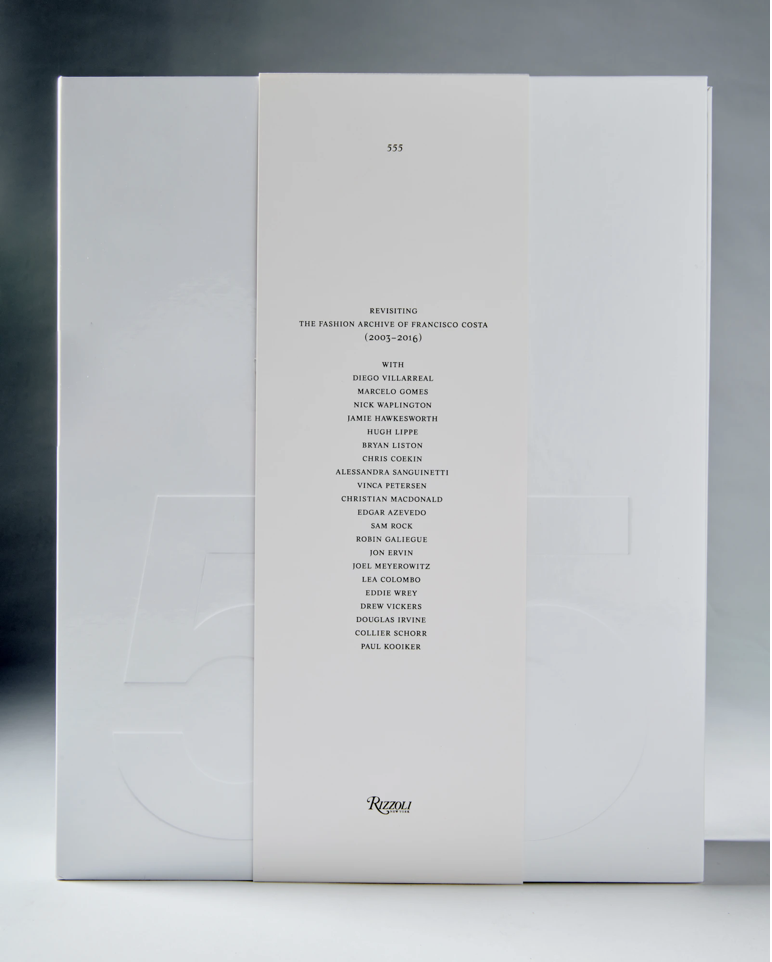
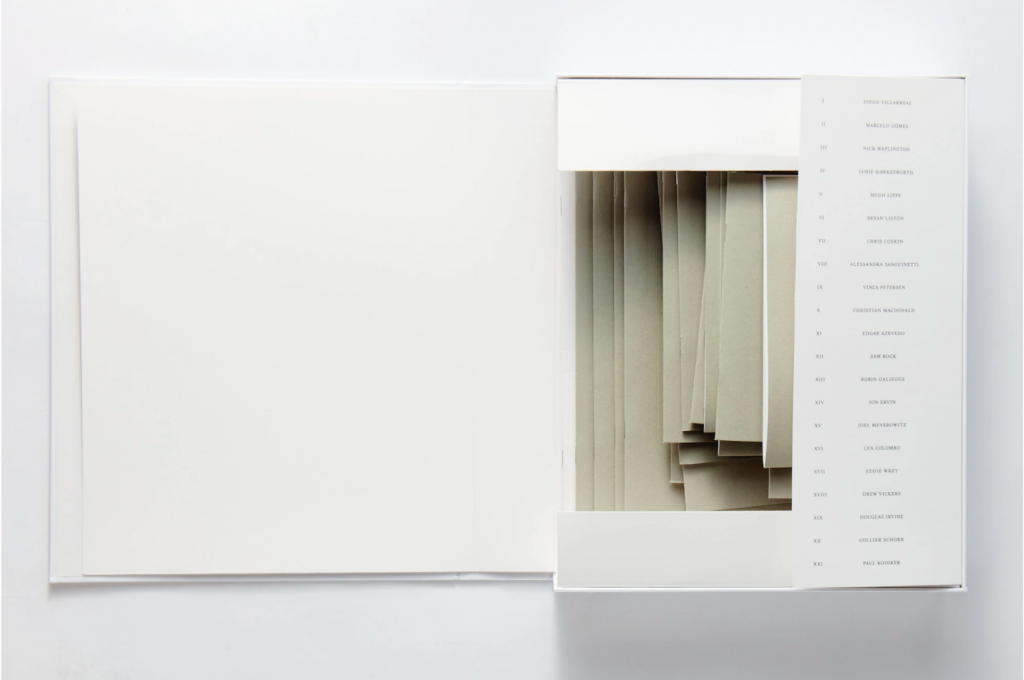
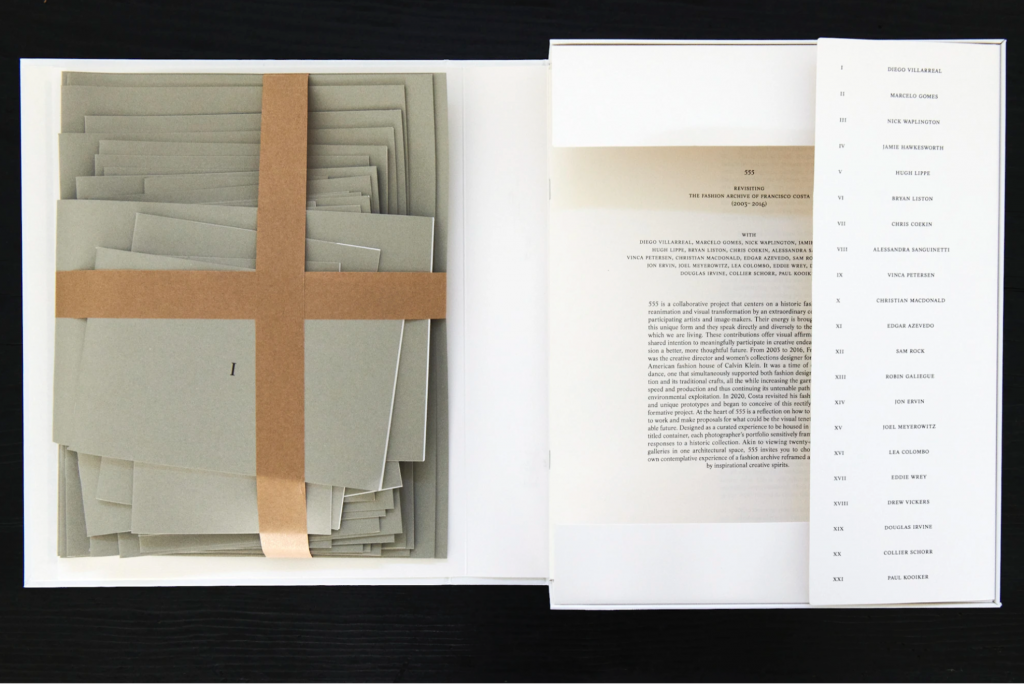
OK-RM’s (2023) ‘555: Revisiting The Fashion Archive of Francisco Costa’ encapsulates contemporary approaches towards archival practices. The visual language of the publication has recognisable archival elements, such as the box construction and the use of a catalogue, but rejects any perception of archival work as being stuffy and outdated, rather embracing strong graphic motifs and well-considered copy.
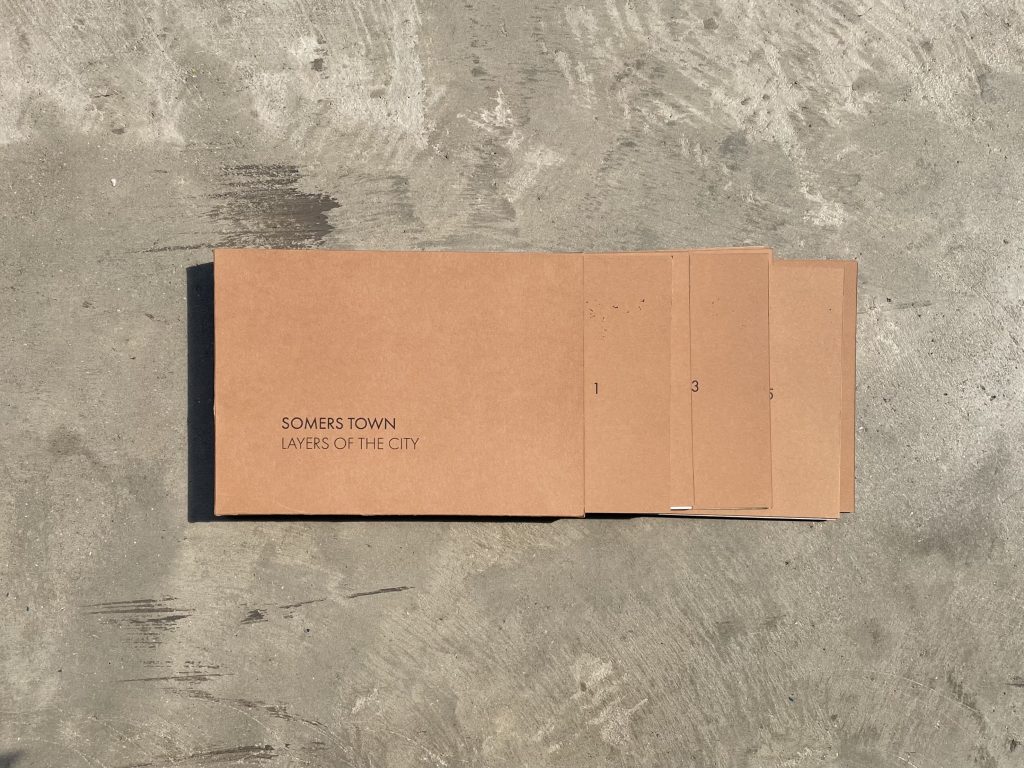
The fragmented parts of the history of Francisco Costa are illustrated through smaller divided publications within the larger archival box (OK-RM, 2023). The format of the smaller publications influenced my studio project, where pieces of the history of The Stone Cottage are collected and contained within The Palimpsest Archive, only revealing the full extent of the buildings history when read in conjunction with one another.
OK-RM (2023) utilise a traditional archival box as a receptacle for the history of Francisco Costa. Parallels can be drawn between this project and John Beattie’s (2021-2023) ‘Shadowing the Archive’. Beattie utilises the box as a physical and metaphorical container of multiple histories, all running in tandem. Mirroring OK-RM’s (2023) position as a collector of histories, The Palimpsest Archive brings together a range of subject matters, all coexisting within the archival box. The Palimpsest Archive is created using a range of bibliographic references that span a range of subject matters: palimpsest within architecture; image manipulation and degradation; the history of derelict stone cottages and their inhabitants in Easkey, County Sligo; the relationship between writing, memory and place; the destruction of The Public Record Office of Ireland in 1922; and, the restoration techniques used by The National Archives of Ireland. These themes all exist concurrently, and layer upon one another to create the palimpsestic history of The Stone Cottage.
The relationship between the materiality of the documents and the contents of the archive is well-considered within ‘555: Revisiting The Fashion Archive of Francisco Costa’ (OK-RM, 2023). A range of paper textures have been used as a critical wayfinding tool within the archive. For example, the recycled grey paper is employed consistently across the covers of the individual categorised publications. The materiality of The Palimpsest Archive demanded an equally considered approach. The selection of the materials hark back to the archival techniques used in the restoration of the documents partially destroyed by The 1922 Fire, whilst simultaneously encouraging the user to engage. A variety of translucent and semi-translucent papers were used to allow the documents to be overlayed and read in conjunction. This created a sense of tactility and ephemerality within the archive, reinforced by the impermanence of the form of the documents due to the lack of binding.
OK-RM (2023) created an overleaf within the construction of the archival box, which provides a space to display the categorisation technique used across the work. This form was adopted within The Palimpsest Archive. The documents are initially bound by the themes of place, memory and writing, reflecting Perec’s (1999) method of recording ageing. Each category assumes a different size document. This cataloguing system is reflected on the box overleaf, which illustrates the positions of place, memory and writing within the publication. OK-RM’s ‘555: Revisiting The Fashion Archive of Francisco Costa’ (2023) provides the infrastructure for the visual language of The Palimpsest Archive. This creates a physical site for further exploration of Perec’s (1999) methods of recording ageing through a participatory archival practice.
BIBLIOGRAPHY INTRODUCTION
The order of the bibliography entries has been considered so that it follows the narrative of my archival process. The key themes of each source interrelate to the previous references, whilst simultaneously introducing a new critical perspective on my work. Each entry is also categorised into place, memory or writing, reflecting Perec’s (1999) methods of documenting ageing. This cataloging process is employed as a critical tool across my written and studio work alike.
A CONTINUALLY GROWING BIBLIOGRAPHY OF REFERENCES.
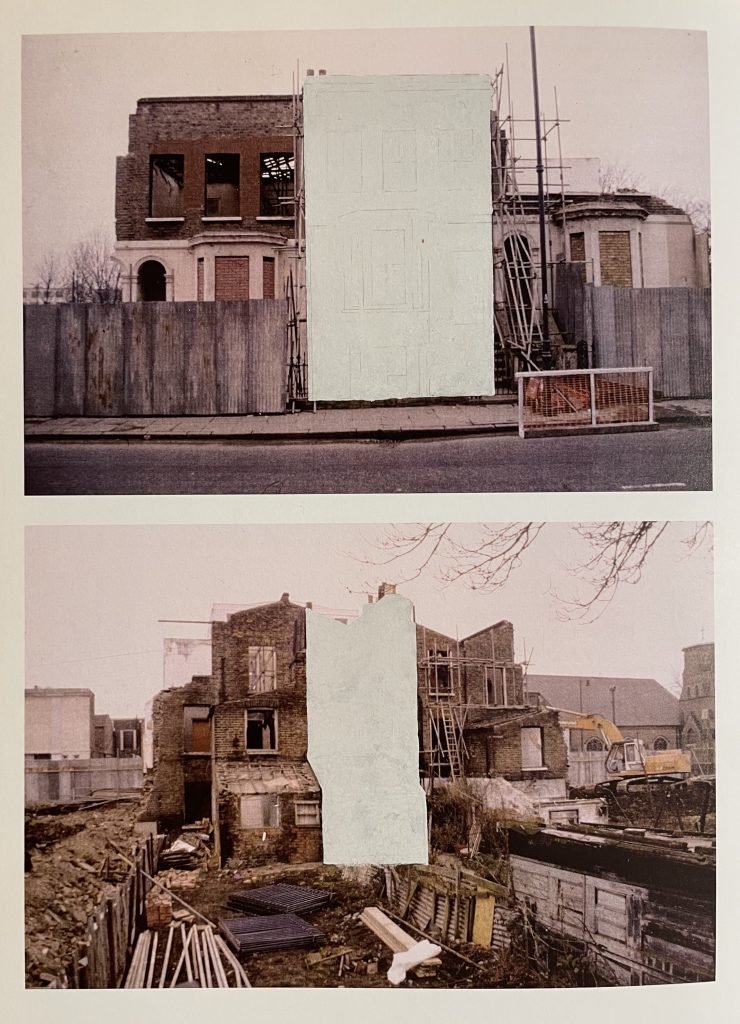
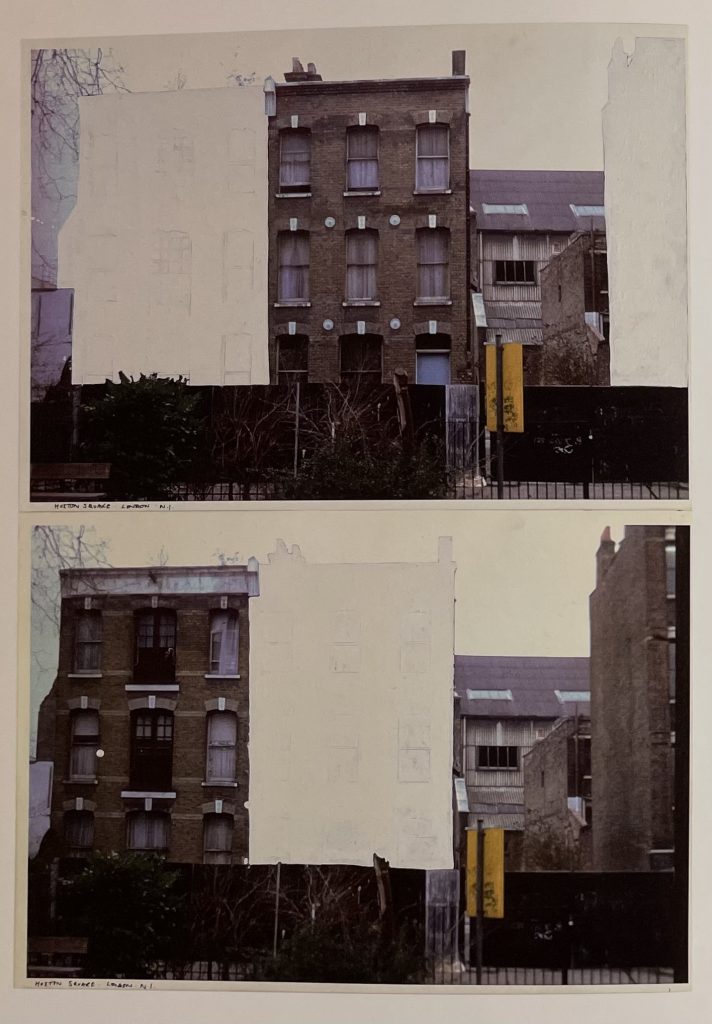
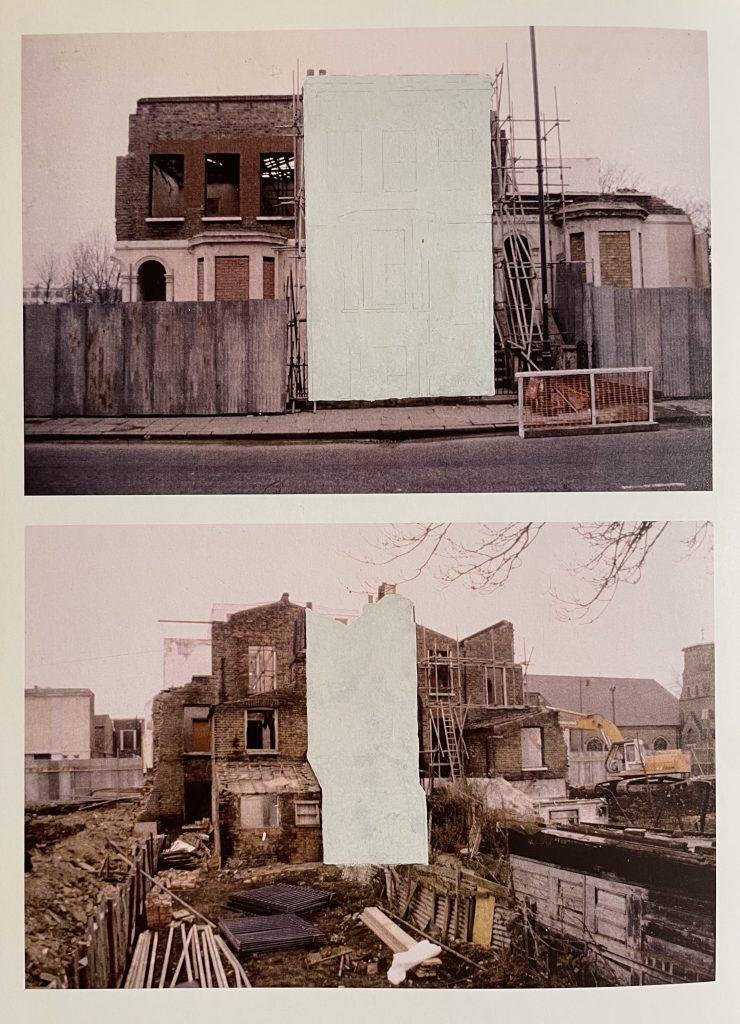
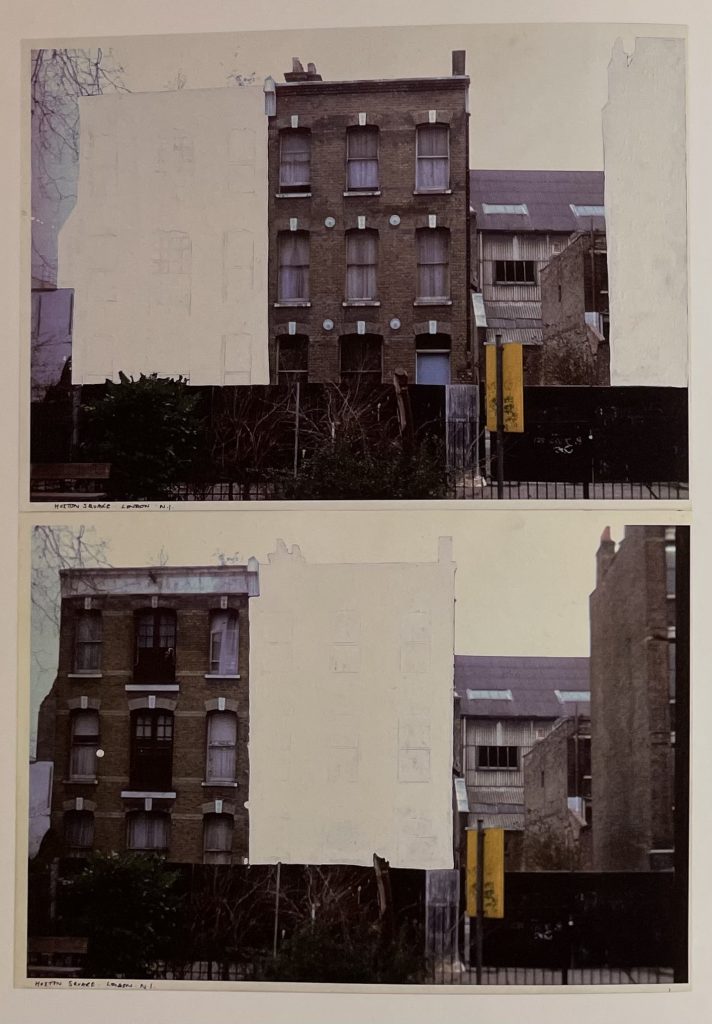
Whiteread, R. (1992) House Study (Grove Road) [Correction fluid, pencil, watercolour on colour photocopy]. [PLACE]
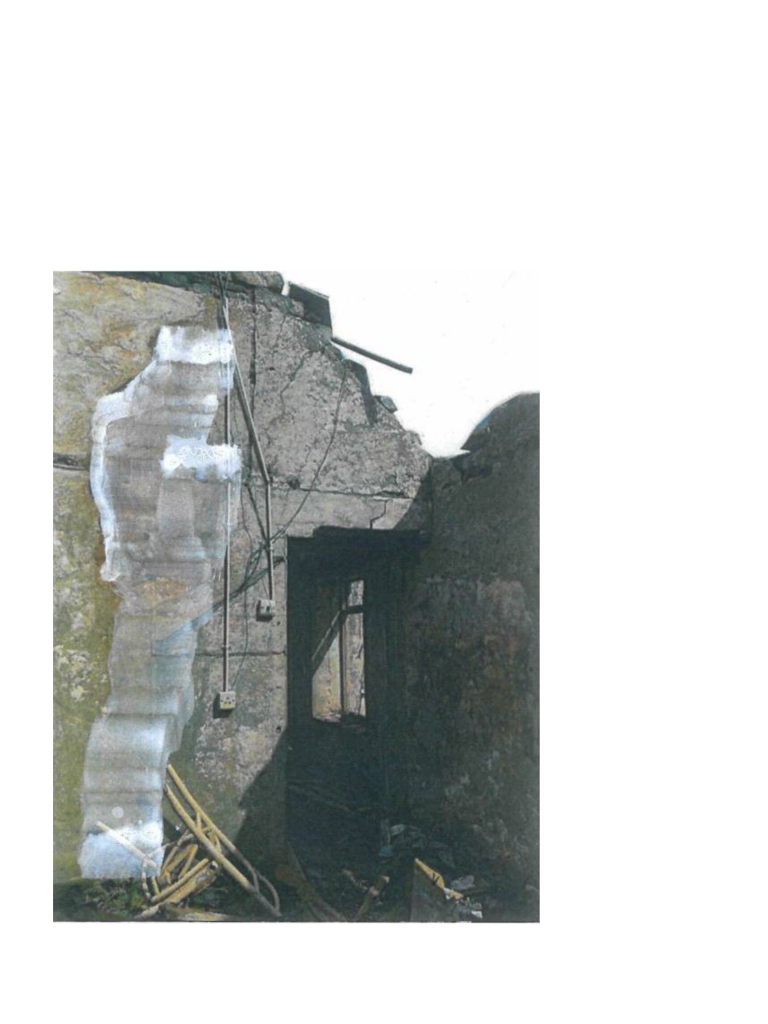
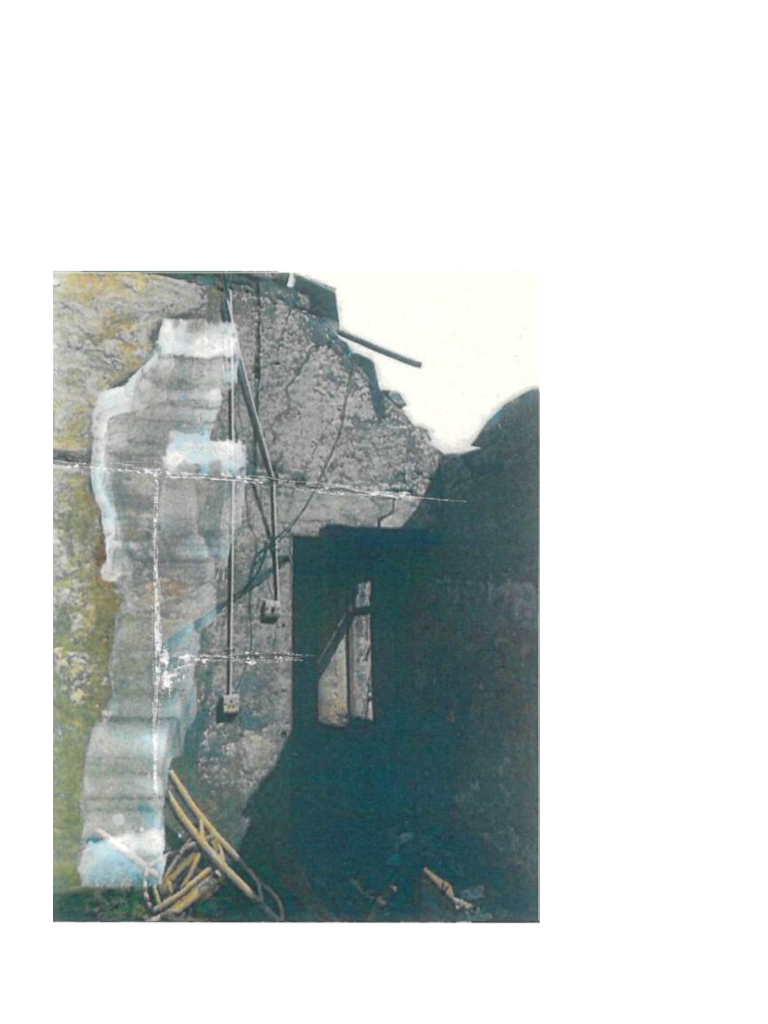
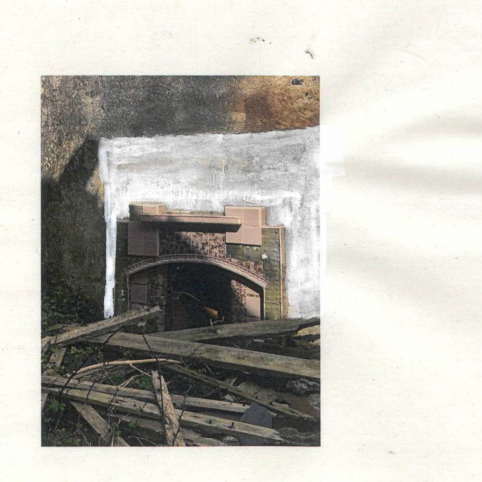
House Study (Grove Road) by Rachel Whiteread (1992) utilises analogue methods of image manipulation to conceal and reveal parts of a building mid-demolition. Whiteread’s (1992) practical process reinforces the sense of palimpsest within the architecture, as the buildings due to be razed are portrayed as ghosts of the city.
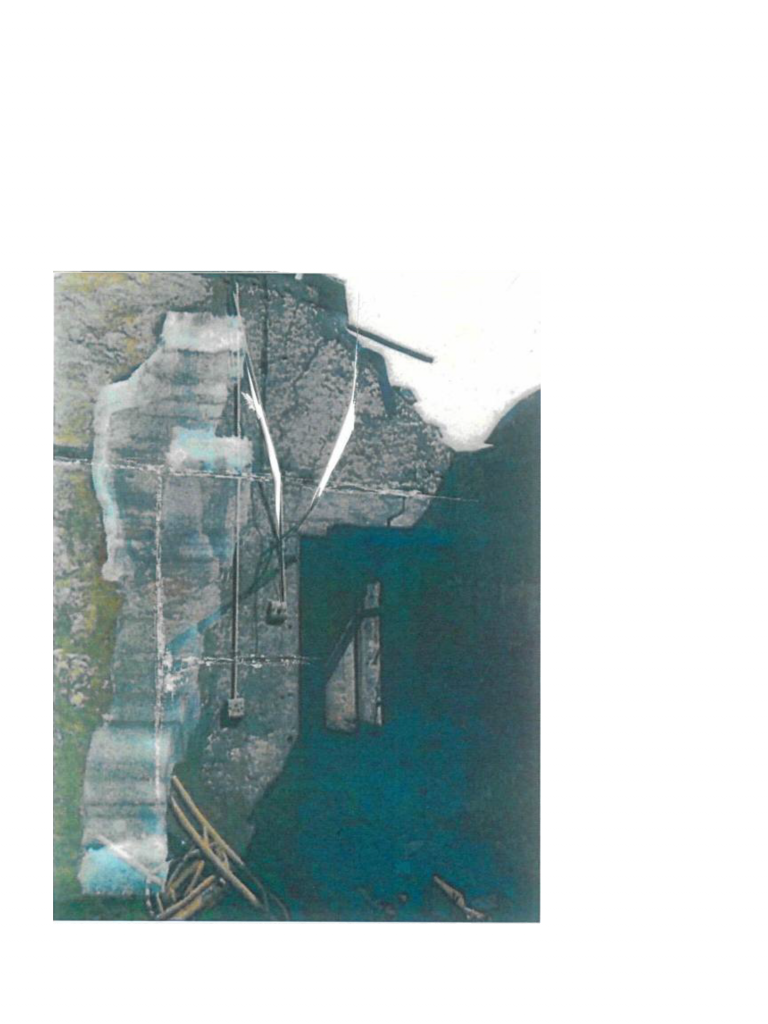
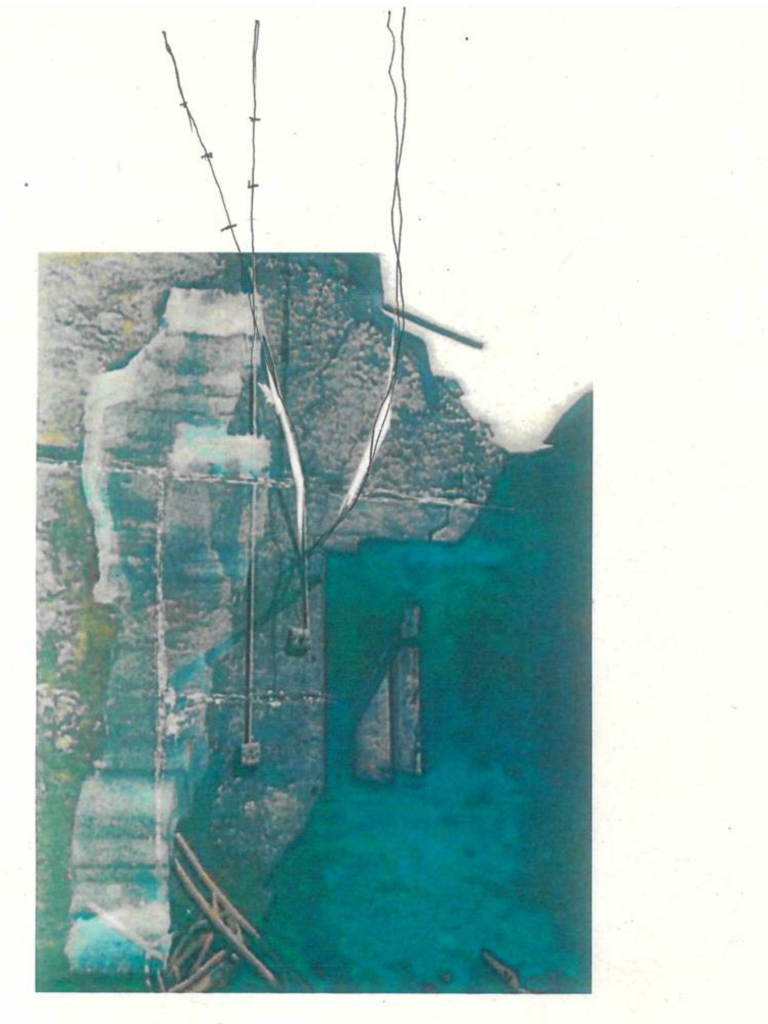
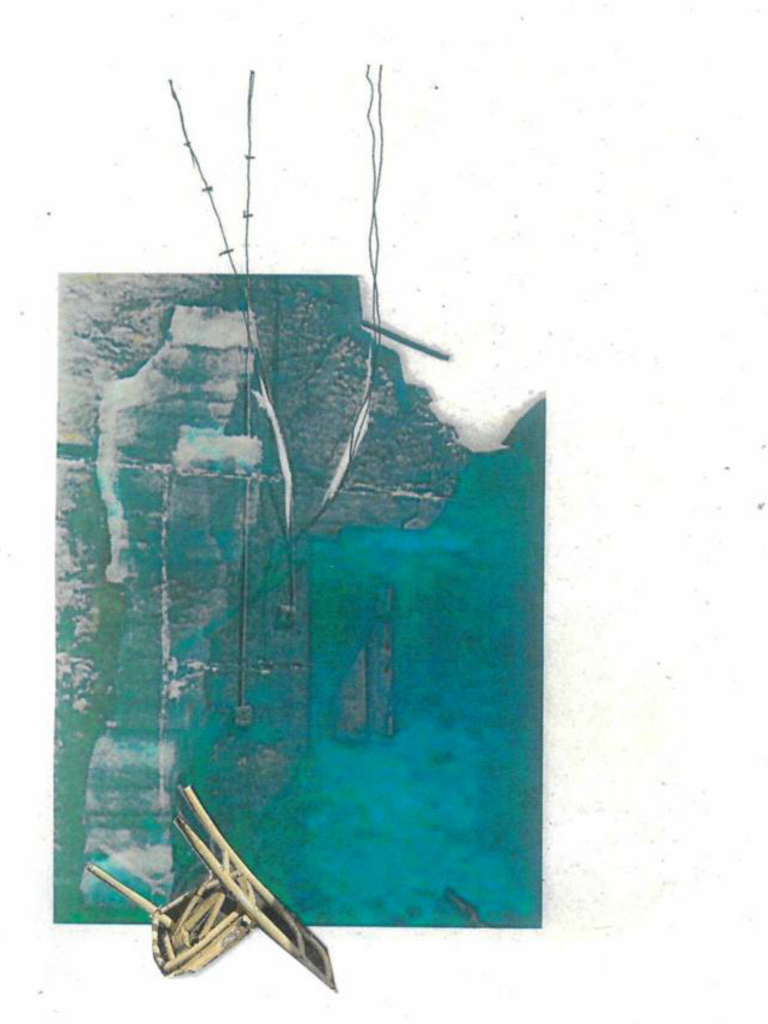
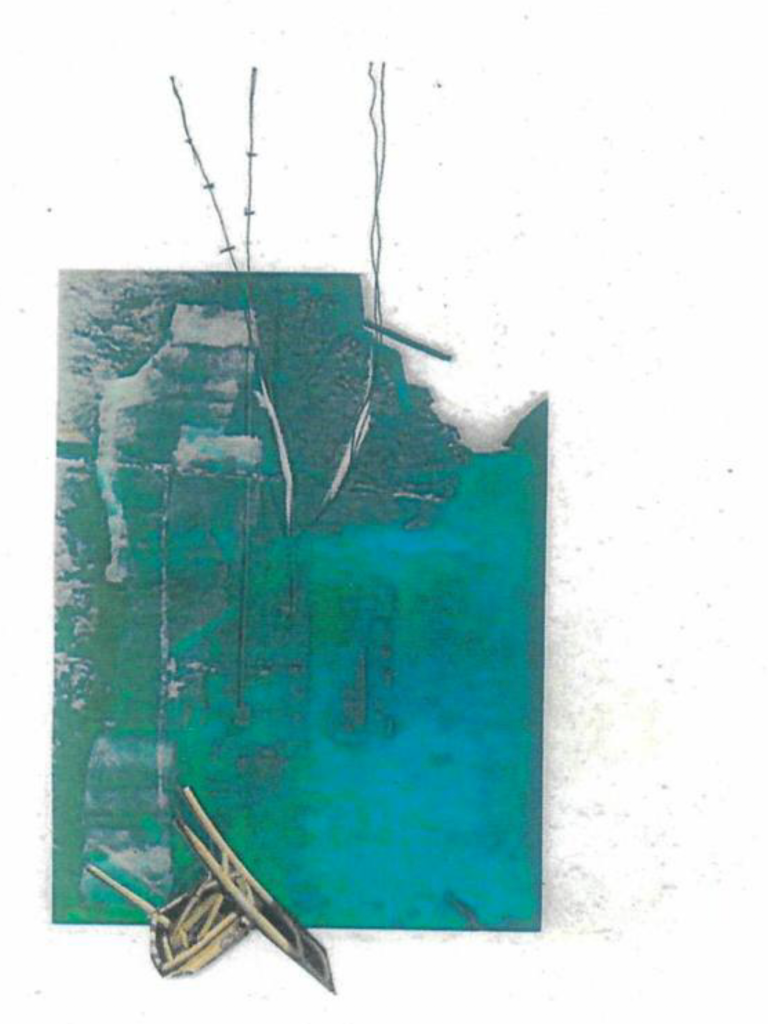
Analogue image-manipulation was my primary method of investigation in Positions through Iterating, as I altered, scanned, and printed photographs of the derelict stone cottage structure. This drew direct inspiration from Rachel Whiteread’s (1992) process, particularly the use of correction fluid to hide and expose elements of the photograph. The degradation of the images mirrored the degradation of the building, and the visual language began to reflect the landscape of Ireland in the final few iterations. The idea that the building eventually returns to the land was explored further through my archive in Positions through Contextualising.
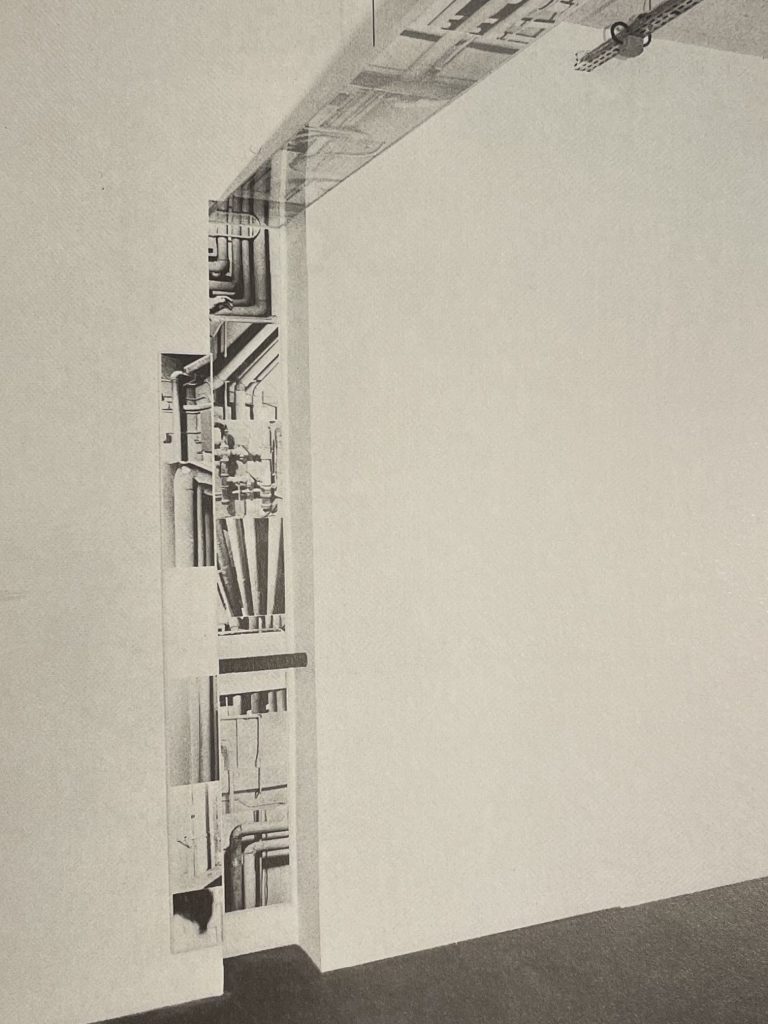
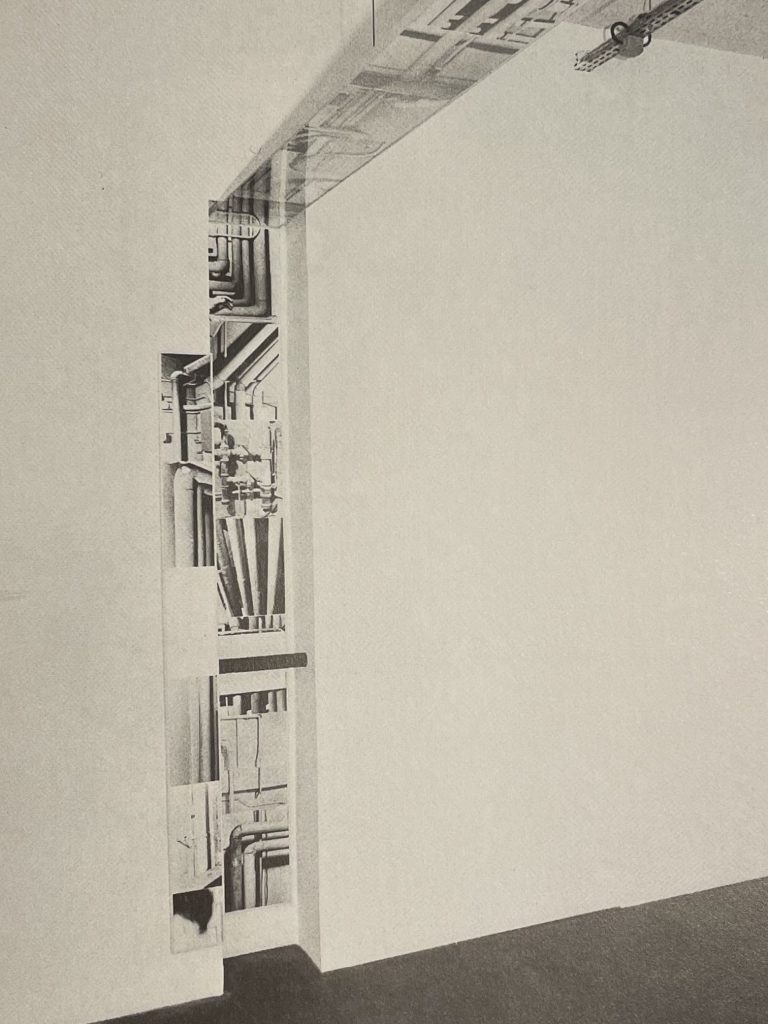
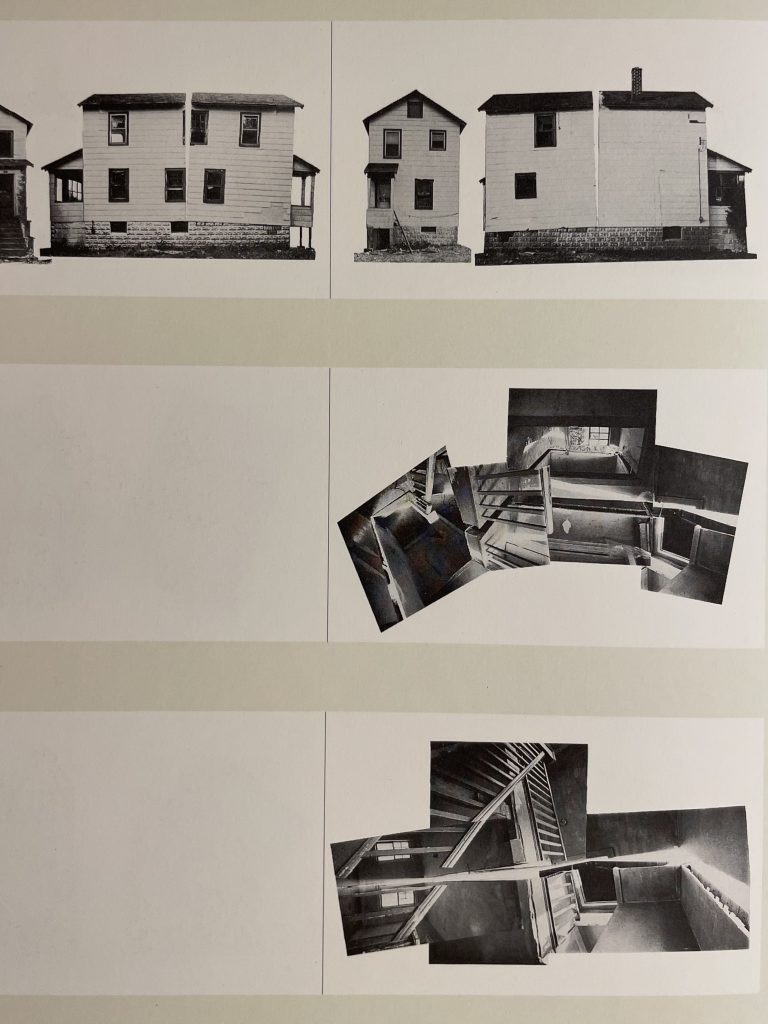
Crow, T. et. al. (2003) Gordon Matta-Clark. London: Phaidon Press Limited. [PLACE]
‘I think Gordon’s were also a reaction against the overbearing use of architecture as an icon’ (Crow, 2003).
My Positions through Iterating studio work mirrored the themes and methods explored by Gordon Matta-Clark. Throughout Matta-Clark’s work there is an impetus to disentangle architecture as an icon; instead understanding space as a reflection of the people that have once existed within it (Crow, 2003). During the first week of my investigation, I observed the buildings of Somers Town exclusively from the outside. Gordon Matta-Clark’s process guided me away from analysing the facade of the buildings, and deepened my enquiry to reveal the exposed fabric of the construction positioned within the space. This shift from external to internal yielded more insight about the layers of history that are present within architecture, and repositioned my work with the context of the West Coast of Ireland.
Gordon Matta-Clark employs collage as a key method to understand the workings of a building. The process of image manipulation and collage remained central within the second week of Positions through Iterating as I overlayed, distorted and degraded photographs of The Stone Cottage. This technique speculatively imagined the future of the building as the structure slowly returns to the land.
Till, J. (2009) ‘Contingency’, in Architecture Depends. Cambridge: MIT Press, pp. 45–61. [WRITING]
‘Architecture is dependent on others at every stage of its journey from initial sketch to inhabitation’ (Till, 2009).
Jeremy Till (2009) introduces the concept that architecture is not complete at the conclusion of construction, as it is exposed to contingency and will metamorphose during inhabitation. Architecture is merely a reflection of that moment in its life as people will continue to designate their own mark onto their urban environment. This reinforces the notion that architecture does not move in a linear fashion, but is cyclical or layered, as it weaves together a tapestry of the threads of its history.
Throughout ‘Contingency’, Till (2009) does not acknowledge the life of a building after inhabitation. Arguably, this is where contingency is most apparent. During the studio brief, I explored the life of a building post-inhabitation, whilst also reflecting on the form of the structure whilst it was in use. Contingency is an implicit line of enquiry throughout my work as I play with the temporality of the building through speculation of it’s past and future form.
Till (2009) writes in two tones of voice. This is visually communicated through the use of different fonts. A serif typeface is deployed for the traditional academic writing, and a san serif used for the informal dialogue. This subtle shift in typeface is a powerful tool to effectively communicate two parallel stories. This is emulated within my archival project. Multiple fonts are used to visually delineate place, memory and writing.
Wyld, F. (2016) ‘The Moving City as Palimpsest’, Landscape Architecture Australia, (151), pp. 65–68. [MEMORY]
‘The city is a palimpsest; it moves within time as a collection of layers for those who read it as a textured landscape. I love this city, but it is not mine. I am living on stolen land’ (Wyld, 2016).
Frances Wyld (2016) astutely introduces the idea that ‘the city is a palimpsest’. The development of the city is not linear, but layered. Layers of history, architecture, people and stories are embedded within the urban fabric of the city. This ignited my interest translating this theory onto a rural setting, and whether a ‘textured landscape’ of layers can be observed here too (Wyld, 2016).
Wyld (2016) adopts an ethnographic viewpoint of the city as she reflects on her own position within the history of Indigenous culture and urbanism within Australia. This sparked me to reflect on my own positionality within the context of the rural West Coast of Ireland. The acknowledgement of my ethnographic position is pertinent to fully contextualise my work and the critical narrative I am trying to convey. This is manifested within my archival publication in the roles undertaken by the viewer and I. I am An Chartlannaí (The Archivist); the viewer is An t-Eadar-theangair (The Interpreter). It is not my place to recount the history of the West Coast of Ireland. I am merely an archivist, collecting histories and presenting them in fragmented form, allowing the viewer to extrapolate their own interpretation.
Lloyd, D. (2008) ‘Overture: Ruins/Runes’, in Irish Times: Temporalities of Modernity. Dublin: Field Days Publications. [WRITING]
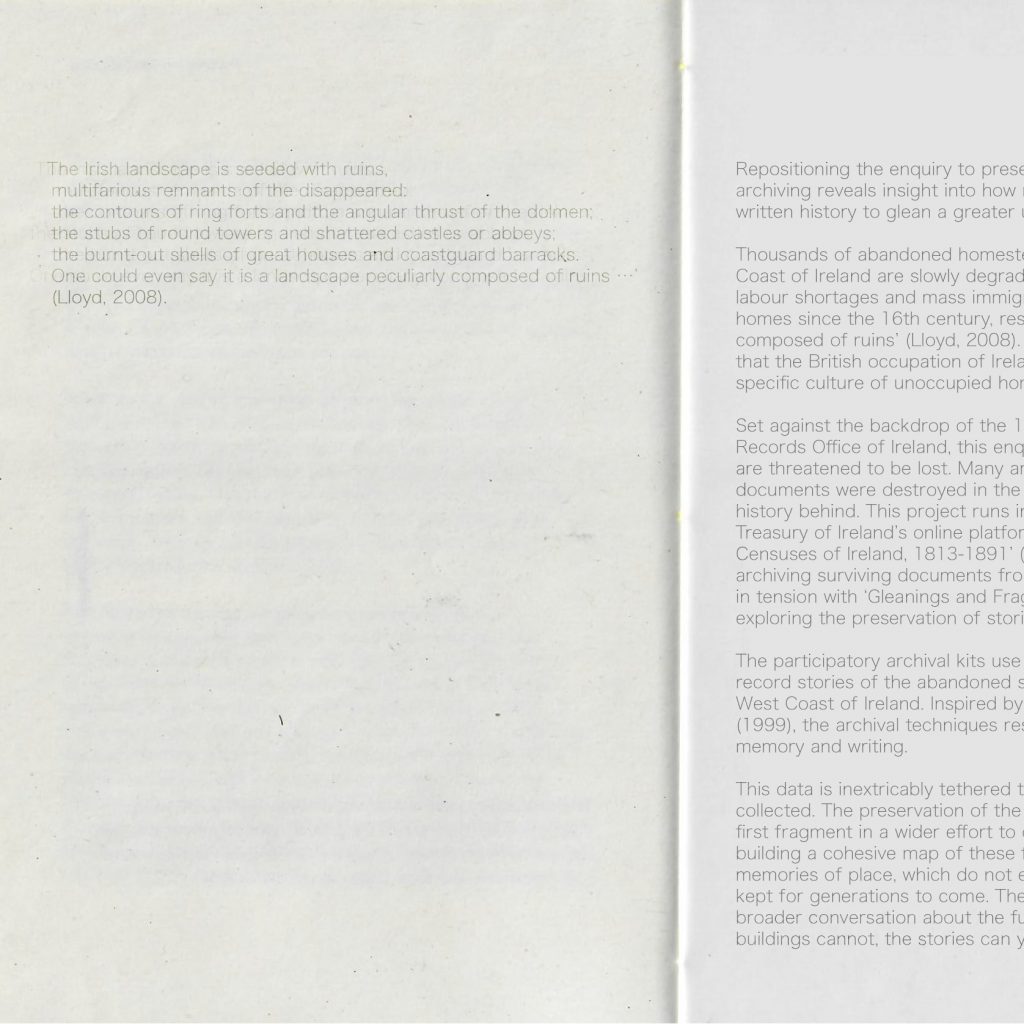
‘The Irish landscape is seeded with ruins, multifarious remnants of the disappeared:
the contours of ring forts and the angular thrust of the dolmen;
the stubs of round towers and shattered castles or abbeys;
the burnt-out shells of great houses and coastguard barracks.
One could even say it is a landscape peculiarly composed of ruins …’ (Lloyd, 2008).
Lloyd (2008) illustrates the landscape of Ireland, populated with remnants and ruins. Found snippets of poetry are used within my work to contrast the heaviness of the archival material, whilst still providing an equally legitimate representation of historical information about Ireland. This encourages a reflection on how my work can remain nostalgic and historically rigorous, whilst being playful and communicative. There has been an impetus to ensure the archive remains engaging so that the user will actively participate in the palimpsestic process of disentangling the material.
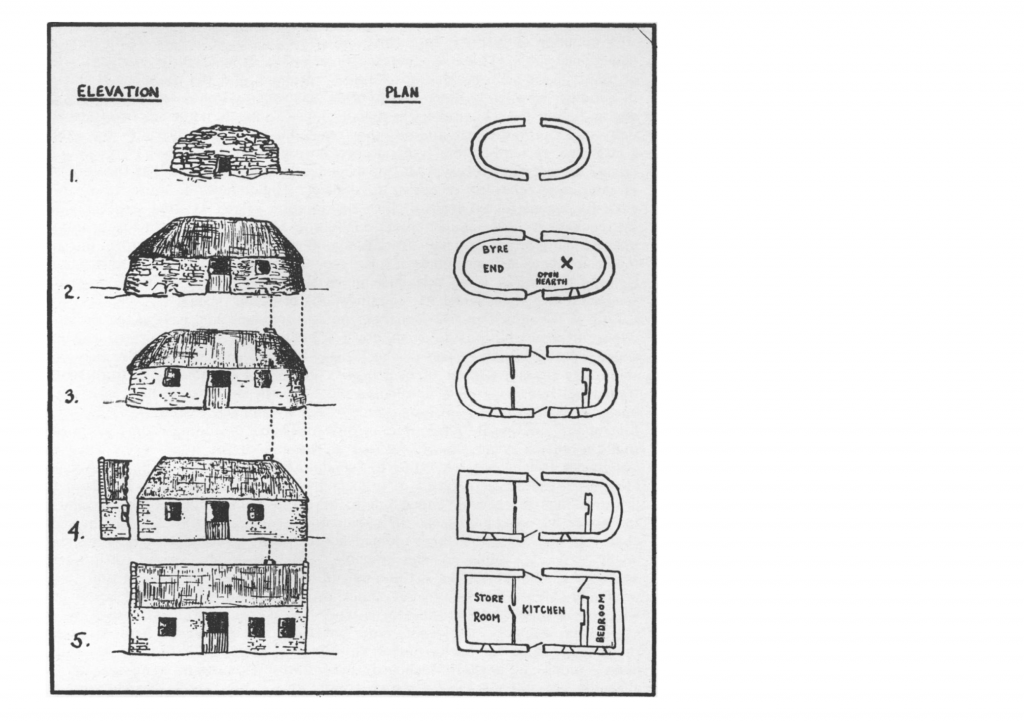
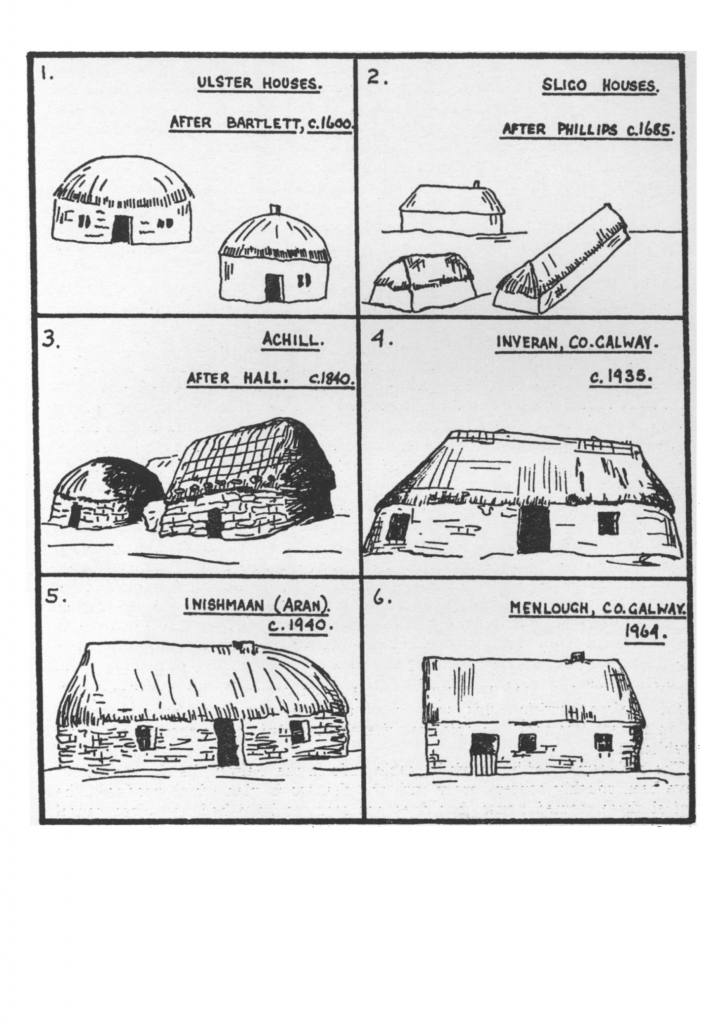
Aalen, F. H. A. (1966) ‘The Evolution of the Traditional House in Western Ireland’, The Journal of the Royal Society of Antiquaries of Ireland, 96 (1), pp. 47–58. [PLACE]
‘Small thatched houses, one storey high, oblong in plan and never more than one room in width, are the type of dwelling traditionally used by the great bulk of the rural population in all parts of Ireland’ (Aalen, 1966).
Aalen (1966) critically recounts the evolution of the traditional house typology in the rural West Coast of Ireland. The set of illustrations within the article, particularly the figure showing the conventional County Sligo dwelling, act as a bedrock to my own collection of archival material. Aalen’s (1966) research underpins the architectural dimension of my studio investigation, as I trace the structural and social evolvement of The Stone Cottage. The drawings are included as an unmodified entry in The Palimpsest Archive, as well as reappearing in the memory segment of the publication. Here, the illustrations are manipulated and overlayed with my own spatial collage to trace the layers of history embedded within the derelict building.
Aalen’s (1966) writing suggests that the evolution of the traditional house in Western Ireland is static; as if the typology has advanced to its complete and final form. My Positions through Contextualising studio work critically challenges this notion, as the lifecycle of architecture is shown to be cyclical. Degradation is framed as the stage after inhabitation, as the building slowly returns to the land. This work builds upon Aalen’s (1966) arguments, but stretches the timeframe, beyond inhabitation, of observation of the traditional house in Western Ireland.
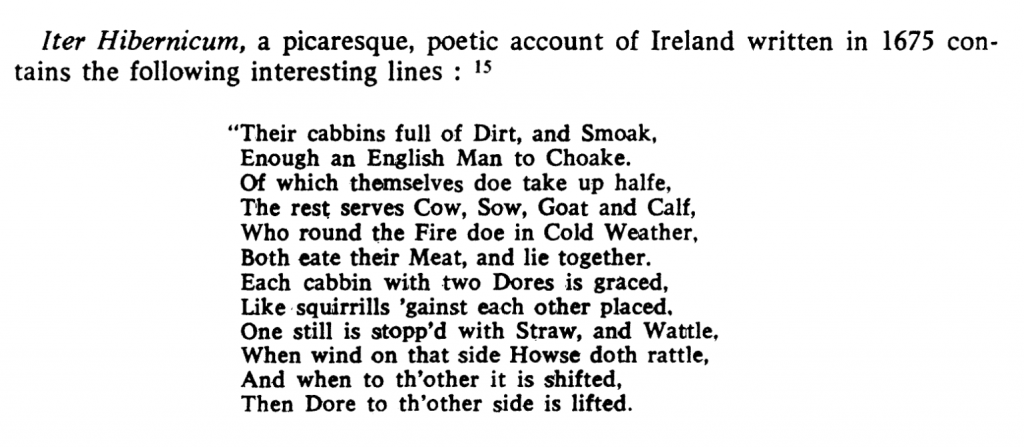
Sloane (1675) ‘Iter Hibernicum or the Ramble, being the voyage and adventures of Three Knights Errent’ [Manuscript]. Western Manuscripts, Sloane MS 360. British Museum, London. [WRITING]
‘Their cabins full of Dirt, and Smoak,
Enough an English Man to Choake.
Of which themselves doe take up halfe,
The rest serves Cow, Sow, Goat and Calf,
Who round the Fire doe in Cold Weather,
Both eate their Meat, and lie together.
Each cabbin with two Dores is graced,
Like squirrills ‘gainst each other placed.
One still is stopp’d with Straw, and Wattle,
When wind on that side Howse doth rattle,
And when to th’other it is shifted,
Then Dore to th’other side is lifted’ (Sloane, 1675).
Similarly to Overture: Ruins/Runes (Lloyd, 2008), Iter Hibernicum (Sloane, 1675) acts as a counterpoint to the historical density of the archival work. The poem references the lifestyle of those living in dwellings like The Stone Cottage. Sloane (1675) states that homes were filled with ‘smoak’, suggesting that the hearth is central to rural lifestyle during this period. Fire appears as a consistent theme across multiple different facets of my work: the traditional lifestyle of rural Ireland, the evolution of the cottage building typology, and, The 1922 Fire that destroyed The Public Records Office of Ireland. Fire is intrinsically interwoven throughout the project, yet never explored explicitly. This could be a fruitful line of enquiry for future studio briefs.
The National Archives of Ireland (2022) Public Record Office of Ireland: The Story of a Building. Available at: https://nationalarchives.ie/engage-and-learn/exhibitions-and-loans/public-record-office-of-ireland-the-story-of-a-building/ (Accessed: 7 May 2026). [MEMORY]
-‘The fire destroyed so much of the building that only the outer wall remained standing. (The National Archives of Ireland, 2022).
-‘Everything that was retrieved from the wreckage was wrapped in brown paper, labelled and secured with string, preserved and patiently waited to be dealt with’ (The National Archives of Ireland, 2022).
‘The Public Record Office of Ireland: The Story of a Building’ (2022) page on The National Archives of Ireland website explains the sequence of events that resulted in the fire which destroyed The Public Records Office of Ireland. The significance of The 1922 Fire transcends the story of the building; it is paramount in shaping the history of Ireland. The event is simultaneously monumental within the history of The Provisional Government of Ireland, and the historiography of the state.
The 1922 Fire creates a contextual container for my archival work, and underpins the speculative world in which the project exists. Documents are fabricated, imagining what could have existed within the archive. The fire destroyed many Irish stories, justifying the need for reflective and speculative archival work. The 1922 Fire grounds my project within the dialogue of the emerging field of work attempting to restore and archive Irish history.
Virtual Record Treasury of Ireland (no date) 1821 Census: Finid (Finned) townland. Available at: https://virtualtreasury.ie/item/VRTI-CEN-1821-4-44-7-3-Finid (Accessed: 6 May 2026). [MEMORY]
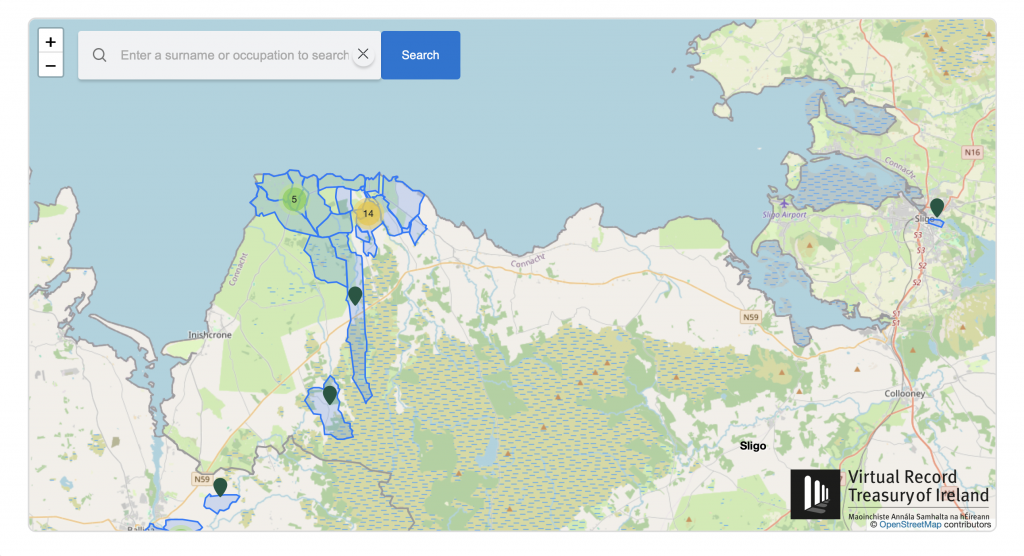
Finid (Finned) is the parish in which The Stone Cottage is situated. Fortunately, the parish is located within a ‘heat cluster’ of the Census Gleaning Map (Virtual Record Treasury of Ireland, no date), meaning the original document survived the fire of 1922. The census was restored by The National Archives of Ireland, and listed all the people living within the townland in 1821.
Through my own archival work, this information was cross referenced with the 1836 Ordnance Survey of Sligo. As corroborated by the Ordnance Survey, The Stone Cottage existed in the early 1800s, therefore its residents are likely to be listed within this household census. 1821 Census: Finid (Finned) townland (Virtual Record Treasury of Ireland, no date) is a crucial reference in piecing together the history of the lives lived within The Stone Cottage, particularly because many other documents about Sligo County perished in the 1922 fire. This concatenation of research sparked a desire to research the history of the people from Finned, which is a theme I wish to explore further in subsequent briefs.
Virtual Record Treasury of Ireland (no date) Gleanings and Fragments from the Censuses of Ireland, 1813–1891. Available at: https://virtualtreasury.ie/gold-seams/census-gleanings (Accessed: 6 May 2026). [PLACE]
Virtual Record Treasury of Ireland (no date) has created a digital map to exhibit restored fragments of documents that survived the 1922 fire which destroyed The Public Records Office of Ireland. Their efforts to piece together fragments of the Censuses of Ireland between 1831 and 1891 has produced new insight into the history that was originally thought to have been lost. This project highlights the need for contemporary archival practices to glean further knowledge about erased histories.
Parallels can be drawn between the work of Virtual Record Treasury of Ireland (no date) and my own archival project, as I attempt to correlate fragments of documents to build the narrative of The Stone Cottage. My studio works enhances the idea of ‘Gleanings and Fragments from the Censuses of Ireland’ (Virtual Record Treasury of Ireland, no date), whilst introducing a dimension of speculation. This is explored through fabricating documents that may have existed within The Public Records Office of Ireland before the fire. Furthermore, the digital platform acts as a form of palimpsestic archiving (Virtual Record Treasury of Ireland, no date). The missing knowledge is visually represented within the map, suggesting traces of the census data that perished. This notion is reflected in the practice emerging within my studio work, which explores participatory palimpsestic archiving.
Beattie, J. (2021-2023) Shadowing the Archives [Film, video stills, archival material]. Dublin Castle, Dublin. [MEMORY]
‘To mark the State Decade of Centenaries Programme 2021-2023, the National Archives of Ireland (NAI) invited proposals from visual artists to engage with material relating to the period 1921-1923 in Irish cultural, social, and political history’ (Beattie, 2021, 2023).
Between 2021 and 2023, Beattie followed conservationists working at the National Archives of Ireland (Beattie, 2021-2023). Beattie’s experiencing shadowing the archives amalgamated in an exhibition at Dublin Castle which explored the processes used within the restoration of historical records (Beattie, 2021-2023). The work utilised an unfolded archival box as a lens to understand the events in Ireland between 1921 and 1923. The Department of Culture, Communications and Sports (2023) astutely wrote: ‘The archive box, with its unique reference code, is a practical storage device for the work of the National Archives, but it is also a signifier, a ‘container’ of history, of multiple histories, and in the exhibition the unfolded, open-plan archive box becomes both a framing device, and a formal reminder of the archival processes that underpin the construction of history’.
My studio project explores methods of conserving and preparing historical records for public display through the making prompt: circulate, distribute, or publish the reference—or some translation of it—via a different platform or economy. The archive box has remained central to my line of enquiry and has acted as the container to display the work.
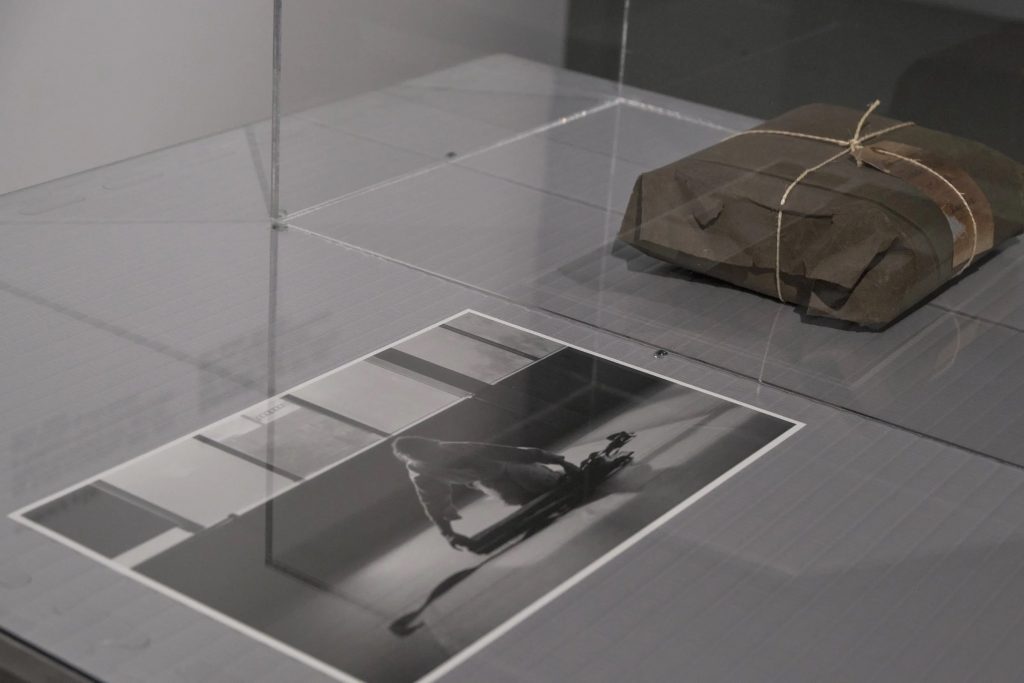
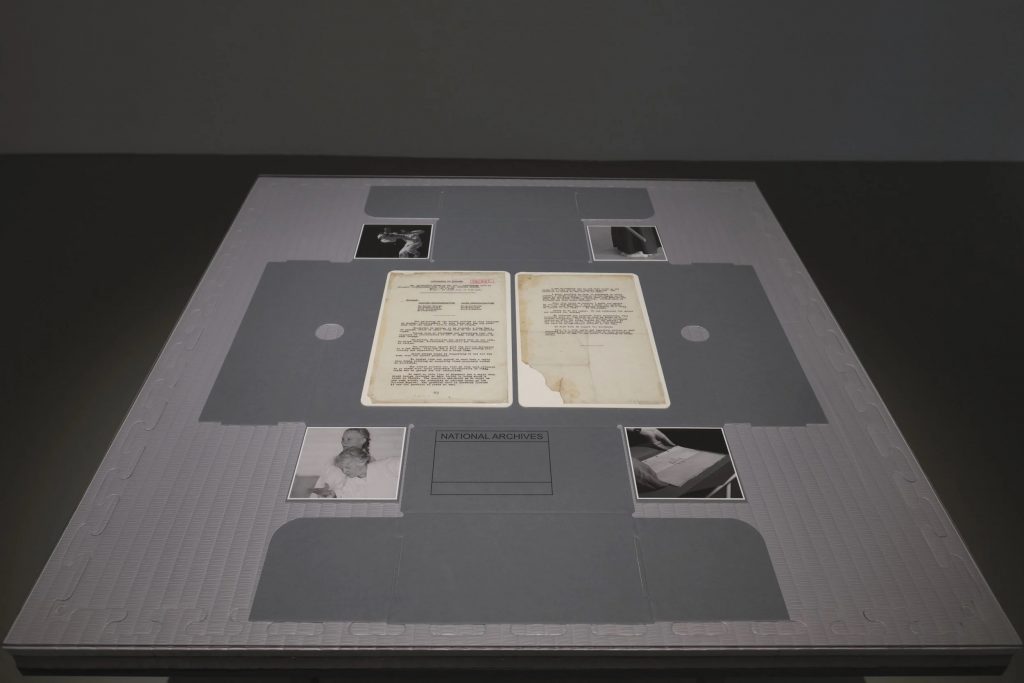
[Department of Culture, Communications and Sport (2023) Artist interprets precious records of the State in unique exhibition at the National Archives. Available at: https://www.gov.ie/en/department-of-culture-communications-and-sport/press-releases/artist-interprets-precious-records-of-the-state-in-unique-exhibition-at-the-national-archives-2/ (Accessed: 5 May 2026).]
Barthes, R. (1977) ‘The Death of the Author’ in Image, Music, Text. London: Fontana Press, pp. 143-148. [WRITING]
‘We know now that a text is not a line of words releasing a single ‘theological’ meaning but a multi-dimensional space in which a variety of writings, none of them original, blend and clash’ (Barthes, 1977).
‘In the multiplicity of writing, everything is to be disentangled, nothing deciphered’ (Barthes, 1977).
Barthes (1977) denotes that the author acts as a steward of pre-existing texts, suggesting that writing is, in all senses, a palimpsest. This is explored within the writing segment of my archive, where short quotes from the dataset of references are manipulated to reveal a glossary of palimpsest. Arguably, this is also the role of the architect as they ‘blend and clash’ the history of the city, landscape and environment. If text is always a layered landscape of others writing, is this true for architecture too?
Furthermore, Barthes (1977) suggests that ‘everything is to be disentangled, nothing deciphered’ within the context of writing. Through my studio work, this sentiment is applied to the process of archiving. Drawing inspiration from Barthes (1977), the real and fabricated documents are not to be deciphered, but disentangled, both physically and metaphorically. The documents are unbound, allowing the interpreter to physically take them apart, whilst simultaneously disentangling the complex and layered history of The Stone Cottage.
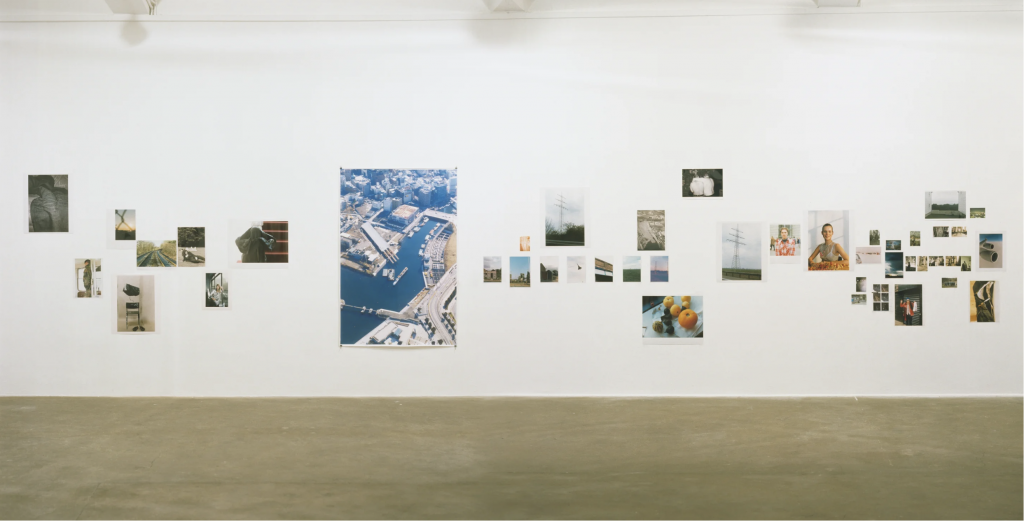
Wolfgang Tillmans, I Didn’t Inhale (1997) [Exhibition]. Chisenhale Gallery, London. 7 July 1997 – 3 August 1997. [PLACE]
‘It has been installed by Tillmans in a way that subverts the categories consigned to photography’ (Wolfgang Tillmans, 1997).
Wolfgang Tillmans’s (1997) exhibition ‘I Didn’t Inhale’ is a key visual reference about the art of placing images in conversation with one another. The Palimpsest Archive created in the studio invites the user to unbind, scrutinise and position the documents to disentangle the history of The Stone Cottage. The viewer ( An t-Eadar-theangair/ The Interpreter) is free to position and overlay the material as they deem fit. Similarly to Tillmans’s work (Wolfgang Tillmans, 1997), this is an act of subversion, as the artefacts are freed from the categories consigned to them at the beginning of the archival process (place, memory and writing).